- Offerings
- Tools & Platforms
Tools & Calculators
- Open API
- Calculators
- SIP Calculator
- CAGR Calculator
- Compound Interest Calculator
- FD Calculator
- RD Calculator
- EPF Calculator
- Retirement Calculator
- HDFC SIP Calculator
- Mutual Fund Return Calculator
- Lumpsum Calculator
- Step Up SIP Calculator
- ETF SIP Calculator
- Brokerage Calculator
- Equity Margin Calculator
- SWP Calculator
- EMI Calculator
- MTF Calculator
- Pricing
- SKY Learn
- Mutual Funds
- Margin Trading
- Financial Planning
- Personal Finance
- Share Trading
- IPO
- Derivatives
- Currencies
- Intraday Trading
- Trading Strategies
- Demat Account
- Commodity
- ETF
- What are Corporate Bonds?
- What are Government Bonds?
- Difference between Corporate Bonds vs Government Bonds
- Types of Government Bonds
- Advantages and Disadvantages of Government Bonds
- Types of Corporate Bonds
- Advantages and Disadvantages of Corporate Bonds
- Conclusion
- FAQs on Corporate Bonds vs Government Bonds
- What are Corporate Bonds?
- What are Government Bonds?
- Difference between Corporate Bonds vs Government Bonds
- Types of Government Bonds
- Advantages and Disadvantages of Government Bonds
- Types of Corporate Bonds
- Advantages and Disadvantages of Corporate Bonds
- Conclusion
- FAQs on Corporate Bonds vs Government Bonds
Difference Between Corporate Bonds and Government Bonds
By HDFC SKY | Updated at: Jul 24, 2025 05:05 PM IST
Summary
- Corporate bonds are issued by private and public sector companies to raise capital, offering higher returns due to greater risk compared to government securities.
- Government bonds are issued by national authorities (like RBI in India) and are considered low-risk, offering relatively stable but lower returns.
- Credit risk is a key differentiator: corporate bonds carry a higher default risk, while government bonds are backed by the state, ensuring safety.
- Tax implications differ interest from both bonds is taxable, but some government bonds may offer tax exemptions under Section 10 of the Income Tax Act.
- Liquidity is generally better for government bonds due to active secondary markets, while corporate bond liquidity can vary by issuer and credit rating.
- Investment goals drive the choice: government bonds suit conservative investors seeking capital preservation, while corporate bonds suit those targeting higher yields.
- Diversification through a mix of both can balance risk and return in a portfolio.
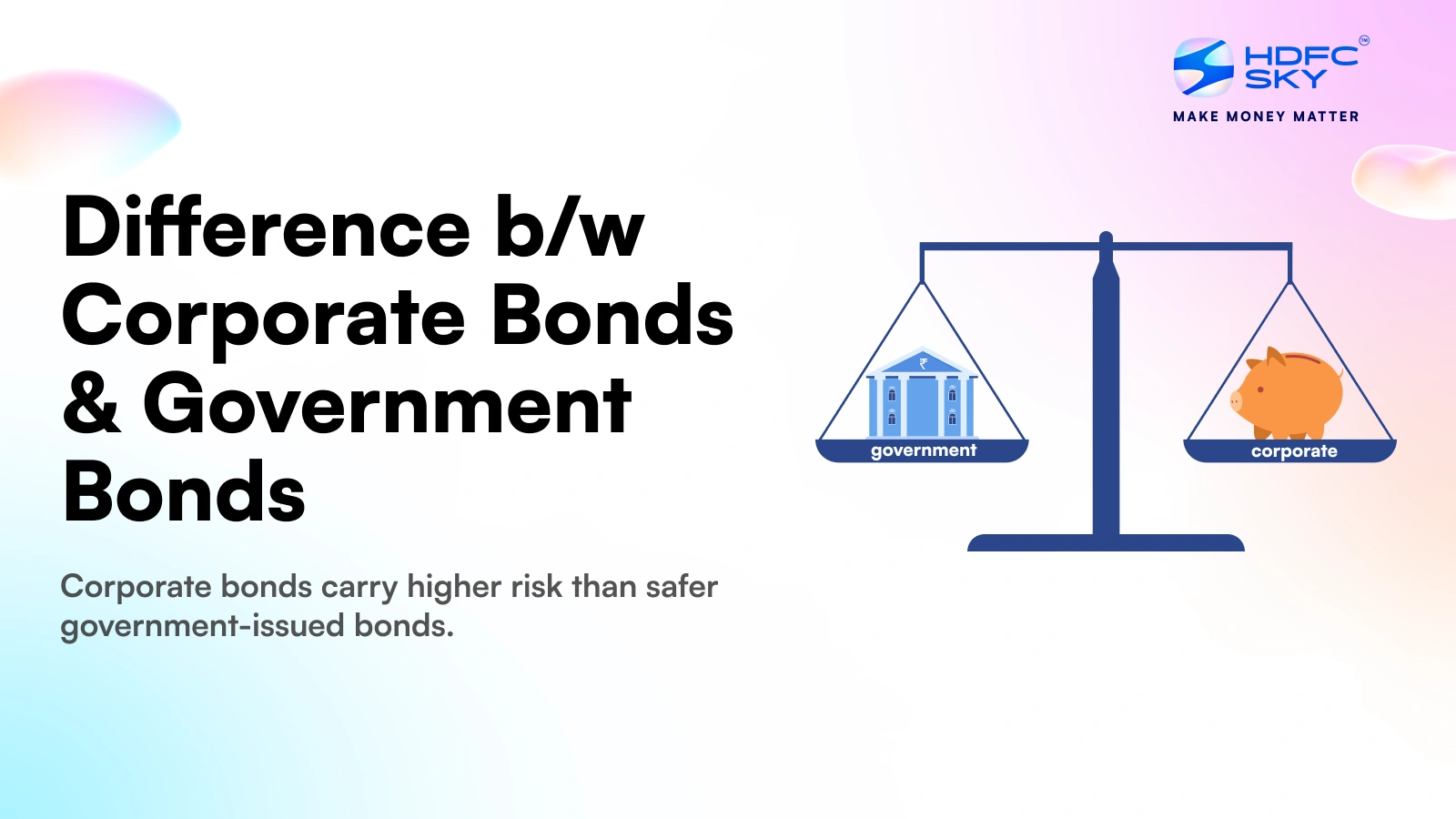
In bond investment, it is crucial to differentiate between Government bonds vs Corporate bonds. Companies usually issue corporate bonds to get funds which have high interest but more risk exposure. Government bonds are issued for funding public projects and are available at a relatively lower interest, but they are backed by the government.
In this article, we will understand the fundamental difference between Government bonds vs Corporate bonds, government and corporate bond advantages.
What are Corporate Bonds?
Companies issue corporate bonds to get money for business purposes like expansion, forthcoming projects, or settling debts. Buying a corporate bond means you effectively loan a company that will pay coupon payments; and the principal amount is returned at maturity.
Bonds are classified according to their credit quality. Financially well-off companies issue investment-grade bonds, which provide some returns but with lower risks. On the other hand, high yield or “junk” bonds are issued by companies with poor credit ratings. These bonds are issued to garner a potentially higher return to offset more significant risk.
Corporate bonds can yield better returns than government-issued bonds. However, they are more risky including the risk of default. Before investing, a company’s soundness, interest rates, and market conditions must be considered.
What are Government Bonds?
Government bonds are a type of debt instrument a country’s government uses to raise funds to finance public expenditures and manage internal debt. When buying these bonds, an investor lends money to the government at agreed-upon interest, payable at intervals (coupons), and returns the initial investment (principal) upon the bond’s maturity.
Government bonds are some of the low risk investments. Because of their lower risks, government bonds offer lower interest rates than corporate bonds.
Different forms of bonds are issued and categorised according to their time to maturity, such as Treasury bonds, Treasury notes, and Treasury bills. These are terms specific to the US, and other countries have their own government bond classification, such as G-Sec (India), Gilts (UK), JGBs (Japan), Bunds (Germany), and OATS (France).
Example: The Indian Government issued Sovereign Green Bonds for the first time in January 2023, issuing two sets of Rs 4,000 crore each, totalling Rs 8,000 crore. The funds raised from these bonds will be used for various environmentally sustainable activities, such as renewable energy, clean transportation, and the effective management of water resources.
Difference between Corporate Bonds vs Government Bonds
There is a difference between corporate and government bonds, which are regarded as fixed-income securities but have some differences.
| Features | Corporate Bonds | Government Bonds |
| Issuer | Issued by companies to raise funds for business operations. | Issued by the government to finance public projects and manage national debt. |
| Risk Level | Relatively high risk is involved because the repayment depends on the company. | Low risk comparatively as involved because government backing is present. |
| Returns (Yield) | In general, it offers higher interest rates in return for the risk taken. | Usually, they offer lower yields but with low risk. Exceptions including inflation-linked bonds may offer competitive yields. |
| Security | Supported by the company’s collateral or future income. | Ensured by the central government, thus making them safer. |
| Liquidity | Highly dependent ongoing market circumstances, together with the credit worthiness of the firm may dictate lower liquidities. Some of the high rated corporate bonds have high liquidity (Ex: Apple) | Liquidity of government bonds is usually high, depending upon the type of specific bond type. |
| Default Risk | High, since these organisations may have limited access to funds or might go bankrupt. | The chances of this occurring are very less as the government can raise money through taxes and other means. |
| Investment Suitability | Ideal for those with a more aggressive attitude toward investing. | Ideal for risk-averse investors looking for safe and consistent returns. |
Types of Government Bonds
Different types of government bonds exist, offering various investment opportunities.
- Treasury Bonds (T-bonds): These areissued for longer periods, with a maturity period of ten to thirty years. They also pay interest at regular intervals. The government backs these bonds, making them very secure.
- Treasury Notes (T-notes): Bonds that are of medium term and have a maturity period of two to ten years. They also pay interest on a regular basis which makes these bonds have less risk than T-bonds.
- Treasury Bills (T-bills): Bonds issued for a short period with a maturity period of less than a year. These Government bonds do not offer interest but are available for purchase at a discounted price, making a profit possible when the bond matures.
- Inflation-Protected Securities (TIPS): Bonds whose returns rise with inflation. In case of inflation, the principal amount increases; therefore, it helps keep the purchasing power intact.
- Sovereign Gold Bonds (SGBs): Bonds provided by the Government of India that are linked to gold rates and provide fixed interest on the bonds more beneficial than gold.
Advantages and Disadvantages of Government Bonds
Bonds issued by the government are one of the most liked investments because they are relatively less risky and provide decent returns. Below is a comparative analysis of their advantages and disadvantages:
Advantages
- Guaranteed by the government, thus, poses minimum investment risk
- Offers stable interest earnings
- Very liquid in the secondary market
- Assists with risk management which improves the overall portfolio balance
- Several bonds allow no tax payment
Disadvantages
- Returns are less than those of corporate bonds
- Interest rates might not always match inflation
- Demand may affect some bonds’ liquidity negatively
- Less potential for growth when compared to stocks
- Interest earned accrued on some bonds can however be taxed
Types of Corporate Bonds
Corporate bonds are categorised differently, each suitable to varying investment objectives and risk tolerances.
- Investment-Grade Bonds: Issued by big credible companies (rating of BBB and above) with comparatively lower yields. These are said to be safer investments.
- High-Yield Bonds (Junk Bonds): These high-yield bonds are issued to companies with low credit standings (ratings BB and below). They are very risky due to the high chance of default by the issuers.
- Convertible Bonds: It may be turned into company stock shares at an agreed-upon price. They have lower yields but will get higher returns if the shares increase.
- Callable Bonds: These bonds can be redeemed before maturity by the issuer at his option. These bonds are sold at a premium rate and pay high yields to offset the risk of being called.
Advantages and Disadvantages of Corporate Bonds
Advantages
- Increased Profits: Corporate bonds usually yield greater returns than government bonds interest
- Fixed Income: Fixed Income can be a constant source of income as they pay a regular interest.
- Variety: A diverse selection of corporate bonds is available based on clients’ level of risk and investment objectives.
- Risk and Return: Corporate bonds can be issued with different credit ratings and maturities, allowing investors to invest according to risk and return objectives.
Disadvantages
- Credit Risk: The company that released the bond might default.
- Liquidity Risk: A few corporate bonds may pose difficulty if you wish to sell them quickly at no loss.
- Market Risk: Prices of bond demand may also change due to market conditions and general economic factors.
- Call Risk: Callable bonds have yield-to-maturity impacts when issuers redeem the bond early.
Conclusion
Investors have varying preferences for risk and return between corporate bonds vs government bonds. The former has a higher yield, but they come with the risk of default. Government bonds pay a lower rate of return, but they are much more stable. Your investment goals and risk appetite determine which bond benefits you the most. Investing in both types of bonds can maximise returns while minimising risk.
Related Articles
FAQs on Corporate Bonds vs Government Bonds
Are government bonds tax-free?
Interest from government bonds is generally taxable. However, certain bonds, such as infrastructure tax-free bonds, have some exemptions. In India, some bonds, like Sovereign Gold Bonds (SGBs), provide an exemption from taxes upon sale if they are held until maturity. Other government bonds attract taxes.
Where to buy government bonds in India?
In India, Government bonds can be purchased through RBI Retail Direct, banks, stock exchanges (NSE, BSE), and brokers. They can also be obtained through mutual funds and debt ETFs. Banks and post offices distribute certain bonds, particularly Sovereign Gold Bonds.
What is the interest rate of corporate bonds?
The market interest in corporate bonds changes according to the company’s credit rating, current market conditions, and the type of bond issued.
What is the maturity of a corporate bond?
Corporate bonds can be of three different maturities: short-term (1 to 5 years), medium-term (5 to 10 years), or long-term (10 years and above). The issuing company’s needs and the market’s state determine maturity periods. Usually, longer-dated bonds have higher interest rates because they take on more risk.
Which Bond Type is Right for You?
Corporate bonds appeal to those seeking higher returns and willing to take on more risk, while government bonds suit those who value stability and prefer smaller returns. A blend of the two will moderate the risks taken and the rewards gained.