- Offerings
- Tools & Platforms
Tools & Calculators
- Open API
- Calculators
- SIP Calculator
- CAGR Calculator
- Compound Interest Calculator
- FD Calculator
- RD Calculator
- EPF Calculator
- Retirement Calculator
- HDFC SIP Calculator
- Mutual Fund Return Calculator
- Lumpsum Calculator
- Step Up SIP Calculator
- ETF SIP Calculator
- Brokerage Calculator
- Equity Margin Calculator
- SWP Calculator
- EMI Calculator
- MTF Calculator
- Pricing
- SKY Learn
- Mutual Funds
- Margin Trading
- Financial Planning
- Personal Finance
- Share Trading
- IPO
- Derivatives
- Currencies
- Intraday Trading
- Trading Strategies
- Demat Account
- Commodity
- ETF
Derivatives Strategies: Guide to Futures and Options Trading Strategies
By HDFC SKY | Published at: May 28, 2025 04:40 PM IST
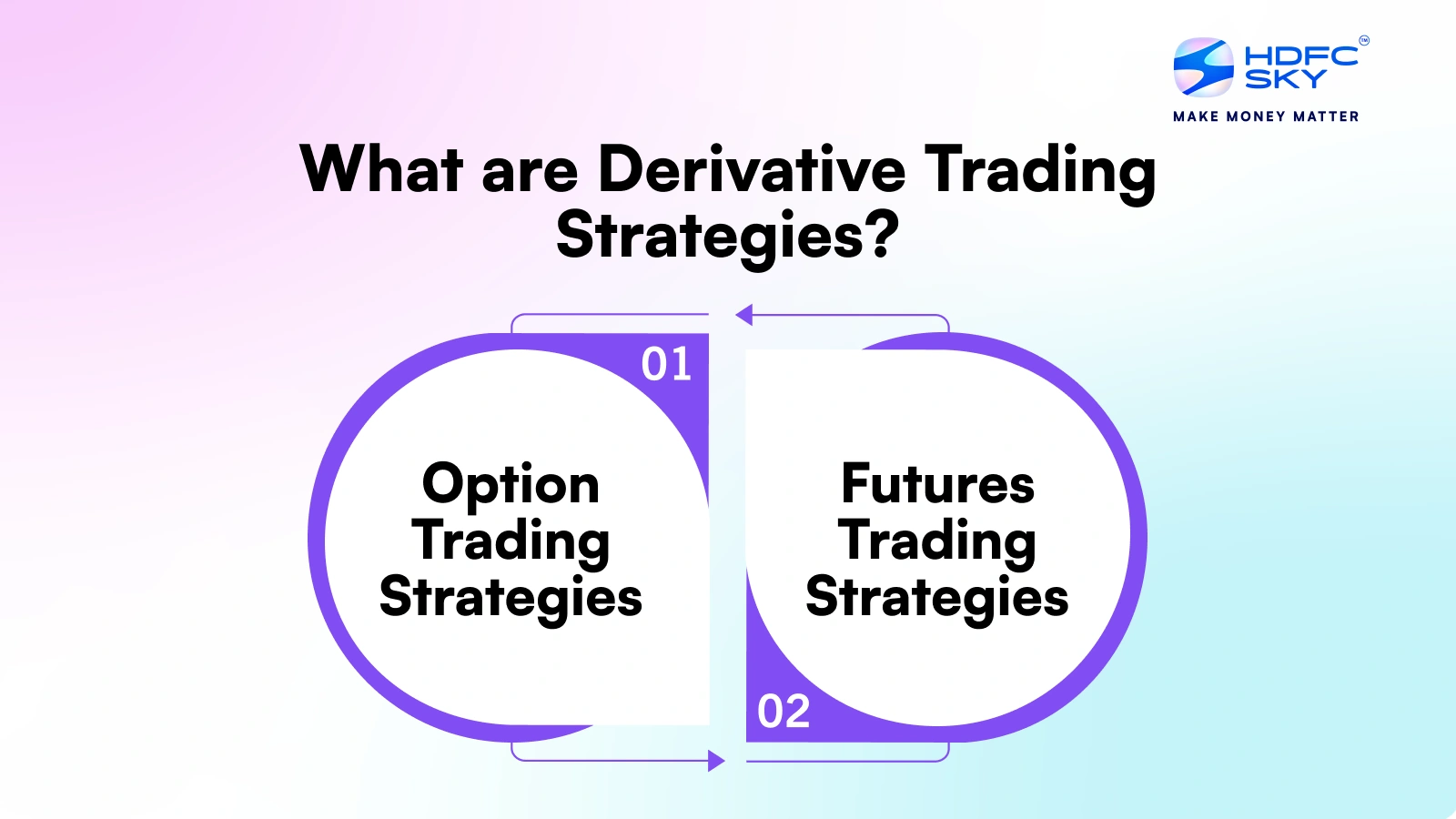
Trading isn’t always simple. There are times when you require tools that allow you to hedge, speculate, or lock in prices. That’s where derivative strategies come in. Whether you’re a beginner or already trading, understanding the right options and futures strategies can enable you to trade smarter and be ahead of the market.
Understanding basic derivative trading strategies is essential for anyone looking to participate in the F&O market on exchanges like the NSE and BSE. This article provides a foundational guide to common options and futures strategies, explaining how they work in the Indian context.
What are Derivative Trading Strategies?
A derivative is a contract where the value depends on another asset’s price, such as a stock, commodity, currency, or index. Derivatives such as future
- Is derivative trading profitable?
Derivative strategies are constructed trading plans centred on these instruments. They assist traders in handling market uncertainty, hedging their positions, or even speculating intelligently. Whether the objective is to cut losses or pursue profit in an unpredictable market, possessing the appropriate strategy can mean a huge difference in the outcome of a trade.
Futures Trading Strategies
Futures trading is common among investors who wish to hedge or speculate on stock price movements. Long futures and short futures are the two key approaches.
- Long Futures: While purchasing a futures contract in a stock or an index (such as Nifty or Bank Nifty), you hope for an increase in the price until the expiry date. If the price rises above your purchase price, the position becomes profitable. Profit/Loss is calculated daily via Mark-to-Market (MTM) settlement against the required margin. Suppose you purchase a Nifty futures contract for ₹18,000 and the price reaches ₹18,500 on expiry; you can close the contract at a profit. It will suit you best if you expect positive market movement.
- Short Futures: This technique is used by selling a futures contract when you anticipate the underlying asset’s price to decline. If the price falls below your selling price, the position becomes profitable. Profit/Loss is settled daily via MTM against the margin. For instance, if you sell a Bank Nifty futures contract at ₹40,000 and the index reduces to ₹39,000 till expiry, you can buy back the contract at the reduced price, making a profit on the price fall. This works well in bear market situations.
These Indian market future strategies provide a mechanism to gain profit from both increasing and decreasing prices. However, traders must manage risks and follow market trends closely.
Option Trading Strategies
Options trading is an integral component of derivative strategies. Option trading strategies are employed by traders to hedge, to speculate, or to lock in profits. Such options provide the right, but not the obligation, to buy or sell an asset at a set price before a specific date. Let’s examine some popular types of option strategies employed in the Indian stock market.
- Long Call Option: It is one of the easiest stock option trading strategies. You can purchase a call if you believe that a stock will move higher in terms of price. Your risk can only be equal to the paid premium, yet your reward could be boundless.
- Short Call Option (Naked Call): Here, you sell a call option without holding the underlying share. It is risky as, if the share price goes up sharply, you may suffer significant losses.
- Long Put Option: You purchase a put when you anticipate the price of the share to decline. It is an excellent F&O strategy during bearish times, with little risk and a huge gain in case of the price falls.
- Short Put Option: You write a put, hoping the price will remain stable or go up. You get the premium, but if the price drops, you might need to buy the stock at a higher price than its current value.
- Bull Call Spread: The bull call spread is an options strategy where a call is purchased at a lower strike and sold at a higher strike. It caps both loss and profit, and functions in moderately bearish markets.
- Bear Put Spread:This is buying a put and selling another put at a lower strike. It’s applied in bearish situations and reduces the cost of purchasing a put on its own.
These various option strategies are employed to match market expectations and risk levels. Proficiency in different option strategies is necessary for effective derivative strategies in the F&O segment.
Conclusion
Derivative strategies are a matter of mastering over time and patience, coupled with market know-how. Whatever your interest is in options and futures strategies to hedge or earn, the correct approach counts. These instruments can provide leverage and flexibility, but they come at a risk. Without careful planning, option strategies and futures trade types can incur huge losses. So, get educated, begin small, and always employ a tried-and-tested strategy for F&O trading. The intention is intelligent trading, not merely quick gains.
Related Articles
FAQs on Derivatives Trading Strategies
Is derivative trading profitable?
Yes, derivative trading can be profitable, particularly with the proper strategy and market timing. Most traders employ derivative strategies such as options and futures to hedge risk or profit from price movements. Nonetheless, through leverage, it may also cause losses if trades are not well thought out or supervised.
Who should invest in derivatives?
Derivative strategies are most appropriate for seasoned investors, active traders, or those who want to hedge their portfolios. It’s not for beginners unless they know the risks and how stock option trading strategies function. F&O strategy knowledge is a must before investing in derivatives.
How to start derivatives trading?
To start derivatives trading, open a demat and trading account with a broker that provides F&O trading. Familiarise yourself with derivative strategies, know contract specifications, and begin with small positions. It’s essential to get hands-on experience and back-test your futures and options strategies before going live.
What are the disadvantages of derivatives trading?
While derivative strategies provide high returns, they have high risks involved. Losses can be multiplied through leverage, and market volatility can result in unforeseen results. Different option strategies are intricate, and novice traders might find it difficult to handle margin requirements and price changes.
How to trade derivatives?
To buy and sell derivatives, follow either futures or options, study the market, and pick an appropriate derivative strategy according to your opinion. Execute your trade through your broker’s platform. Always keep an eye on positions carefully, handle risks intelligently, and continue learning various derivative strategies to enhance your methodology.