- Offerings
- Tools & Platforms
Tools & Calculators
- Open API
- Calculators
- SIP Calculator
- CAGR Calculator
- Compound Interest Calculator
- FD Calculator
- RD Calculator
- EPF Calculator
- Retirement Calculator
- HDFC SIP Calculator
- Mutual Fund Return Calculator
- Lumpsum Calculator
- Step Up SIP Calculator
- ETF SIP Calculator
- Brokerage Calculator
- Equity Margin Calculator
- SWP Calculator
- EMI Calculator
- MTF Calculator
- Pricing
- SKY Learn
- Mutual Funds
- Margin Trading
- Financial Planning
- Personal Finance
- Share Trading
- IPO
- Derivatives
- Currencies
- Intraday Trading
- Trading Strategies
- Demat Account
- Commodity
- ETF
IPO vs FPO Explained: Meaning, Purpose, and Key Differences
By HDFC SKY | Updated at: Jun 5, 2025 04:35 PM IST
Investors interested in Initial Public Offerings (IPOs) should also be aware of Follow-on Public Offerings (FPOs) as they represent another opportunity to invest in a company’s shares. While IPOs mark a company’s debut on the stock market, FPOs occur when a publicly traded company issues additional shares to raise more capital from the stock market.
IPOs are offered by companies to raise capital for growth, expansion, or other purposes. Investors can buy shares in the IPO, becoming shareowners of the company. On the other hand, a Follow-on Public Offering (FPO) occurs when a company that is already publicly traded issues new shares to the public. This can be done for similar reasons as an IPO, such as raising capital for expansion or reducing debt. Understanding FPOs is crucial because they can provide insights into a company’s growth trajectory and financial health. FPOs offer investors a chance to participate in a company’s ongoing expansion or development plans. Understanding the differences between IPOs and FPOs can help investors navigate the stock market more effectively.
In this blog, we will discuss IPO and FPO, their types and how are these two public offerings different from each other.
What is an IPO?
The first time a company goes public, it is through an IPO (Initial Public Offering). An erstwhile private company “goes public” when it offers its shares to the general public and is prepared to be listed on the nation’s stock markets. This is the first time the company offers its shares to the general public, enabling them to become shareholders of the company.
An IPO is the initial public offering (IPO) made by a company when it lists on Exchange Bombay Stock Exchange (BSE) and the National Stock Exchange, or both and makes its shares available for trading.
Types of IPO
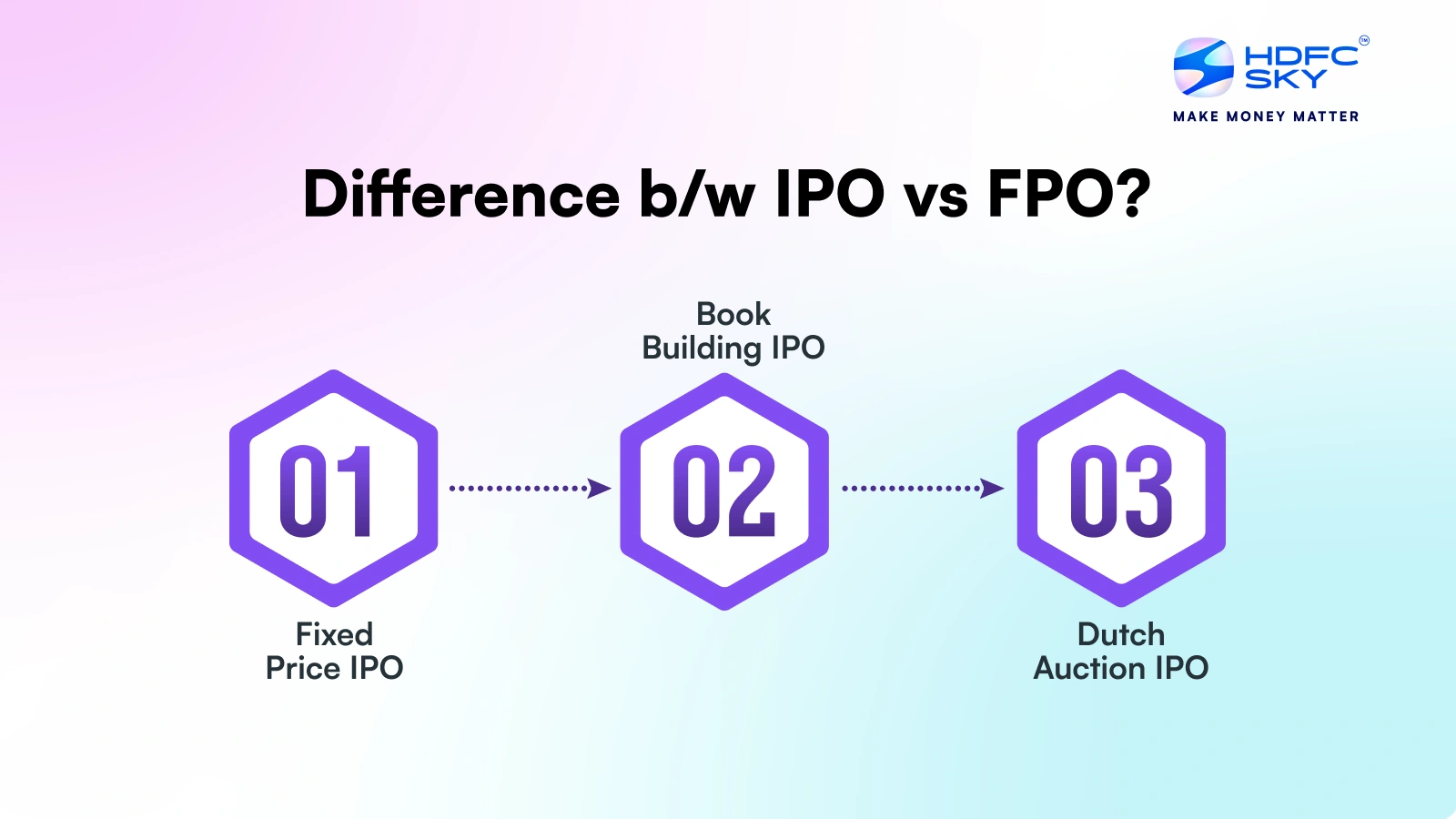
There are 3 types of IPOs –
- Fixed Price IPO – In this type of IPO, the issuer company determines a fixed price at which shares are offered to the public. Investors know the price upfront, simplifying the investment decision.
- Book Building IPO – In Book Building Issue, companies determine a price range, and investors bid for shares within that range. The final price is based on demand from investors.
- Dutch Auction IPO – In Dutch Auction IPO, investors specify the number of shares and the price they are willing to pay. The price is set at the highest price that allows all shares to be sold.
What Does an IPO Signify for a Company?
When a company starts, it gets money from different sources like investors and the government. As it grows, it might need more money. So, it launches an IPO, which means it sells shares to the public for the first time and gets listed on stock exchanges. This gives the company more funds to grow but also means it has to manage the business well to keep shareholders happy and not lose money. It also makes it easier for people to buy and sell the company’s shares.
An IPO signifies a significant milestone for a company. It indicates that the company is ready to expand and grow further with the help of public funds. However, along with this opportunity comes the responsibility of managing the company efficiently to ensure shareholder value and maintain a good reputation in the market. Additionally, going public increases the company’s visibility and credibility, potentially attracting more investors and increasing the company’s liquidity.
What Does an IPO Signify for Investors?
An IPO, or Initial Public Offering, signifies a big opportunity for investors. When a company goes public, it means they are offering shares to the public for the first time. Investors can buy these shares, which means they can buy shares of the company and become partial owners. This can be exciting because it allows investors to invest in a company’s growth and potentially earn money if the company does well. It also opens up the possibility of investing in ESOP (Employee Stock Ownership Plan), which can be a valuable benefit for employees.
What is FPO?
In an FPO (Follow-on Public Offering), a listed company decides to offer more shares to the public. It is like a second round of selling shares after the initial IPO. Companies do this when they need more money to grow or fund new projects. Investors can buy these new shares, just t they do in the IPO , which can help the company to raise more capital . FPOs can also increase the number of shares available in the market, which might affect the stock price. Overall, an FPO is a way for a public company to raise additional funds by selling more shares to investors.
Types of FPO
There are two types of FPOs –
- Dilutive FPO – In a dilutive FPO, the issuing company issues extra shares to the public without changing the value of the shares. As a result, earnings per share and share price decline.
- Non-Dilutive FPO – In a non-dilutive FPO, the company’s major shareholders, such as the founders or the board of directors, sell their privately held shares to the public. This type of FPO raises the number of shares that are available to the general public. It does not alter or increase the number of shares for the company. In contrast to dilutive FPO, this type of FPO has no effect on the company’s EPS (Earning Per Share) because it has no effect on the number of shares outstanding.
Also Read: How Shares Are Alloted in IPO?
What Does an FPO Signify for a Company?
For a company, an FPO signifies an opportunity to raise more money from the public. When a company decides to go for an FPO, it means they are already listed on the stock exchange and want to sell more shares to raise additional capital. This extra money can be used for various purposes like expanding the business, paying off debt, or investing in new projects. It is a way for the company to grow and strengthen its financial position. Additionally, an FPO can also further increase the company’s visibility and credibility in the market.
What Does an FPO Signify for Investors?
An FPO presents investors with a fresh opportunity to invest in a company. When a company conducts an FPO, it means they are offering additional shares to the public for purchase. This allows investors to expand their investment in a company and they believe that the company has the potential for growth and profitability. Essentially, an FPO signifies an invitation for investors to further participate in the company’s growth and success by purchasing more shares. FPO is a relatively easier analysis for investors as the concerned company is already listed on the stock exchanges and investors have access to a wide range of information on the growth and past performance of the FPO issuing company.
IPO Vs. FPO – Key Differences
While we have discussed the basics of IPO and FPO and their implications, given below is a comparative study to help you understand the difference between IPO and FPO with clarity
| Particulars | Initial Public Offering (IPO) | Follow-on Public Offering (FPO) |
| Meaning | The company is going public by offering shares to the general public for the first time | The company is already publicly traded/listed and is offering shares after it has already done the IPO |
| Purpose | Raise capital from the public for the first time | Raise additional capital from the public. The company has already raised capital from the public in an IPO. This is a second-tier capital expansion. |
| Price | Fixed price or a price range, depending on the type of IPO | Determined by the market and if the number of shares of the company is decreasing or remains the same |
| Share Quantity | The number of shares increases as fresh shares are issued to the public | The number of shares increases in case of dilutive FPO and remains the same in case of non-dilutive FPO |
| Cost | Expensive process as there are several steps | Lower cost as the process is relatively much simpler |
| Timing | When a private company becomes public | When a public company issues additional shares |
| Risk | Higher risk quotient | Relatively less risky |
| Status of the Company | IPO is issued by a company which is yet to be listed | FPO is issued by a company which has already listed |
| Process | Higher legal and compliance requirements | Relatively less complicated process |
Related Articles
FAQs
Which is better, IPO or FPO?
From an investment perspective, the success of IPO or FPO depends on the company’s objective, past performance, future prospects, performance of the corresponding industry and how the market is responding to the access of the shares of the company.
What is the meaning of IPO?
IPO full form is “Initial Public Offering”. It is the process through which a private company goes public and offers its shares to the general public for the first time.
How does FPO work?
A company which is already publicly traded raises additional capital by issuing additional shares for the general public, by Follow-on Public Offering (FPO).
Which is profitable – IPO or FPO?
Both IPO and FPO have their own sets of pros and cons. There is no set result. In general, IPOs can give higher profits and FPOs come with lesser risk, however, this is not guaranteed.
How does FPO differ from IPO?
In FPO, an already public company issues shares to raise a second round of capital from the public. IPO on the other hand is done when a private unlisted company goes public and raises capital from them, for the first time.