- Offerings
- Tools & Platforms
Tools & Calculators
- Open API
- Calculators
- SIP Calculator
- CAGR Calculator
- Compound Interest Calculator
- FD Calculator
- RD Calculator
- EPF Calculator
- Retirement Calculator
- HDFC SIP Calculator
- Mutual Fund Return Calculator
- Lumpsum Calculator
- Step Up SIP Calculator
- ETF SIP Calculator
- Brokerage Calculator
- Equity Margin Calculator
- SWP Calculator
- EMI Calculator
- MTF Calculator
- Pricing
- SKY Learn
- Mutual Funds
- Margin Trading
- Financial Planning
- Personal Finance
- Share Trading
- IPO
- Derivatives
- Currencies
- Intraday Trading
- Trading Strategies
- Demat Account
- Commodity
- ETF
Difference Between REIT and InVIT in India
By Ankur Chandra | Updated at: Jul 28, 2025 01:29 PM IST
Summary
- REIT (Real Estate Investment Trust) and INVIT (Infrastructure Investment Trust) are SEBI-regulated investment vehicles allowing retail and institutional investors to invest in income-generating assets.
- REITs primarily invest in completed and income-generating commercial real estate assets (e.g., offices, malls), offering steady rental income and capital appreciation.
- INVITs focus on infrastructure projects like roads, power transmission lines, and telecom towers. These typically have long-term contracts with government or corporate entities ensuring stable cash flow.
- REITs are more accessible to retail investors, have stricter regulations on asset allocation, and are traded like stocks.
- INVITs offer exposure to India’s infrastructure growth but may have higher risk due to project-based revenues and longer gestation periods.
- Both offer diversification, regular income, and liquidity, but differ in asset class, risk profile, and return expectations.
- Ideal for long-term investors seeking passive income through professionally managed real estate or infrastructure assets.
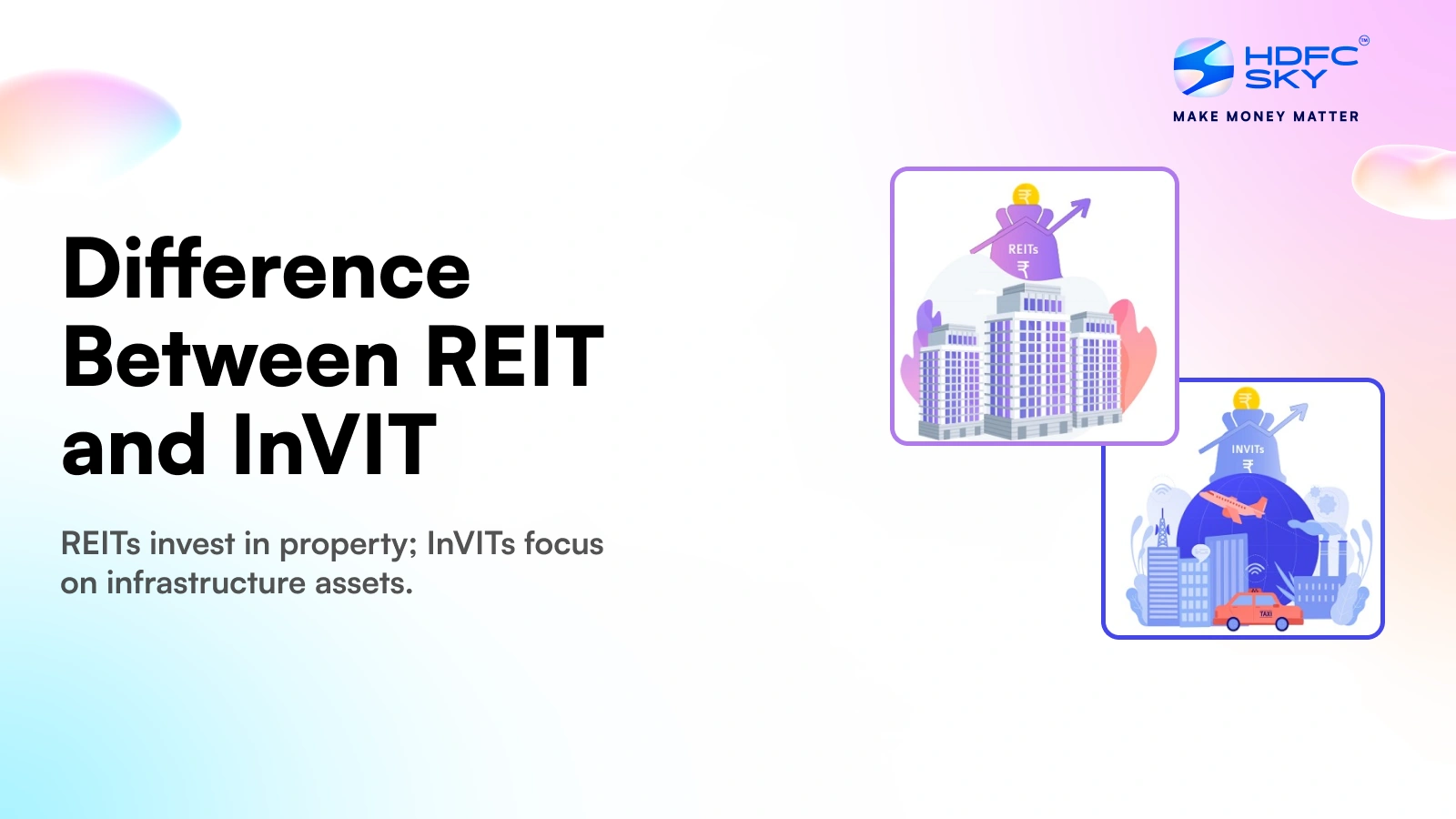
Both REIT and InvIT investments are relatively new investment instruments in India. They offer a way to invest in income-generating assets without directly owning them. While they share some similarities, their underlying assets and investment strategies differ significantly. Understanding these differences is crucial for making informed investment decisions. The growing interest in REIT and InvIT in India stems from their potential to provide stable income streams, diversification benefits, and exposure to high-growth sectors.
What are REITs?
REIT full form is Real Estate Investment Trust. REITs are companies that own, operate or finance income-producing real estate. They pool money from multiple investors to invest in a diversified portfolio of real estate assets. This allows investors to access the real estate market without the large capital outlay required for direct property ownership.
- Structure: REITs, or Real Estate Investment Trusts, operate with a distinct three-tier structure that ensures efficient management and investor protection.
- Benefits: So, is REIT a good investment? REITs, or Real Estate Investment Trusts, offer a unique avenue for investors to participate in the real estate market without the burdens of direct property ownership. Here are some reasons that make REITs an attractive investment option:
- Diversification: One of the primary advantages of REITs is diversification. By pooling funds from multiple investors, REITs can invest in a diversified portfolio of real estate assets. This spreads your investment across various property types, locations, and tenants, reducing overall risk. Instead of putting all your eggs in one basket by owning a single property, you can gain exposure to a broader segment of the real estate market through REITs.
- Stable Income: REITs are designed to generate a stable income stream for investors. They earn revenue from rent and lease payments from tenants occupying their properties. These rental incomes provide a predictable and steady cash flow, making REITs appealing to income-seeking investors. This benefits those seeking regular dividends or a consistent income stream to supplement their other investments.
- Liquidity: Unlike direct real estate investments, which can be illiquid and difficult to sell quickly, REITs offer high liquidity. This is because REITs are traded on major stock exchanges, allowing investors to buy and sell units easily throughout the trading day. This liquidity provides flexibility and allows you to adjust your portfolio based on your needs and market conditions.
- Professional Management: REITs are managed by professionals with expertise in the real estate market. These professionals have the knowledge and experience to acquire, manage, and optimise real estate assets, maximising returns for investors. This professional management takes the burden off individual investors who might not have the time or expertise to manage properties.
- Income Distribution: REITs must distribute a significant portion of their income (typically 90%) to investors through dividends. This makes them attractive for income-seeking investors.
REITs have transformed or changed real estate investment with these benefits. Understanding REITs how they work makes it accessible to a broader range of investors. Whether seeking diversification, stable income, liquidity, or professional management, REITs can be valuable to your investment portfolio.
Example of REITs
Which REIT is best in India? Examples of REITs in India include Embassy Office Parks REIT, Mindspace Business Parks REIT, and Brookfield India Real Estate Trust. These REITs invest in commercial office spaces across major Indian cities.
What are InvITs?
InvIT full form is Infrastructure Investment Trust. InvITs are similar to REITs but focus on infrastructure projects. They allow investors to pool their money and invest in a portfolio of income-generating infrastructure assets. This provides exposure to a sector crucial for economic growth without the complexities of direct ownership. InvIT meaning essentially revolves around collective investment in infrastructure projects.
Example of InvITs
Examples of InvITs in India include the IRB InvIT Fund, India Grid Trust, and PowerGrid Infrastructure Investment Trust. These InvITs invest in road projects, power transmission lines, and renewable energy assets. How to invest in InvIT? Or Where to invest? Investing in InvITs is fairly simple. You can invest in InvITs through a demat account or through mutual funds of any company which has invested in InvITs.
Differences Between REIT vs InvIT
So, are REITs a good investment? Or, are InvITs better? While both REITs and InvITs offer exposure to income-generating assets, they have distinct characteristics:
| Feature | REIT | InvIT |
| Underlying Assets | Commercial real estate (office buildings, shopping malls, hotels) | Infrastructure projects (roads, highways, power transmission lines, renewable energy projects) |
| Structure | Typically, a three-tier structure with a sponsor, trustee, and manager | Similar three-tier structure |
| Revenue Generation | Primarily through rent and lease payments from tenants | Through tolls, tariffs, and user fees collected from the usage of infrastructure assets |
| Stability | Revenue streams are generally stable due to long-term leases with tenants | Revenue stability can vary depending on the type of infrastructure project and regulatory environment |
| Risks | Market risks, property value fluctuations, interest rate risks | Regulatory risks, project execution risks, political risks |
| Minimum Investment | Lower minimum investment requirements, making them more accessible to retail investors | Minimum investment requirements can be higher compared to REITs |
| Liquidity | Generally higher liquidity due to listing on stock exchanges and smaller trading units | Liquidity can be lower compared to REITs, especially for InvITs with fewer listed units |
| Growth | Growth potential linked to the real estate market and rental yields | Growth potential tied to infrastructure development and economic growth |
Conclusion
You now know what is a REIT and InvIT investment. REIT and InvIT offer unique investment opportunities in India, allowing investors to participate in the growth of real estate and infrastructure sectors. Consider your investment horizon, income needs, and risk tolerance when choosing between REIT vs InvIT.
Related Articles
FAQs on Difference Between REIT Vs InVIT
What are the major REITs in India?
Prominent REITs in India include Embassy Office Parks REIT, Mindspace Business Parks REIT, and Brookfield India Real Estate Trust, among others. Always do your research before investing.
Is InvIT a good investment?
INVITs can be a good investment for those seeking stable income and exposure to infrastructure growth. However, they carry risks, such as regulatory changes and project delays. Before investing, evaluate your risk tolerance and investment goals.
How many REIT and InvIT in India?
The number of REITs and INVITs in India constantly evolves as new ones are listed. As of December 2024, around 5 REITs and 15+ INVITs are listed on Indian stock exchanges.
Is InvIT debt or equity?
INVITs are hybrid instruments with characteristics of both debt and equity. They hold a portfolio of income-generating infrastructure assets and distribute a significant portion of their income to investors as dividends.
How to invest in REITs in India?
You can invest in REITs in India just like you invest in stocks. Open a Demat account with a broker, transfer funds, and buy units of listed REITs through your trading platform.
What are the types of REIT?
REITs are broadly divided into Equity, Mortgage, and Hybrid REITs. Equity REITs own and operate income-producing real estate, Mortgage REITs finance real estate, and Hybrid REITs combine both approaches.