- Offerings
- Tools & Platforms
Tools & Calculators
- Open API
- Calculators
- SIP Calculator
- CAGR Calculator
- Compound Interest Calculator
- FD Calculator
- RD Calculator
- EPF Calculator
- Retirement Calculator
- HDFC SIP Calculator
- Mutual Fund Return Calculator
- Lumpsum Calculator
- Step Up SIP Calculator
- ETF SIP Calculator
- Brokerage Calculator
- Equity Margin Calculator
- SWP Calculator
- EMI Calculator
- MTF Calculator
- Pricing
- SKY Learn
- Mutual Funds
- Margin Trading
- Financial Planning
- Personal Finance
- Share Trading
- IPO
- Derivatives
- Currencies
- Intraday Trading
- Trading Strategies
- Demat Account
- Commodity
- ETF
Exchange-Traded Derivatives: A Comprehensive Guide to Features, Types, and Advantages
By HDFC SKY | Published at: May 28, 2025 05:36 PM IST
Derivatives are contracts derive their value from an underlying asset and are used for various purposes, including hedging risks, speculating on price movements, and implementing complex trading strategies. Derivatives can be traded either privately between parties (Over-The-Counter or OTC) or on organised exchanges.
This article focuses on Exchange-Traded Derivatives (ETDs), explaining what are exchange-traded derivatives, their key features, common types available in India, examples, advantages, and how they operate within the regulated framework.
What are Exchange-Traded Derivatives?
The meaning of exchange-traded derivatives is simple. These are financial contracts whose value is based on an underlying asset, such as stocks, indices, currencies, commodities, or interest rates. They are standardised and traded on recognised stock exchanges, such as the NSE or BSE, or commodity exchanges like MCX in India.
The value of these contracts fluctuates in tandem with the value of the underlying asset. In India, the exchange-traded derivatives market is regulated by SEBI. This ensures trading is safe and fair for all. You can sell or purchase these contracts easily on the exchange. Exchange-traded derivatives types are futures and options. These are the most common ones used in India and are used by most traders.
Features of Exchange-Traded Derivatives
- Standardisation
ETD contracts are highly standardised. The exchange defines key parameters like the underlying asset, contract size (lot size), expiration dates (e.g., monthly, weekly cycles), strike price intervals (for options), and settlement procedures. This uniformity simplifies trading and enhances liquidity.
- Reduced Risk of Default through Intermediation
There is less chance of someone defaulting on payment in exchange-traded derivatives. The exchange is like a middleman. It makes sure both sides follow the rules. If someone defaults on payment, it is the exchange that steps in. This minimises the risk for everyone. The clearing house settles trades. This makes traders feel safe trading without worrying about defaults. In India, it is settled by the clearing corporation of NSE or BSE. This is a big plus over private deals.
- Highly Liquid
You can sell or purchase these contracts quickly. There are always sufficient buyers and sellers in the exchange-traded derivatives market. That is, you can get in or get out of a position without having to wait for a long time. Very high liquidity enables you to obtain good prices. It also implies that you can trade huge amounts without moving the market much. Stock and index derivatives are highly liquid in India. Both small and large traders benefit from this.
- Simple Offsetting
If you wish to close your position, you simply do a reverse trade. The exchange matches you with someone who desires the opposite of what you do. It’s easy to close your trade before expiry. You don’t have to wait or search for a buyer yourself. The system is quick and instant. This aspect is extremely convenient for active traders in India.
- Regulated Exchange
Exchange-traded derivatives are watched by SEBI and the exchanges. This makes trading safe. The rules are strict. The exchange checks all trades and reports big deals. This keeps the market fair for small traders too. Regulation also means problems are solved quickly. In India, this helps build trust in the exchange-traded derivatives market.
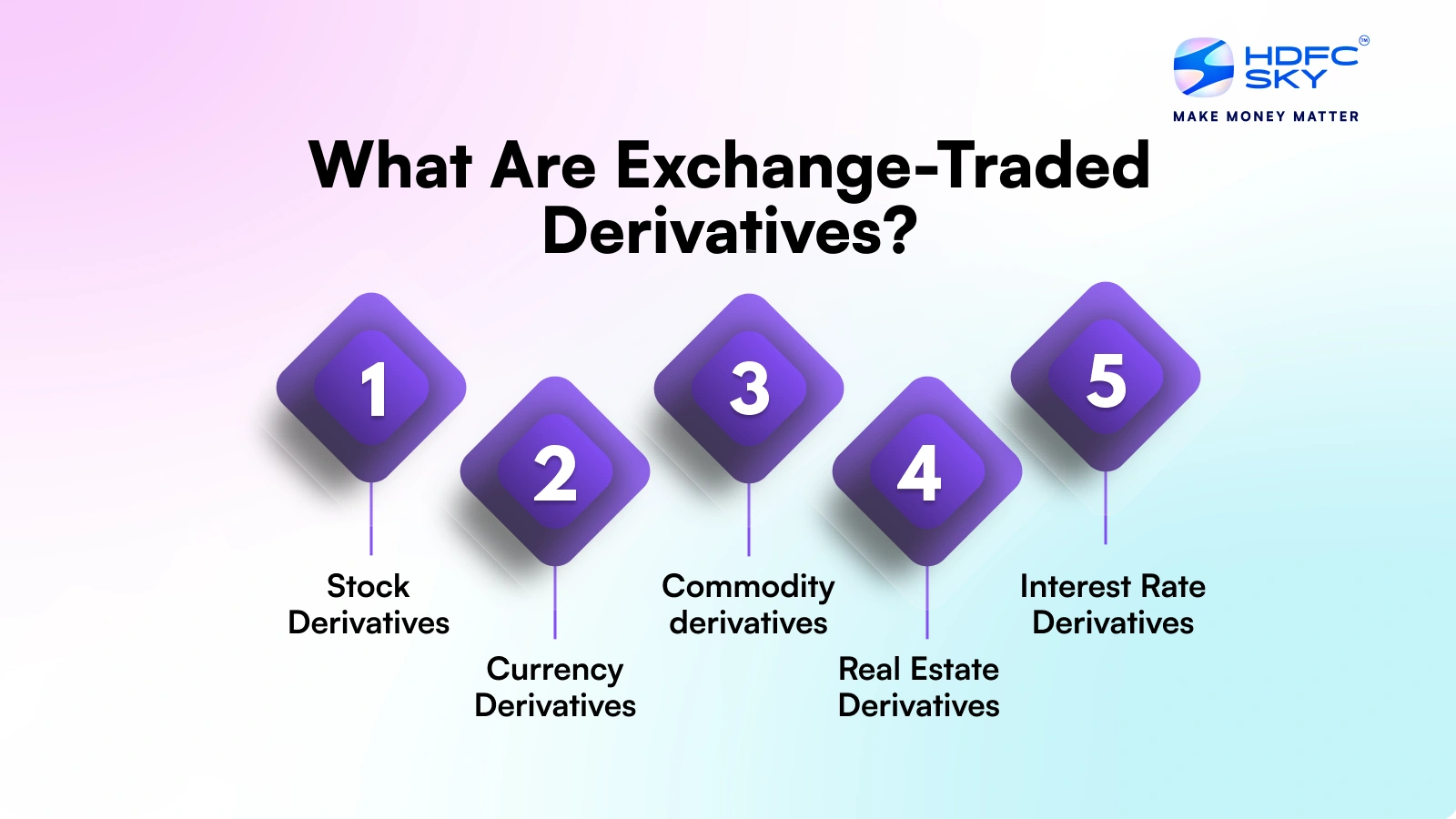
Types of Exchange-Traded Derivatives
There are numerous types of exchange-traded derivatives in India and some of them are discussed below:
- Stock Derivatives
Stock derivatives are on the shares of Indian firms. You can trade options or futures on a stock like Reliance, Infosys, or HDFC Bank. They are standardised and listed on the BSE or NSE. They allow you to speculate on a movement in shares or hedge investments. Index derivatives are on stock indices like NIFTY or BANKNIFTY. You cannot sell an index per se. You can, however, trade index options or futures. This allows you to take a view on the entire market and not on an individual stock.
- Currency Derivatives
Currency derivatives are currency pair-based contracts. For instance, you can trade futures and options of INR/USD or INR/EUR. Companies and traders use currency trading to hedge currency risk. They are traded on NSE, BSE, and MCX-SX. These contracts are used by importers, exporters, and those who require hedging currency risk.
- Commodity derivatives
Commodity derivatives are commodity-based contracts such as gold, silver, crude oil, or copper. You can do commodity trading on MCX. These are used to hedge risk if you trade in these commodities as part of your business. These are also used by traders who wish to make money based on price movements in commodities.
- Real Estate Derivatives
Real estate derivatives are not common in India. Certain exchanges, nonetheless, plan to introduce contracts based on the prices of property in future. They are new and not extensively traded hitherto. The purpose is to allow for hedging or investing in property price changes without owning the actual property.
- Interest Rate Derivatives:
Futures and Options contracts based on interest-bearing instruments, primarily Government of India bonds. Institutions like banks and insurance companies mostly use these to hedge against adverse movements in interest rates.
In India, trading is primarily in stocks, indices, currency, and commodity derivatives. They are stringently regulated and heavily traded.
The exchange-traded derivatives market in India is developing rapidly. Increasing numbers of people are trading these contracts for risk management and to make potential profit. The exchanges and SEBI ensures that trading is fair, transparent, and safe. This increases market access for traders and investors. The primary exchange-traded derivatives types are simple to sell and buy and comprehend. Indian traders and investors have numerous options.
Examples of Exchange-Traded Derivatives
Some common examples of exchange-traded derivatives actively traded in India:
- Nifty 50 Index Futures (Future contracts are available for the current month, next month and next to next month)
- Bank Nifty Index Call Option (e.g., 50000 Strike Price, Weekly Expiry)
- Reliance Industries Stock Futures (Monthly Expiry)
- Infosys Stock Put Option (e.g., 1400 Strike Price, Monthly Expiry)
- USD/INR Currency Futures (Monthly Expiry)
- Gold Mini Commodity Futures (Available on MCX)
- 10-Year GOI Bond Futures (Interest Rate Futures on NSE/BSE)
An exchange-traded options example could be buying a Nifty 24000 Call option, expecting the index to rise above that level before expiry. An exchange-traded derivatives example for futures could be selling a Tata Motors futures contract anticipating a fall in its price.
Advantages of Exchange-Traded Derivatives
Compared to OTC derivatives or direct trading in underlying assets, ETDs offer significant advantages:
- Transparency: Real-time prices, trading volumes, and open interest data are publicly available, ensuring market transparency.
- Liquidity: Major contracts offer high liquidity, making it easy to enter and exit.
- Counterparty Risk Mitigation: The clearing corporation guarantees minimise the risk of one party defaulting on their obligation.
- Regulation and Investor Protection: Trading takes place within a robust regulatory framework defined by SEBI, which offers investor protection mechanisms.
- Accessibility: Retail investors who meet eligibility and margin requirements can participate through registered brokers.
- Efficient Price Discovery: The centralised exchange platform facilitates efficient discovery of futures and options prices.
- Leverage: Allows traders to control large contract values with a smaller margin deposit, although this also amplifies risk.
Conclusion
Exchange-traded derivatives , encompassing futures and options trading on stocks, indices, currencies, and commodities, form a vital and active segment of the Indian financial markets. Exchange-traded derivatives enable traders to earn a profit and manage risk. The contracts are standardised, secure, and simple to trade.
Understanding the meaning of exchange-traded derivatives and their features allows investors and traders to utilise these instruments more effectively, while always being mindful of the inherent risks associated with leverage and derivative products. The exchange-traded derivatives market in India provides sophisticated avenues for market participation beyond traditional cash market investing.
Related Articles
FAQs on Exchange-Traded Derivatives
What are the differences between exchange-traded and OTC derivatives?
OTC derivatives are customised contracts entered into between counter-parties with flexibility but lower transparency and liquidity. Exchange-traded derivatives are standardised, traded on regulated exchanges like the NSE or BSE, with high transparency, strict regulation, and higher liquidity for all participants.
How do exchange-traded derivatives work?
Exchange-traded derivatives are standardised contracts, such as futures and options, traded on recognised exchanges. The exchange dictates contract terms, acts as an intermediary, and settles the contracts. This provides transparency, reduces counterparty risk, and allows traders to easily enter and exit the market during trading hours.
Are exchange-traded derivatives liquid?
Exchange-traded derivatives are highly liquid in India. There are lots of buyers and sellers who trade on the BSE and NSE exchanges. It is conducted daily, and selling or purchasing contracts is simple at current prices, ensuring all market players have efficient and smooth transactions.
Who regulates exchange-traded derivatives in India?
In India, exchange-traded derivatives are primarily regulated by the Securities and Exchange Board of India (SEBI) for equity and financial derivatives, and by the Forward Markets Commission (FMC) for commodity derivatives. Certain currency and interest rate derivatives are regulated by the Reserve Bank of India (RBI).