- Offerings
- Tools & Platforms
Tools & Calculators
- Open API
- Calculators
- SIP Calculator
- CAGR Calculator
- Compound Interest Calculator
- FD Calculator
- RD Calculator
- EPF Calculator
- Retirement Calculator
- HDFC SIP Calculator
- Mutual Fund Return Calculator
- Lumpsum Calculator
- Step Up SIP Calculator
- ETF SIP Calculator
- Brokerage Calculator
- Equity Margin Calculator
- SWP Calculator
- EMI Calculator
- MTF Calculator
- Pricing
- SKY Learn
- Mutual Funds
- Margin Trading
- Financial Planning
- Personal Finance
- Share Trading
- IPO
- Derivatives
- Currencies
- Intraday Trading
- Trading Strategies
- Demat Account
- Commodity
- ETF
Understanding the Forex Trading Challenges in India
By HDFC SKY | Updated at: Jul 29, 2025 03:34 PM IST
Summary
Forex trading in India is strictly regulated by RBI and SEBI, allowing trades only in INR-based pairs like USD/INR, EUR/INR, GBP/INR, and JPY/INR through exchanges like NSE and BSE. Leverage is capped at 1:50, and profits are taxed as speculative income. Trading on unregulated offshore platforms is illegal and risky. Limited broker options and lack of forex education further restrict trader growth. Time zone differences also hinder access to high-volatility sessions. The article calls for regulatory easing and better education to safely boost forex trading in India.
Forex trading involves dealing with world currencies through various derivatives like futures and options in exchanges. While spot forex trading takes place OTC (over-the-counter) and the main participants in the spot market are central banks, financial institutions and forex broker-dealers, outside the formal exchange setup. It is a continuous process that happens around the clock. Forex trading can be a complicated process in case one is not fully aware of.
What is Forex Trading?
Forex trading involves exchanging one currency for another, often through spot, forward, futures, options, and swaps. The profit or loss in these positions depends on the price fluctuations in the currencies. The Forex market is one of the most actively traded markets globally, with daily transactions of trillions of dollars.
For a better and comprehensive understanding of the forex market, here is a quick Introduction to forex trading terminologies:
- Currency Pairs: Currencies are traded in pairs consisting of two fiat currencies (like USD/GBP, USD/CAD, EUR/USD).
- Pip: Pip refers to ‘Percentage in Points’ and is the smallest measurement unit for tracking currency price quotes. For most major currencies, Pip is the fourth decimal point, which equals 0.0001.
- Ask Price: The lowest price that the seller is willing to accept
- Bid Price: Price that a buyer is willing to pay
Now, forex traders are vulnerable to certain forex trading challenges. Let’s uncover some of these forex trading challenges and learn more about forex trading in general.
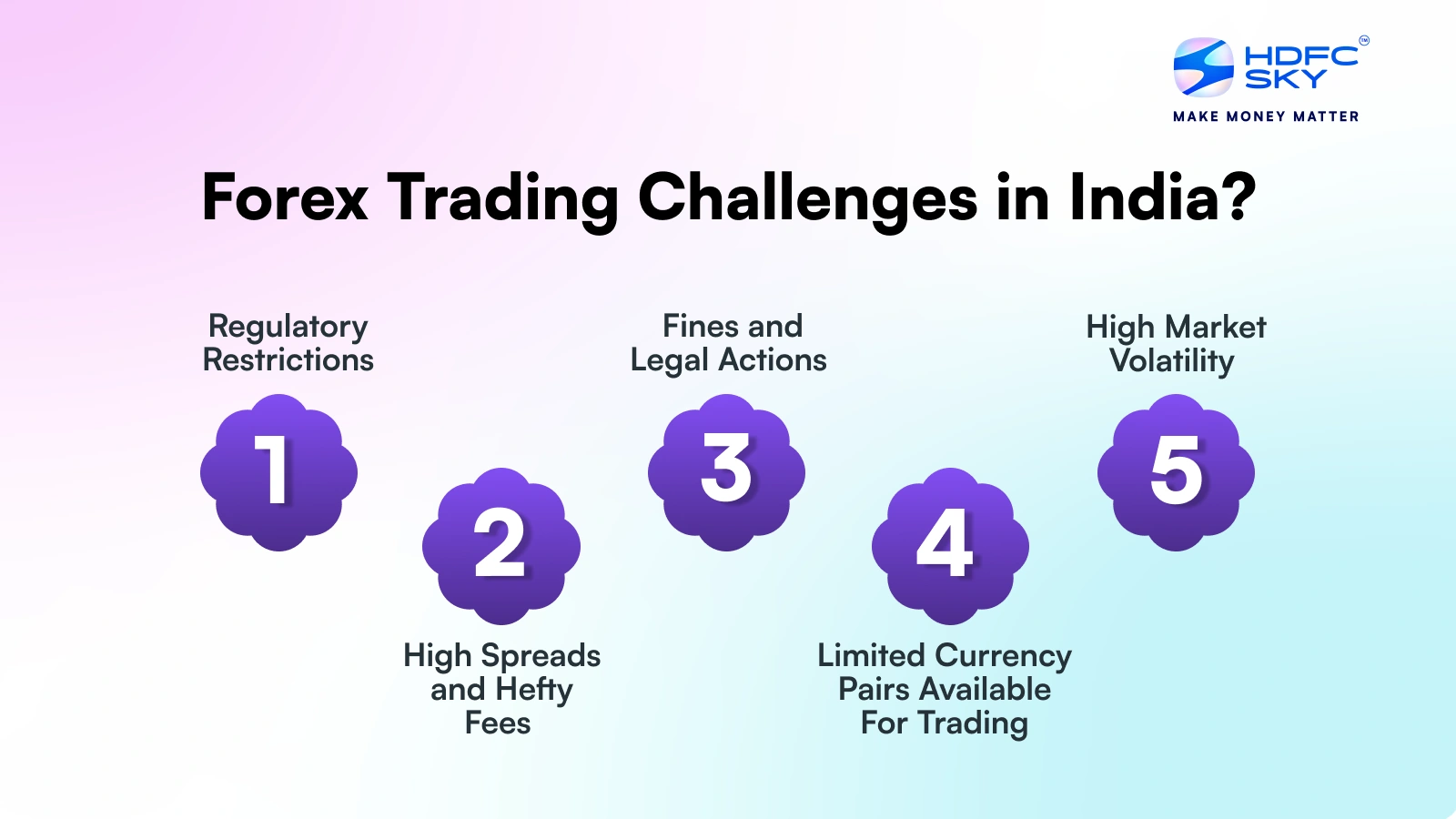
Forex Trading Challenges in India
Here are a few important challenges that are faced in ‘forex currency trading’ in India:
1. Limited Currency Pairs Available For Trading
Forex trading in India is regulated by the Reserve Bank of India (RBI) and governed by the Foreign Exchange Management Act (FEMA). Traders can only trade in approved currency pairs, where one currency must be the Indian Rupee. Note that, due to regulatory restrictions, Indian traders can trade only in four INR-based pairs (USD/INR, EUR/INR, JPY/INR, and GBP/INR) in the exchange-traded forex market.
Forex option trading, which offers the right (but not the obligation) to buy or sell currencies at a set price within a specified time, is also regulated. Indian investors cannot trade in the currency pair of their choice.
2. Regulatory Restrictions
Indian forex participants are subject to regulatory restrictions regarding the quantity of cash that can be imported or exported. FEMA has also imposed restrictions on permissible current and capital account transactions involved in foreign exchange. The maximum amount that can be exchanged within the country is also restricted, and the RBI has imposed caps for individuals and firms on the amount of foreign exchange. These restrictions safeguard the Indian currency from speculation, but they also restrict the prospects available for Indian Forex participants.
3. Fines and Legal Actions
Violations of FEMA rules, such as trading forex through unauthorised brokers (offshore platforms), can lead to fines and legal action under RBI regulations. Any trader who violates these rules may face legal action and be asked to stop using the forex trading markets. Although this is a fundamental forex trading challenge, it is a by-product of regulatory and safeguarding measures
4. High Spreads and Hefty Fees
The brokers often charge hefty commissions and fees. The spreads, which are actually the difference between the buying and selling prices, are quite high, especially when the markets are volatile. Indian traders that have a small budget are unable to invest in the forex trading market as they are unable to make significant profits, making this a core forex trading challenge.
5. High Market Volatility
Another fundamental forex trading challenge is that all types of global events, such as natural disasters, major economic announcements and political tensions, can have a significant impact on the forex market. This tends to cause volatility, which further swings the currency prices. Indian traders who do not have access to the right technological tools or adequate know-how to predict and mitigate these risks are prone to financial losses.
Amongst the key challenges for Indian forex traders in regards to market volatility are:
- Managing risk at the time of major global movements, especially when the volatility is high
- Difficulty in finding accurate forex trading signals
- Issues with timing the trades due to different time zones for different sessions in the forex exchange market timing.
6. Leverage Risks
The term ‘leverage’ in the Forex Market refers to the amount of borrowed capital provided by brokers to traders, allowing them to control a larger position than their initial investment. Indian Forex Markets are highly leveraged markets, typically offering leverage ratios of 20:1 to 30:1, meaning traders can control a position 20 to 30 times their initial capital.
There aren’t any caps regarding the maximum movement that can happen daily in the Forex market. Hence, the participants taking highly leveraged trades face risks of losing their capital.
7. Barriers in terms of Language and Culture
Since forex currency trading is conducted globally, the tools, analysis reports, and platforms are usually created in English. Indian traders who are unaware of or inept at English due to their preference for local languages may face many challenges.
Traders may not easily understand forex trading patterns without proper educational resources in their native languages. The learning curve is a significant forex trading challenge that discourages Indian traders from investing in forex trading.
8. Counterparty Risks
It is challenging to forecast the forex market, as it is an international market involving currencies of various countries. There is no centralised exchange at a global level. The global forex market is decentralised, but it is regulated in various jurisdictions. In India, it is regulated by the RBI and SEBI. Therefore, a trader entering forex trading needs to be aware of the counterparty risks associated with it.
9. Lack of Awareness
Forex trading is legal in India under RBI and FEMA regulations, but it is strictly limited to INR-based currency pairs traded through authorised exchanges. However, many traders mistakenly believe it is illegal due to restrictions on offshore forex trading via international brokers, which is prohibited under FEMA. This lack of knowledge about how the market works and about its legalities in India keeps potential traders away, which tends to limit the growth of trading in the forex market.
10. Experimental Learning Through Trial and Error
While forex trading is not typically included in standard university curriculums, SEBI-registered institutes, private financial training platforms, and professional certification courses offer structured education on forex trading and market strategies. Sometimes, this lack of proper education can be a major forex trading challenge, as it can lead to losses, discouraging traders from making further investments.
11. Financial and Technological Infrastructure
Even though India has made progress in technological advancements, many regions continue to have problems, such as insufficient access to financial tools, poor internet connection and outdated devices.
Forex trading is conducted globally, which is why traders should ideally have access to advanced devices, AI-equipped financial tools, good internet connections, reliable payment gateways, advanced software, etc. In India, retail traders trade through RBI-approved exchanges and regulated brokers, which provide necessary platforms and market access.
Effective Ways for Navigating the Indian Forex Market
In order to survive the Indian forex market, traders need to understand and hone forex trading strategies. They need to plan and adhere to all the legal rules and regulations of the government. Here are some methods that can help them trade successfully:
- Follow Regulations: Traders should trade only in INR-based currency pairs as allowed by RBI and FEMA.
- Use Authorised Platforms: They must ensure that they trade through exchanges like NSE Ltd, BSE Ltd, Metropolitan Stock Exchange of India Ltd (MSE), or authorised electronic trading platforms (ETPs) approved by the RBI.
- Gain Knowledge: It is essential to learn about forex trading through courses, mentorship, and market analysis tools.
- Stay Informed: Traders should always monitor global and domestic economic news to make informed decisions.
- Manage Risks: They must also use stop-loss orders and diversify forex trading investments to minimise losses.
- Choose Reliable Brokers: All traders should consider engaging brokers with low fees and make sure they have access to good customer support.
- Technical Analysis and Understanding the Impact of Economic Data: It is recommended that traders study Forex trading chart patterns and analyse the impact of data on currencies while trading in the Forex market.
Conclusion
Forex trading challenges in India include limited access to global markets, strict regulatory measures, and risks associated with volatility. Traders face many problems managing currency fluctuations, understanding the government’s legal rules, and navigating the uncertain market. However, despite these challenges, forex trading offers immense opportunities for those who want to explore something new and make good profits. To overcome the forex market issues in India, traders must stay informed and seek proper guidance while using risk management strategies.
Related Articles
FAQs on Forex Trading Challenges in India
Is forex trading safe in India?
Forex trading can be safe in India if it is conducted legally and all laws are adhered to according to RBI guidelines. Some risks include market volatility and excessive regulatory compliance.
Is forex now legal in India?
Yes, forex trading is legal in India under the Foreign Exchange Management Act (FEMA) and is regulated by the Reserve Bank of India (RBI).
Who manages forex in India?
The Reserve Bank of India (RBI) manages forex regulations in India through the Foreign Exchange Management Act (FEMA) and related guidelines.
What are some forex trading legal issues in India?
Legal issues can include using unauthorised trading platforms, violating RBI guidelines, and not complying with tax regulations on foreign income.
Are there anyforex trading challengesfor Indian traders?
Challenges include regulatory compliance, market volatility, a lack of understanding of global markets, and an inability to manage currency risks effectively.
Is forex trading allowed in India?
Yes, forex trading is allowed in India within the regulatory framework set by the RBI under FEMA guidelines.
What are the legal steps to trade forex in India?
To trade forex legally in India, retail traders must open accounts with authorized stock exchanges or RBI-approved electronic trading platforms. Additionally, they should comply with RBI regulations and limits.