- Offerings
- Tools & Platforms
Tools & Calculators
- Open API
- Calculators
- SIP Calculator
- CAGR Calculator
- Compound Interest Calculator
- FD Calculator
- RD Calculator
- EPF Calculator
- Retirement Calculator
- HDFC SIP Calculator
- Mutual Fund Return Calculator
- Lumpsum Calculator
- Step Up SIP Calculator
- ETF SIP Calculator
- Brokerage Calculator
- Equity Margin Calculator
- SWP Calculator
- EMI Calculator
- MTF Calculator
- Pricing
- SKY Learn
- Mutual Funds
- Margin Trading
- Financial Planning
- Personal Finance
- Share Trading
- IPO
- Derivatives
- Currencies
- Intraday Trading
- Trading Strategies
- Demat Account
- Commodity
- ETF
What is a Forward Market and How Does It Work?
By HDFC SKY | Published at: May 28, 2025 05:19 PM IST
Financial markets in India facilitate a vast number of transactions daily. While many associate markets with immediate buying and selling, like in the equity spot market, another significant segment deals with agreements for future transactions. The Forward Market is a crucial part of this landscape, allowing participants to lock in prices today for assets to be delivered and paid for at a later date.
Primarily used for managing price risk, particularly in currencies and commodities, understanding the forward market meaning, its workings, and how it compares to other market types like the spot and futures markets is essential for businesses and investors navigating the complexities of finance in India.
What is a Forward Market?
The forward market is a distinct Over-the-Counter (OTC) marketplace where two parties directly enter into a private, customised agreement, known as a forward contract, to buy or sell a specific asset (like currency in the forward forex market or commodities) at a pre-agreed price for settlement on a specified future date. Unlike standardised, exchange-traded futures, forwards offer significant flexibility in contract terms, making them highly suitable for businesses in India that hedge specific future exposures, such as importers or exporters, by locking in exchange rates through the RBI-regulated currency forward market. However, this OTC nature means that forward contracts lack the liquidity and central clearing guarantee of exchanges, exposing participants to significant counterparty risk— the risk that the other party will default on the agreement.
How Does the Forward Market Work?
Given below is a breakdown of how the forward market works in India:
- In the forward market, two parties are involved. They sign an agreement. They agree on price, quantity, and exchange date.
- This is what is known as a forward contract. It is between two parties and can be negotiated to suit both parties.
- A company can use the forward forex market to hedge the exchange rate of buying dollars in three months.
- This prevents losses in case of a depreciating rupee. Exporters and importers use the forward exchange market to hedge and safeguard themselves against a shift in currency rates.
- The currency forward market enables banks and firms to exchange a rate today for a future exchange.
- The commodity forward market works in a similar way, but for products such as wheat or oil.
- In India, the foreign exchange forward market is vast and supports many firms.
- The agreements (or contracts) are not traded on an exchange, so there is a risk that someone will not pay.
- The market gives freedom to set any terms. The forward market economics is about reducing risk and planning ahead.
- The primary purpose for which individuals use the forward market is to hedge, or protect themselves against, price fluctuations.
Types of Forward Market
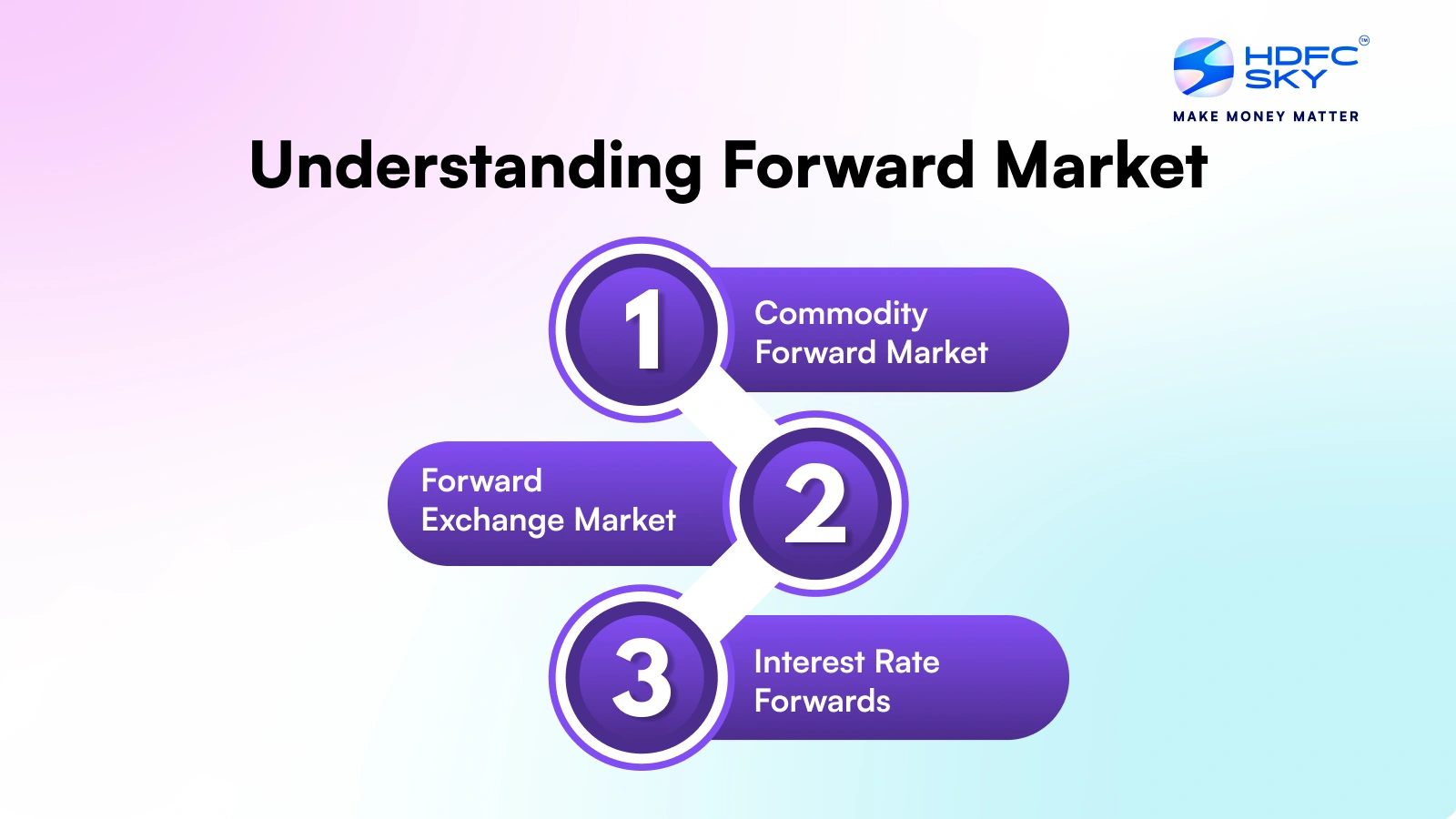
There are several types of forward markets in India. The most significant ones are as follows:
- Forward Exchange Market: This is the largest and most common type, dealing with forward contracts in derivatives for currencies. The forward forex market, or forward market for foreign exchange, is extensively used by Indian importers and exporters to hedge against adverse movements in exchange rates (like USD/INR, EUR/INR). By entering a forward contract, they can lock in a specific exchange rate for future payments or receipts, providing cost certainty. This currency forward market primarily operates OTC between banks and their corporate clients.
- Commodity Forward Market: This market involves customised agreements for the future delivery of physical commodities, such as agricultural products (grains, spices), metals, or energy products. These contracts are often used by producers, such as farmers and miners, and consumers, including manufacturers and processors, to lock in prices and manage supply chain risks. These agreements often occur directly between parties or through specialised commodity brokers, sometimes outside the purview of major commodity exchanges where standardised futures are more common.
- Interest Rate Forwards (FRAs): Less visible to retail participants, Forward Rate Agreements (FRAs) are OTC contracts used to lock in an interest rate for a specific future period on a notional principal amount. Banks and large corporations mainly use them to hedge against interest rate fluctuations.
Forward Market Example
A straightforward forward market example in India is a wheat farmer and a flour mill. The farmer believes wheat prices will decrease after harvest. The mill fears prices will increase. They agree to sell wheat at ₹2,200 per quintal in six months. If prices increase, the mill saves money. If prices decrease, the farmer receives a better price. Both know what they will pay or receive. This is a forward market hedge example.
In the forward market for foreign exchange, an exporter can fix the dollar rate today for payment in three months to prevent losses if the rupee depreciates.
Benefits and Limitations of the Forward Market
Benefits
- Customisation: Contracts can be tailored precisely to match the specific needs of the parties involved regarding asset quantity, quality, delivery date, and location.
- Hedging Effectiveness: Provides an excellent tool for businesses to perfectly hedge specific future exposures against price or rate volatility.
- Privacy: Transactions are private agreements, not publicly disclosed like exchange trades.
Limitations
- Counterparty Risk: This is a major drawback. Since there’s no clearing house guarantee, there’s a significant risk that the other party might default on the contract.
- Low Liquidity: Forward contracts are typically not transferable or easily offset before maturity due to their customised nature and lack of a secondary market. Exiting a position early can be difficult or costly.
- Lack of Price Transparency: Prices are negotiated privately, limiting market-wide price transparency compared to exchange-traded instruments.
- Accessibility: Primarily used by institutions, banks, and corporations; generally less accessible or suitable for retail speculation compared to exchange-traded futures or options.
Difference Between Forward Market and Futures Market
| Basis | Forward Market | Futures Market |
| Trading Place | Occurs privately, over the counter. | Occurs in organised exchanges like the NSE of MCX. |
| Contract Terms | Terms are flexible and customisable. | Terms are extremely standardised. |
| Regulation | There are very few regulations. | They are strictly regulated by SEBI. |
| Risk | There is a high risk that the other side may not pay. | There is a low risk as the exchange guarantees payment. |
| Liquidity | Less liquid | More liquid |
| Settlement | Happens on contract maturity. | Occurs daily from market to market. |
| Transparency | It is low as prices are not public. | It is high because prices are public. |
| Suitability | Suitable for specific needs. | Suitable for general trading and hedging. |
Conclusion
The forward market individuals and businesses from price volatility. There are various forms of forward markets, including the forward forex market, commodity forward market, and bond forward market. The contracts are convenient and personal, but risky. The forward market is not the same as the futures market. It is a convenient but less secure option. Nevertheless, it is an important aspect of Indian business and commerce.
Related Articles
FAQs on Forward Market
Which instruments does the forward market employ?
The forward market employs instruments such as forward contracts, bonds, swaps, equity, forward rate agreements, and bills of exchange. These contracts include assets like currencies, commodities, interest rates, and securities, enabling parties to agree on future delivery prices and manage risk in the best way possible.
Who enters into forward agreements?
Forward contracts in India are entered into by banks, corporations, institutional investors, hedge funds, exporters, importers, and occasionally individuals. They enter into forward contracts to hedge against price risk or to speculate on future prices. The terms of the contracts are negotiated directly between the buyers and sellers.
Is it possible to sell a forward contract?
Yes, selling a forward contract is possible in India, but only if the terms of the contract permit assignment or transfer. Forward contracts being private and tailored, their sale or transfer is permitted with the consent of both original parties. Otherwise, the original buyer and seller are to settle the contract.
What is the Forward Market Commission?
The Forward Markets Commission (FMC) was the statutory regulator of the commodity and futures market in India. It controlled trading, promoted fair play, made recommendations to the government, and supervised exchanges. In 2015, FMC was merged with the Securities and Exchange Board of India (SEBI) for combined market regulation.