- Offerings
- Tools & Platforms
Tools & Calculators
- Open API
- Calculators
- SIP Calculator
- CAGR Calculator
- Compound Interest Calculator
- FD Calculator
- RD Calculator
- EPF Calculator
- Retirement Calculator
- HDFC SIP Calculator
- Mutual Fund Return Calculator
- Lumpsum Calculator
- Step Up SIP Calculator
- ETF SIP Calculator
- Brokerage Calculator
- Equity Margin Calculator
- SWP Calculator
- EMI Calculator
- MTF Calculator
- Pricing
- SKY Learn
- Mutual Funds
- Margin Trading
- Financial Planning
- Personal Finance
- Share Trading
- IPO
- Derivatives
- Currencies
- Intraday Trading
- Trading Strategies
- Demat Account
- Commodity
- ETF
Different Types of Trading in Stock Market
By HDFC SKY | Updated at: Sep 26, 2025 05:03 PM IST
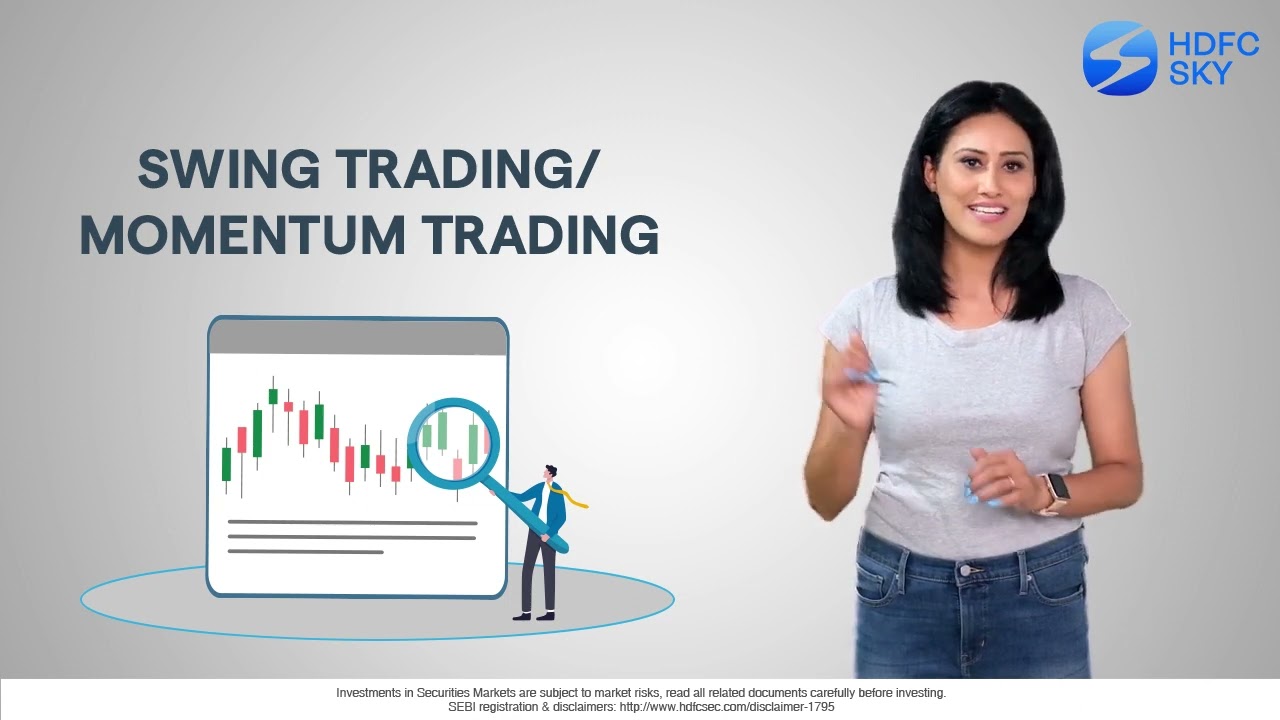
Trading refers to buying and selling of financial instruments like stocks, commodities, currencies or derivatives to earn profits. There are various types of trading in the stock market each suited to different risk appetites, goals and timeframes. From intraday trading that involves quick trades within a day to swing trading, position trading and scalping, each style has its own approach and strategy. Understanding these types helps traders choose a method that suits their financial goals and market experience.
Meaning of Trading
Trading refers to the buying and selling of financial instruments such as stocks, bonds, commodities, or currencies with the goal of making a profit. In the stock market, trading means purchasing shares at a low price and selling them at a higher price, or vice versa in case of short selling. It can be done over short or long periods, and is typically classified into types like day trading, swing trading, and position trading, depending on the strategy and time horizon.
History of Stock Trading
Stock trading dates back to the early 1600s when the Amsterdam Stock Exchange was established as the world’s first official stock market. Over time, trading evolved with the formation of major exchanges like the London Stock Exchange (1801) and the New York Stock Exchange (1792), making it easier for companies to raise capital and for investors to buy and sell ownership in businesses. Today, stock trading is a global, technology-driven activity accessible to both institutional and retail investors.
Different Types of Trading in Stock Market
The stock market offers various types of trading, such as intraday, swing, positional, and scalping, each suited to different risk levels and time horizons. Understanding these types helps investors choose strategies that align with their financial goals and trading style.
1. Intraday trading or Day Trading
Intraday trading is all about buying and selling stocks on the same day, before the market closes. Instead of holding on to shares for the long term, intraday traders look to take advantage of small price movements throughout the day. It’s fast-paced and requires quick decisions, a solid understanding of charts and the ability to stay calm under pressure. If you enjoy staying close to market action and have time to track prices closely, intraday trading could be a good fit-but it does come with higher risk, so having a plan is important.
For example: A trader notices that Infosys stock is trending upward in the morning and buys 200 shares at ₹1,450 each. Throughout the day, the price rises to ₹1,475. The trader sells all 200 shares at this price before the market closes.
2. Shorting or Short Selling
Short selling is a trading strategy that speculates on the decline in the price of a stock. If a trader expects the price of a stock to fall, he will first sell the stock and later buy it back at a lower price. A trader can sell a stock even if he does not have it in his demat account and can buy it back during the day. This is called shorting or short selling. This is done in expectation of the stock price going down and the trader making a profit out of the negative trend.
However, shorting must be done strictly on an intraday basis. This means, a trader can short sell anytime during the day, but he must buy back the shares by the end of the day before the market closes. However, shorting in the futures segment does not have such a restriction and the short position in this segment can be carried forward.
Example: You short-sell 100 shares of XYZ at ₹500 each. Later, the price drops to ₹460 and you buy them back.
Profit: (₹500 – ₹460) × 100 = ₹4,000 (excluding charges)
3. Swing Trading
Swing trading is a short to medium-term trading strategy where traders aim to capture price swings or “moves” in a stock or asset over a few days to weeks. Unlike intraday trading, swing traders don’t need to monitor markets constantly but still depend on technical indicators like moving averages, RSI and candlestick patterns to make decisions. This approach balances risk and reward, making it suitable for those who want to trade actively but don’t have time for full-time market watching.
Example: You buy shares of ABC at ₹200, expecting the price to rise to ₹250 over the next two weeks. Once the price reaches your target, you sell to book profits.
4. Momentum Trading
Momentum trading is a strategy where traders capitalise on strong price movements by buying assets that are rising and selling those that are falling. The idea is to ride the momentum until signs of a reversal appear. This approach depends on indicators like RSI, MACD and volume trends. Momentum traders act quickly, aiming to profit from short to medium-term moves driven by news, earnings or market sentiment. It requires sharp timing, discipline and a strong understanding of market behavior.
Example: If stock XYZ has been rising steadily from ₹100 to ₹130 due to strong earnings, a momentum trader might buy at ₹130 expecting the price to keep rising. They sell once the momentum slows or reverses.
5. Fundamentals Trading
A fundamentals trader makes buying decisions based on fundamental analysis, rather than on price alone. A fundamentals trader looks at financial data like earnings per share (share of profits per share), revenue and cash flow. For a short-term trader, the most important are earnings announcements and upgrades and downgrades by analysts. These can lead to big swings in share prices, rendering them rich pickings for those who are clued in. But they’ll have to act fast, since this news reaches thousands of people in a short time.
Example: If a company consistently reports strong profits, has low debt, and operates in a growing industry, a fundamentals trader may buy its shares expecting long-term price appreciation.
6. Positional Trading
The basic premise behind positional trading is that stock price movements show a certain trend and that once a trend starts, it is likely to continue for some time. Positional traders generally hold stocks for the long term, weeks, months or maybe years. While they may use fundamental analysis to identify the stock they wish to purchase, the selling decision may be taken according to technicals. To do this they study the longer term movement of prices, like a 200-day moving average (DMA). This kind of strategy works well in a bull market, rather than in flat or bearish phases.
Example: A trader spots a strong upward trend in a stock and buys it, planning to hold for several weeks until signs of reversal appear, aiming to profit from the price increase over that period.
7. Sentiment Trading
In this type of trading, market sentiment is used to make buying decisions. A trader looks at the general sentiment prevailing-whether people are bullish or bearish-and decide if he would like to buy or sell. Rising prices indicate a bullish sentiment and falling prices mean that bears are ruling the roost. To use this strategy, a trader must be a keen observer of the market and know exactly when sentiments turn. Some sentiment traders use quantitative analysis (QA) to get an idea of which way the wind is blowing as regards a particular stock. They scan thousands of reports and articles to ascertain whether the overall sentiment is negative or positive.
Example: If positive news about a company spreads, creating bullish sentiment, a sentiment trader may buy the stock expecting prices to rise as more investors get optimistic. Conversely, negative sentiment can prompt selling before prices drop.
8. Arbitrage Trading
An arbitrage trader takes advantage of the differential between markets to make money. For instance, the price difference of a stock between the NSE and the BSE. These traders have to be quick since the difference will exist only for a short period of time. Many big traders have put in place automated arbitrage systems that enable them to track variations in prices between exchanges and cash in on them. It’s harder for retail investors to make any real money from arbitrage. The problem is that you cannot buy a stock on the NSE and sell it on the BSE in real-time. You can do that only if you already have the stock in your demat account. You can, of course, do arbitrage in the cash and futures markets.
Example: If gold is priced lower on one exchange and higher on another, an arbitrage trader buys gold on the cheaper exchange and sells it on the expensive one, locking in the price difference as profit with minimal risk.
9. Scalping
Scalping is a type of day trading strategy that involves taking positions in many different stocks for very short periods (sometimes less than a minute) and making small gains from each. The advantage of such a strategy is that since the trader is holding the stock for a very short period of time, the chances of making losses are much lower. Another advantage is small movements in share prices are more common than large ones, resulting in more opportunities to make a profit, small though it may be.
Example: A scalper might buy a stock at ₹100.00 and sell it at ₹100.10 multiple times a day, making small gains that add up over many trades.
10. Technical Trading
Technical trading is a trading approach based on analysing price charts, patterns and technical indicators to predict future market movements. Instead of looking at a company’s financials or economic trends, technical traders focus on price action, volume, trends and signals from tools like moving averages, RSI, MACD and support/resistance levels. This method is popular among short-term traders like day and swing traders who rely on timing and market behavior to make decisions.
Example: A technical trader might spot a “head and shoulders” pattern on a stock chart, signaling a potential price drop and decide to sell before the price falls.
How Online Trading Has Transformed Stock Trading?
Online trading has changed stock trading by making it faster, more accessible and cost-effective. Investors can now buy and sell stocks instantly from anywhere using digital platforms, removing the need for brokers and physical trading floors. This shift has democratised investing, allowing beginners to participate with smaller amounts and access real-time data, research tools and automated trading options. Online trading also offers transparency and control, empowering traders to make decisions quickly. Overall, it has made stock trading more efficient and convenient.
Risk Management for Different Types of Trading in Share Market
Regardless of the trading style, applying key risk management techniques is essential to protect capital and manage losses effectively.
- Set Stop-Loss Orders: Limit losses by automatically exiting losing trades.
- Use Proper Position Sizing: Don’t risk more than 1–2% of capital on a single trade.
- Maintain Risk-Reward Ratio: Aim for a minimum 1:2 ratio to justify the risk taken.
- Diversify Trades: Spread investments across sectors or assets to reduce risk.
- Avoid Overleveraging: Use leverage cautiously to avoid magnified losses.
- Stick to a Trading Plan: Follow a disciplined strategy without emotional decisions.
- Review and Adjust: Regularly analyse performance and fine-tune strategies.
Conclusion
Trading in the stock market offers a wide range of strategies, from rapid intraday moves to long-term positional plays, each catering to different risk profiles, goals and time commitments. By understanding these various approaches whether it’s scalping for quick profits, swing trading for medium-term gains or leveraging technical and fundamental analysis traders can choose a style that suits their skills and resources
Related Articles
FAQs
Which Type of Trading Is Profitable?
Profitability depends on your risk appetite, time commitment, and strategy. Intraday offers quick gains but high risk; positional trading suits long-term profits with lower stress.
Which type of stock trading is best?
It depends on your goals, risk appetite, experience, and time availability. Choose the type that aligns with your financial goals and comfort with risk.
How many types of trading are in the stock market?
There are generally 5 main types of trading in the stock market:
- Intraday Trading
- Swing Trading
- Positional Trading
- Scalping
- Momentum Trading