- Offerings
- Tools & Platforms
Tools & Calculators
- Open API
- Calculators
- SIP Calculator
- CAGR Calculator
- Compound Interest Calculator
- FD Calculator
- RD Calculator
- EPF Calculator
- Retirement Calculator
- HDFC SIP Calculator
- Mutual Fund Return Calculator
- Lumpsum Calculator
- Step Up SIP Calculator
- ETF SIP Calculator
- Brokerage Calculator
- Equity Margin Calculator
- SWP Calculator
- EMI Calculator
- MTF Calculator
- Pricing
- SKY Learn
- Mutual Funds
- Margin Trading
- Financial Planning
- Personal Finance
- Share Trading
- IPO
- Derivatives
- Currencies
- Intraday Trading
- Trading Strategies
- Demat Account
- Commodity
- ETF
- What is a Hedge Fund?
- Hedge Fund Example
- Features of Hedge Fund
- How Do Hedge Funds Work?
- Different Types of Hedge Funds
- Strategies for Hedge Fund Investing
- How to Invest in a Hedge Fund?
- How are Hedge Funds Taxed?
- Hedge Funds vs Mutual Funds: What is the Difference?
- Difference Between Hedge Funds and Private Equity
- What are the Risk and Return Profiles of Hedge Funds?
- Is Investing in Hedge Funds Right for You?
- Things to Consider Before Investing in a Hedge Fund
- Things to Keep in Mind Before Investing in Hedge Funds
- Conclusion
- FAQs on What are Hedge Funds?
- What is a Hedge Fund?
- Hedge Fund Example
- Features of Hedge Fund
- How Do Hedge Funds Work?
- Different Types of Hedge Funds
- Strategies for Hedge Fund Investing
- How to Invest in a Hedge Fund?
- How are Hedge Funds Taxed?
- Hedge Funds vs Mutual Funds: What is the Difference?
- Difference Between Hedge Funds and Private Equity
- What are the Risk and Return Profiles of Hedge Funds?
- Is Investing in Hedge Funds Right for You?
- Things to Consider Before Investing in a Hedge Fund
- Things to Keep in Mind Before Investing in Hedge Funds
- Conclusion
- FAQs on What are Hedge Funds?
What is a Hedge Fund & How to Invest in a Hedge Fund?
By HDFC SKY | Updated at: Sep 22, 2025 02:13 PM IST
Summary
- Definition & Structure: Hedge funds are alternative investment vehicles pooling capital from accredited investors or institutions to pursue complex strategies for high returns, distinct from mutual funds.
- Key Characteristics:
- Not regulated like mutual funds, offering more flexibility.
- Employ strategies like short selling, leverage, arbitrage, and derivatives.
- Require high minimum investment and charge performance-based fees.
- Investor Requirements:
- Typically restricted to high-net-worth individuals and institutional investors due to risk and complexity.
- Investors must meet specific net worth or income thresholds.
- Hedge Fund Strategies:
- Common types include long/short equity, market neutral, event-driven, global macro, and quantitative strategies.
- Risks & Returns:
- Potential for high returns but with elevated risk exposure.
- Market volatility, leverage, and lack of transparency can amplify losses.
- Comparison with Mutual Funds:
- Hedge funds are more aggressive, less liquid, and less regulated.
- Mutual funds are better suited for retail investors due to higher transparency and lower risk.
- Regulatory Oversight: Operate with limited regulatory scrutiny compared to traditional investment vehicles, increasing due diligence importance for investors.
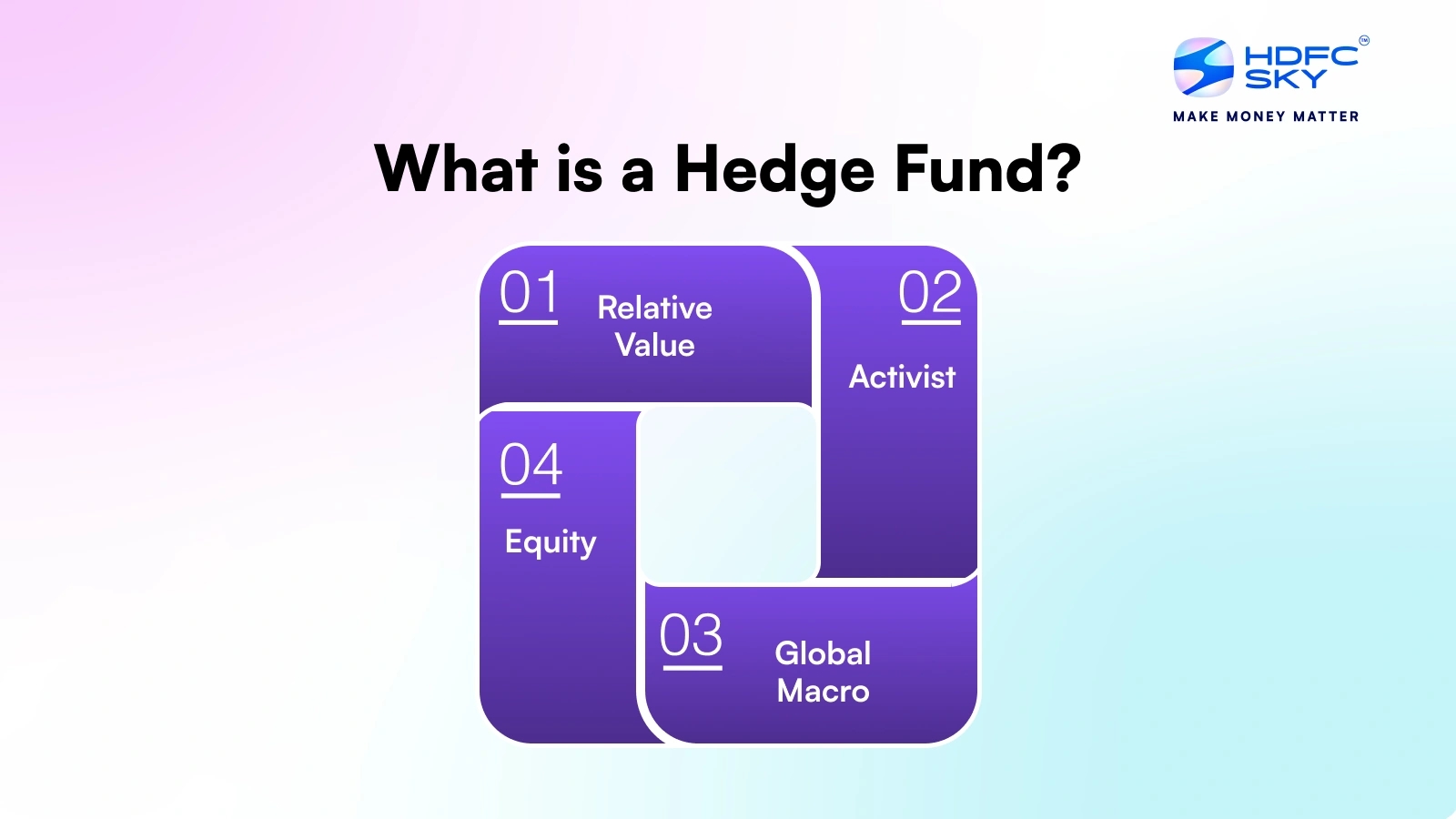
A hedge fund is a pooled investment vehicle that uses diverse strategies to earn active returns for its investors. These funds often invest in equities, derivatives, currencies, and other assets, and may use leverage, short selling, and other complex techniques. They typically target high-net-worth individuals or institutional investors and are less regulated than mutual funds.
What is a Hedge Fund?
Hedge fund meaning is a type of investment fund that pools capital from accredited investors or institutions and uses advanced strategies like leverage, derivatives, and short selling to maximise returns. Hedge funds aim for high gains and often take on more risk compared to traditional investment funds.
Hedge Fund Example
Suppose XYZ Fund is a hedge fund managing ₹100 million in assets with a “2 and 20” fee structure and a hard hurdle rate of 15%. Incentive fees are calculated on gross gains, not net of management fees. Below is the fund’s performance and the calculation of total fees paid to fund managers:
- Portfolio Performance: The portfolio generated a 100% return, surpassing the 15% hard hurdle rate, qualifying fund managers for incentive fees.
- Management Fees: Management fees are calculated as: ₹1,000,000 x 2% = ₹20,000
- Return Above Hurdle Rate: The rupee return above the hurdle rate is: [₹2,000,000 – ₹1,000,000 x (1+20%)] = ₹800,000
- Incentive Fees: Incentive fees are: ₹800,000 x 20% = ₹160,000
- Total Fees: The total fees paid to the fund managers are: ₹20,000 + ₹160,000 = ₹180,000
This example of trading in hedge funds reveals how hedge fund fees are structured and calculated on performance and management
Features of Hedge Fund
Hedge funds are investment vehicles designed to generate high returns using diverse and often aggressive strategies. They are typically open to accredited or high-net-worth investors.
- Exclusive Access: Available only to institutional and accredited investors due to high entry limits.
- High Minimum Investment: Often requires a minimum investment of ₹1 crore or more.
- Aggressive Strategies: Use leverage, short selling, derivatives, and arbitrage.
- Performance-Based Fees: Usually charge both a management fee (2%) and a performance fee (20% of profits).
- Low Regulation: Less regulatory oversight compared to mutual funds.
- Limited Liquidity: Investments may be locked in for months or years with limited withdrawal options.
- Diversification: Invest across asset classes equity, bonds, currencies, commodities, etc.
- Risk-Return Trade-off: Higher risk aiming for higher returns.
- Fund Manager Expertise: Heavily relies on the fund manager’s skill and strategy.
How Do Hedge Funds Work?
Hedge funds pool money from accredited investors to generate high returns using advanced strategies. They operate with more flexibility and less regulation than mutual funds.
- Pooling of Capital: Gather funds from high-net-worth individuals or institutions.
- Wide Investment Scope: Invest in stocks, bonds, derivatives, currencies, commodities, etc.
- Use of Leverage: Borrow capital to amplify potential returns (and risks).
- Short Selling: Profit from declining asset prices by selling borrowed securities.
- Hedging Strategies: Use financial instruments to reduce market risk.
- Active Management: Fund managers actively adjust portfolios based on market conditions.
- Performance-Based Fees: Typically charge a management fee and a performance fee (e.g., 2% + 20%).
Different Types of Hedge Funds
Hedge funds come in various types based on their investment strategies. Each type has its own approach to risk, return, and asset classes:
- Equity Hedge Funds: Invest primarily in stocks; use long and short positions to capitalise on market movements.
- Event-Driven Funds: Focus on corporate events like mergers, acquisitions, bankruptcies, or restructurings.
- Global Macro Funds: Make investment decisions based on macroeconomic trends and global financial indicators.
- Relative Value Funds: Seek to exploit price differences between related securities while minimising market risk.
- Distressed Securities Funds: Invest in the debt of companies facing bankruptcy or financial distress, aiming for high returns.
- Multi-Strategy Funds: Use a combination of strategies to diversify and reduce risk across different market conditions.
- Quantitative Funds: Use mathematical models, algorithms, and data analysis to identify trading opportunities.
Each type serves different investor goals and risk appetites.
Strategies for Hedge Fund Investing
Hedge funds use a variety of strategies to generate returns regardless of market conditions. Some of the most common include:
- Long/Short Equity: Buying undervalued stocks (long) and selling overvalued ones (short) to profit from price differences.
- Market Neutral: Aims to reduce market risk by balancing long and short positions, focusing on relative performance.
- Merger Arbitrage: Involves investing in companies involved in mergers or acquisitions to exploit price inefficiencies.
- Global Macro: Makes trades based on large-scale economic and geopolitical trends across global markets.
- Event-Driven: Focuses on opportunities created by corporate events like takeovers, spin-offs, or bankruptcies.
- Convertible Arbitrage: Profits from pricing differences between a company’s convertible bonds and its stock.
- Distressed Securities: Invests in financially troubled companies with the potential for recovery.
- Quantitative Strategies: Uses mathematical models and algorithms to identify and execute trades.
These strategies help hedge funds manage risk and target returns across various market scenarios.
How to Invest in a Hedge Fund?
Generally, hedge funds are accessible to accredited or seasoned investors. However, non-accredited investors can gain indirect access through fund-of-funds, hedge fund-mimicking ETFs, or shares in publicly traded investment firms. For accredited investors, here are the key steps to consider before investing
- Meet Eligibility Criteria: Most hedge funds require investors to be “accredited,” meaning you must meet certain income or net worth thresholds (e.g., ₹5 crore or more in India).
- Research Hedge Funds: Compare fund strategies, performance history, risk levels, fund managers’ experience, and fees before committing.
- Consult a Financial Advisor: Since hedge funds involve complex strategies, professional advice can help you assess if it’s a suitable option.
- Submit Application and Documents: Once you choose a fund, complete the subscription documents and comply with KYC/AML requirements.
- Commit Capital: Hedge funds may have minimum investment amounts, often starting from ₹1 crore or more.
- Monitor Your Investment: Hedge funds typically have limited liquidity and periodic reporting, so review fund updates and performance regularly.
How are Hedge Funds Taxed?
Hedge funds in India fall into Category III AIFs. They are taxed according to the rules that apply to this category at the fund level rather than like pass-through entities, where taxes are passed on to the individual investor.
The fund itself pays taxes on realised gains or income before it distributes profits to investors. The fund settles the tax obligation, so the investor incurs no additional tax liability on the income received.
This tax structure drastically reduces the net returns of domestic investors, as tax is deducted in advance before the distribution of profit. The heavy tax burden deters would-be investors, which is one reason hedge funds have not been very popular in India.
Hedge Funds vs Mutual Funds: What is the Difference?
Below is a comparison table that outlines the main differences between hedge funds and mutual funds:
| Parameters | Mutual Funds | Hedge Funds |
| Investor Base | Open to the public and suitable for individuals across income levels | Exclusively for high-net-worth individuals (HNIs) and institutional investors |
| Management and Ownership | Professional fund managers manage these with no significant ownership stakes | Hedge fund managers invest their own capital, aligning their interests with investors |
| Objective | Aim for steady growth by mirroring (passive) or slightly outperforming market indices (active). The objective depends on the type of fund | Target aggressive growth using high-risk strategies for potentially higher returns |
| Transparency | Very high as regular reports and disclosures are mandatory | Limited as information is shared only with fund investors. |
| Fees | Low fees, typically a percentage of assets under management (AUM), charged under a single expense ratio | Higher fees, including management fees and performance-based incentive fees. |
| Liquidity | Highly liquid, allowing daily trading | Liquidity varies based on the fund’s structure and policies |
| Minimum Amount to Be Invested | Low and varies based on the scheme, can be as low as ₹100 per month | High as it typically requires a minimum of ₹1 crore |
| Investor Type | Retail investors | High-net-worth individuals (HNIs) and institutional investors |
| Tax | Pass-through vehicle as tax is paid by the investor as per applicable norms | Taxes at the fund level and returns are distributed post-tax |
Difference Between Hedge Funds and Private Equity
Knowing the fundamentals of private equity and hedge funds, let us compare some key aspects directly:
| Parameters | Hedge Funds | Private Equity |
| Risk & Potential Returns | Aims for positive returns regardless of market trends; strategies include financial derivatives. | Higher risk with potential for substantial returns; often outperforms public equity over time. |
| Investment Strategies | Aggressive strategies, including leveraging and high-risk asset investments to maximise returns. | Focuses on growing the value of private companies through funding for expansion and development. |
| Structure & Liquidity | Structured as limited partnerships with variable liquidity as withdrawals may be difficult. | Managed by a private equity firm; liquidity is more restricted due to long-term focus. |
| Management and Ownership | Professional fund managers manage with no significant ownership stakes. | Fund managers invest their capital, aligning their interests with investors. |
| Access & Investment Amounts | Exclusive to accredited investors. | Open to accredited investors and qualified clients |
What are the Risk and Return Profiles of Hedge Funds?
Let’s have a look at the risk and return profiles of hedge funds:
Risk Profile
There is a high risk for hedge funds and possible big returns. Major risks that one has to consider are:
- Limited Liquidity: Many hedge funds have lock-in periods, limiting the investors’ ability to withdraw funds. This can be problematic during market downturns or urgent financial needs.
- High Fees: Hedge funds charge management fees (1-2%) and performance fees (typically 20% of profits), which can reduce net returns, especially if the fund underperforms.
- Regulatory Risks: The regulator authority (SEBI) regulates these hedge funds differently than traditional investment vehicles. Regulation changes can affect the operations and performance of funds.
- Manager Risk: The performance of the fund is heavily reliant on the manager’s decision. Bad management may lead to severe losses where the investor has little control.
- Leverage Risk: Although leverage used by hedge funds can result in greater returns, it also magnifies losses. When market conditions are unfavourable, it can cause great financial distress due to excessive borrowings.
- Market and Strategy Risks: Hedge funds use very complex strategies, which are often leveraged and short-sold. These strategies expose investors to huge market risks, and leverage amplifies potential gains and losses.
- Concentration Risk: Some hedge funds concentrate investments in particular sectors or assets, and this increases risk if those sectors underperform.
Is Investing in Hedge Funds Right for You?
Hedge funds are a popular choice for high net-worth investors who ensure hedge fund capital raising and who are ready to take greater risks in hopes of higher returns. Hedge funds are generally intended for high-net-worth individuals, institutional investors, banks, insurance companies, and pension funds. They best suit individuals who have ample finances and also good access to advisory services. For structured investment planning, you can use the HDFC SIP Calculator to evaluate your mutual fund investments.
Hedge funds are not accessible to the common investors as they require a minimum investment of ₹1 crore. Moreover, they are risky and tax-intensive. Therefore, they are an investment option that deserves consideration after much thought.
Things to Consider Before Investing in a Hedge Fund
Investing in hedge funds involves significant thought and careful consideration of the factors. Hedge funds are usually high-risk with high fees and, therefore, should be decided based on financial goals and risk tolerance. The considerations in this respect include the following:
- Risk Tolerance: Check how consistently the risk profile of the fund matches your ability to absorb losses and meet financial goals.
- Fund Strategy and Documents: Evaluate the fund’s offering documents regarding its investment strategies, associated risks, locations, and other terms. They must be compatible with your investment objective.
- Manager Reputation: Check the track record and background of hedge fund managers and look for any conflicts of interest that may jeopardise the decision-making process.
- Leverage: Find out whether the fund uses leverage or speculation, which can multiply both returns and risks.
- Liquidity and Redemption Terms: Analyse the fund’s liquidity, including lock-in periods and redemption policies, to align it with your investment horizon and liquidity needs.
- Performance review: Ensure that the numbers provided for reported performance reflect actual cash gains or inflows, not estimates or paper gains. For investors considering structured periodic investments like SIPs, using a SIP Calculator can help evaluate and compare potential returns across different funds.
- Valuation and fees: Know how the fund values its assets and what fees are charged if it holds illiquid securities. This can significantly impact the return.
To estimate returns and compare different investments, consider using the Mutual Funds Return Calculator for precise projections.
Things to Keep in Mind Before Investing in Hedge Funds
Hedge funds offer high return potential but come with significant risks and require large capital. Here’s what every investor should consider beforehand:
- Eligibility Requirements: Most hedge funds require investors to be accredited or have high net worth.
- Investment Size: Minimum investments are usually very high compared to mutual funds.
- Liquidity Issues: Funds often have lock-in periods, limiting early exits.
- Risk Level: Use of leverage and complex strategies can amplify both gains and losses.
- Fee Structure: Hedge funds typically follow a “2 and 20” fee model 2% management fee and 20% profit share.
- Transparency: Limited public disclosures; you may not know where your money is allocated.
- Regulation: Operate under less regulatory oversight compared to mutual funds.
- Tax Impact: Returns may be taxed differently; consult a financial advisor.
Conclusion
Hedge funds are aggressive investment products that provide high return potential to accredited investors. The managers apply various aggressive strategies that may generate high profits, so the risks associated with them may be justified.
Overall, although hedge funds can be extremely lucrative, they also involve an appropriate understanding of risk and proper deliberation on what one’s objectives are in relation to the kind of risk a person can absorb.
Related Articles
FAQs on What are Hedge Funds?
What are the basics of hedge funds?
Among the basic things you need to learn about hedge funds include:
- Regulation
- Investment strategy
- Historical performance
- Fees
- Risk tolerance and the fund manager’s expertise
- Investment horizon
How much ROI do hedge funds make?
It is also known that risk and returns go hand in hand. Hence, Hedge fund returns are supposed to be more significant since an annual average return can reach 15%. In fact, most of this performance can be attributed to the skill of hedge fund managers.
Who cannot invest in a hedge fund?
Hedge funds are not accessible to retail investors due to higher minimum investment limits They are open only to sophisticated investors, known as accredited investors. Accredited investors are usually high-net-worth individuals or organisations who understand the unique risks hedge funds pose.
What is the minimum investment for a hedge fund?
The hedge fund minimum investment required per investor to join the hedge fund is ₹1 crore, and every fund should have a minimum corpus of ₹20 crore.
How to analyse hedge funds?
When evaluating a hedge fund, one should consider its investment strategy, the fund manager’s reputation and experience, performance track record, fee structure, risk profile, leverage level, and liquidity terms.
How are hedge funds taxed?
In India, hedge funds pay taxes at the fund level, and investors do not absorb the tax costs. That is quite different from traditional mutual funds, wherein the latter qualify as pass-through entities and have their tax burden passed on to the investors concerned.
How do hedge funds compare with other investments?
Hedge funds are highly leveraged and involve extremely sophisticated strategies for the purpose of attracting high returns to sophisticated investors. Mutual funds, on the other hand, search for relatively modest returns at reduced risk for a wider audience and carry higher fees with stricter access requirements.
| Content Checklist: | Version 2.0 |
| Level 1 | |
| Copyscape Premium Verification | 100% Passed (except key phrases matched) |
| Grammarly Premium Score | 87 |
| Readability Score | 46.7 |
| Primary Keyword Usage | 25 Times |
| Secondary Keyword Usage | All Used- Except 1 |
| Highest Word Density | The–4.25% |
| Data/Statistics Validation Date | 03/01/2025 |
| Level 2 | |
| YOAST SEO Plugin Analysis | 2 Green, 1 Orange, 3 Red |
| Call-to-action Tone Integration | NA |
| LSI Keyword Usage | Incorporated |
| Level 3 | |
| Google Featured Snippet Optimisation | NA |
| Content Camouflaging | NA |
| Voice Search Optimisation | NA |
| Generic Text Filtration | Done |
| Content Shelf-life | 6 months+ |