
- Offerings
- Tools & Platforms
Tools & Calculators
- Open API
- Calculators
- SIP Calculator
- CAGR Calculator
- Compound Interest Calculator
- FD Calculator
- RD Calculator
- EPF Calculator
- Retirement Calculator
- HDFC SIP Calculator
- Mutual Fund Return Calculator
- Lumpsum Calculator
- Step Up SIP Calculator
- ETF SIP Calculator
- Brokerage Calculator
- Equity Margin Calculator
- SWP Calculator
- EMI Calculator
- MTF Calculator
- Pricing
- SKY Learn
- Mutual Funds
- Margin Trading
- Financial Planning
- Personal Finance
- Share Trading
- IPO
- Derivatives
- Currencies
- Intraday Trading
- Trading Strategies
- Demat Account
- Commodity
- ETF
How to Invest in S&P 500 Stocks Through Index Funds
By Shishta Dutta | Updated at: Apr 24, 2025 02:25 PM IST
The S&P 500 is a well-known stock market index. The pinnacle of American economic strength is represented by the S&P 500. With its promises of growth and stability, the S&P 500 index fund entices investors from all over the world. It is an unmatched benchmark for the U.S. stock market, with 500 dominant corporations.
An index fund or exchange-traded fund that tracks the index is an alternative to directly investing in a stock market index, such as the S&P 500.
What is S&P 500
The 500 biggest publicly traded businesses on American stock markets make up the S&P 500. It is a stock market index that is chosen using a system that weighs market capitalisation. The S&P 500 index was launched in 1957 by the credit rating agency Standard and Poor’s.
It is more than just a list of the largest companies by market capitalisation, though. When deciding on its composition, the S&P 500 also takes into account a number of other variables. The following formula is applied:
Weighting in S&P 500 = Company’s Market Capitalization / Total Market Capitalization of All Companies in the Index
An S&P index fund is a path taken by many investors if they wish to invest in S&P companies without having to go through the hassle of looking through each one individually.
What is the S&P 500 index fund
Mutual funds or exchange-traded funds (ETF) that mimic the performance of the S&P 500 index are called as S&P 500 Index Funds.
By maintaining a portfolio of equities that closely resembles the composition of the index, these funds seek to replicate the returns of the S&P 500 rather than actively managing investments to beat the market.
With a single investment, you can obtain exposure to a variety of industries, such as consumer goods, technology, healthcare, and finance, by purchasing an S&P 500 Index Fund.
One kind of mutual fund or exchange-traded fund (ETF) that mimics the performance of the S&P 500 index is called an S&P 500 Index Fund. By maintaining a portfolio of equities that closely resembles the composition of the index, these funds seek to replicate the returns of the S&P 500 rather than actively managing investments to beat the market.
Top 10 companies in S&P 500 based on market capitalization
How to invest in an S&P 500 index fund
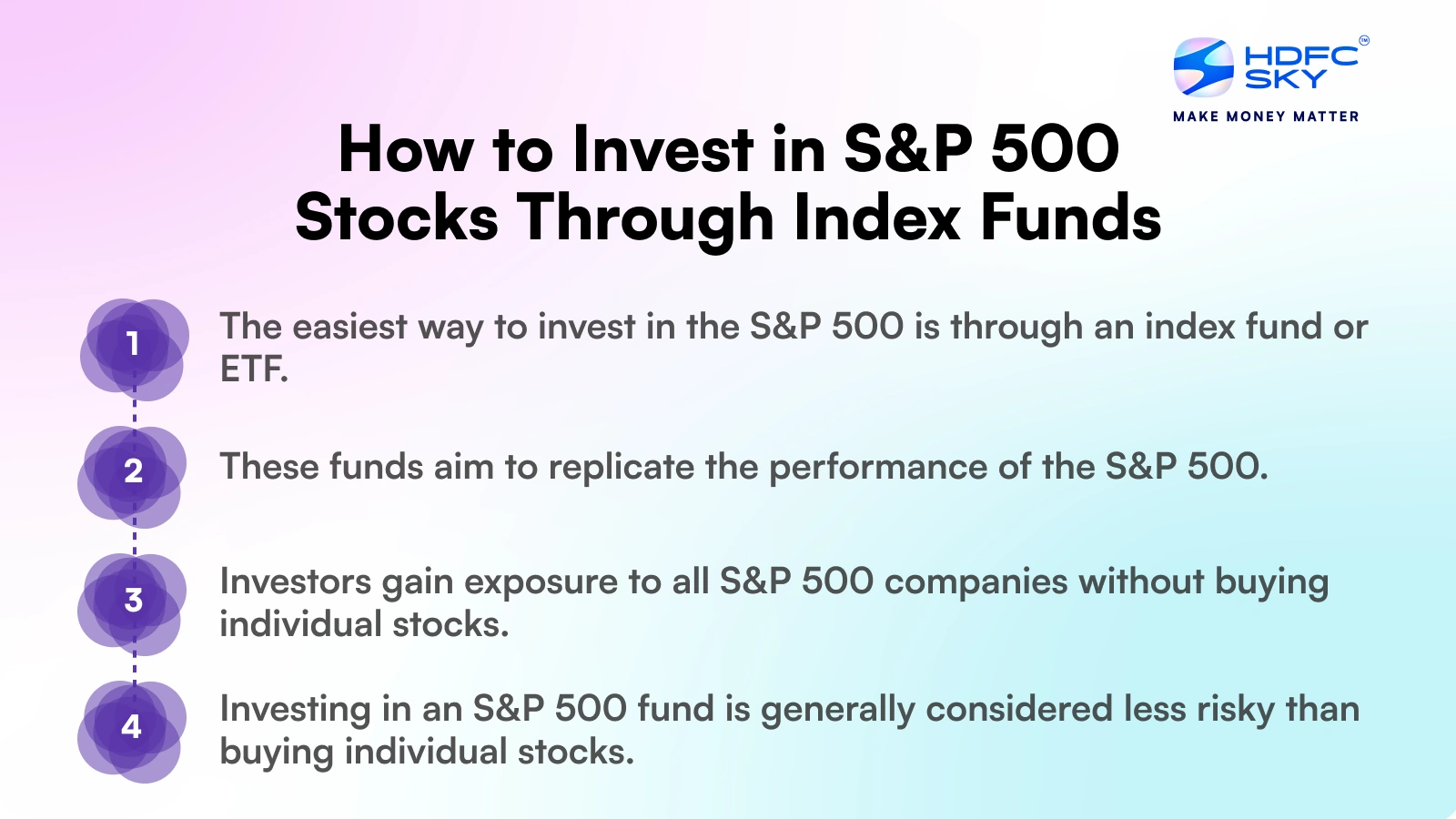
The easiest way to invest in the index is through an S&P 500 index fund or exchange-traded fund (ETF). By following the S&P 500, these funds seek to duplicate its results and provide investors with exposure to S&P 500 firms without requiring them to put in the work of buying individual stocks.
Compared to buying individual companies directly, investing in an S&P 500 fund is generally seen as less risky and may rapidly diversify your portfolio. ETFs or S&P 500 index funds mimic the performance of the S&P 500, so when that index performs well, so will your investment.
Regulations changed in April 2020, making it simpler for Indian investors to purchase S&P equities through Mirae Asset S&P 500 Top 50 ETF Fund and Motilal Oswal S&P 500 Index Fund.
Advantages of investing in the S&P 500
With a track record of 12.7% and 17.8% CAGR in rupee terms over the last five and ten years, respectively, the index outperformed all other Indian indices, which produced returns of 4-6% during the same time frame.
From 2000 to 2012, there was no monthly fall in the S&P 500 index. It bounced back from the 2000 tech crash to produce a strong return. The Vanguard S&P 500 index fund (VFIAX) had a return of 28.59% in 2003.
Purchasing an S&P 500 index fund enables inexpensive diversification. Over the long run, the S&P 500 has produced strong returns. The S&P 500 index yields a respectable return if you remain invested for an extended period of time and weather market fluctuations.
Disadvantages of investing in the S&P 500
All of the stocks in the S&P 500 are large-cap U.S. stocks. Investors frequently combine stocks with other asset classes like bonds, cash, or alternative investments, deploy funds across domestic and foreign markets, and include mid- and small-cap companies in order to attain broader portfolio diversification.
Even though S&P 500 funds have some restrictions, these are usually not as significant as those of many other investment options, especially if the funds are held for an extended period of time and are a component of a diversified portfolio.
The S&P 500 is dominated by large-cap enterprises; approximately one-third of the index is made up of the top 10 companies. This indicates that small- and mid-cap stocks, which frequently have higher growth potential, are under-represented in the index.
The S&P 500 is subject to risks like volatility and possible losses, just like any other stock investment. It might be difficult for novice investors to handle this degree of volatility.
Should you invest in an S&P 500 index fund or S&P 500 ETF?
Investors that are risk averse should choose index funds. Investing in index funds is safe and offers a more consistent return if you don’t want to deal with the hassle of routinely monitoring your mutual fund investments.
An additional benefit is that index funds are handled passively, meaning that no fund manager chooses the stocks. The fund only makes investments in stocks that are already included in the index.
In order to get a larger return from an index that produced a consistent performance, it provides inexpensive diversification in US stocks. You will be investing in top digital, financial, and core sector industries across multiple sectors because the companies featured in the S&P 500 are transnational with extensive global exposure.
For Indians, the import is getting more costly as the dollar’s value keeps rising. Even the price of education in US colleges is rising. It is expected to persist in the future, therefore investing a portion of your money in S&P 500 funds that allow you to profit in dollars provides a buffer against the value of the dollar rising.
Top 20 performers in the S&P 500 index
- Vistra Corp
- Nvidia Corp
- Axon Enterprise, Inc.
- United Airlines Holdings, Inc.
- Targa Resources Corp.
- Howmet Aerospace Inc.
- Constellation Energy Corporation
- Westrock Company
- Netflix Inc
- Royal Caribbean Group
- Fair Isaac Corporation
- Nrg Energy, Inc.
- Deckers Outdoor Corp
- Arista Networks
- Synchrony Financial
- Walmart Inc.
- Meta Platforms, Inc. Class A
- Fortinet, Inc.
- Tesla, Inc.
- Garmin Ltd
Conclusion
Indian investors now have more flexibility when it comes to investing in US stocks thanks to the launch of the NFO (new fund offer). Since the lowest investment amount is Rs 500, even small individuals can invest in the leading international corporations through S&P 500 mutual funds. But before you invest, we advise you to thoroughly assess the NFO.
Investing in the S&P 500 Index Fund opens you a world of financial possibilities. It provides a portion of the global economic superpower. People can take part in and profit from the success of the well-known American businesses included in this recognisable index by making strategic investments.
Related Articles




