- Offerings
- Tools & Platforms
Tools & Calculators
- Open API
- Calculators
- SIP Calculator
- CAGR Calculator
- Compound Interest Calculator
- FD Calculator
- RD Calculator
- EPF Calculator
- Retirement Calculator
- HDFC SIP Calculator
- Mutual Fund Return Calculator
- Lumpsum Calculator
- Step Up SIP Calculator
- ETF SIP Calculator
- Brokerage Calculator
- Equity Margin Calculator
- SWP Calculator
- EMI Calculator
- MTF Calculator
- Pricing
- SKY Learn
- Mutual Funds
- Margin Trading
- Financial Planning
- Personal Finance
- Share Trading
- IPO
- Derivatives
- Currencies
- Intraday Trading
- Trading Strategies
- Demat Account
- Commodity
- ETF
- Understanding Capital Assets and Trading Assets
- Types of Intraday Trading Income
- Tax Rules for Intraday Trades
- Intraday Trading Tax Calculation
- Old Tax Regime vs New Tax Regime for Intraday Trading
- Advanced Tax Considerations for Intraday Trades
- Conclusion
- FAQs on How Gains from Intraday Trading are Taxed?
- Understanding Capital Assets and Trading Assets
- Types of Intraday Trading Income
- Tax Rules for Intraday Trades
- Intraday Trading Tax Calculation
- Old Tax Regime vs New Tax Regime for Intraday Trading
- Advanced Tax Considerations for Intraday Trades
- Conclusion
- FAQs on How Gains from Intraday Trading are Taxed?
How Gains from Intraday Trading are Taxed?
By HDFC SKY | Published at: May 28, 2025 04:50 PM IST
Intraday trading is the practice of buying and selling financial instruments within the same trading day. It offers the potential of quick profits. However, understanding the tax implications of intraday trading is crucial for tax compliance and helps you manage your finances.
Many traders are unclear regarding how taxes on intraday trading are computed. The income tax rules on intraday trading in India are quite detailed. If you fail to comply with them, you may be penalised. It is prudent to know about intraday trading taxability beforehand. This blog will explain it all in a straightforward and simple manner.
Understanding Capital Assets and Trading Assets
The first step to understanding taxes on intraday trading is knowing if your shares are considered capital or trading assets. This distinction determines how your income will be taxed according to Indian law.
If you purchase shares mostly to keep them for the long term, seek to receive dividends, or hope they will appreciate, those shares qualify as capital assets. When selling them, the profit realised is taxed under the heading ‘Capital Gains’.
- If you have owned the shares for more than 12 months, the gain is classified as Long-Term Capital Gain (LTCG).
- If you sell within 12 months, it’s Short-Term Capital Gain (STCG).
Tax rate for Long-term gains over ₹1.25 lakh is 12.5%, and for short-term gains is 20%. These apply only if you are investing, not trading actively.
Conversely, if you buy and sell stocks regularly to earn quick money, your shares will be considered trading assets (or stock-in-trade). Your profit from this practice is referred to as business income and taxed according to your income tax slab.
If you understand this simple distinction, you’ll use the correct intraday trading tax calculation and pay taxes on intraday trading effectively without any unexpected blow from the Income Tax Department.
Types of Intraday Trading Income
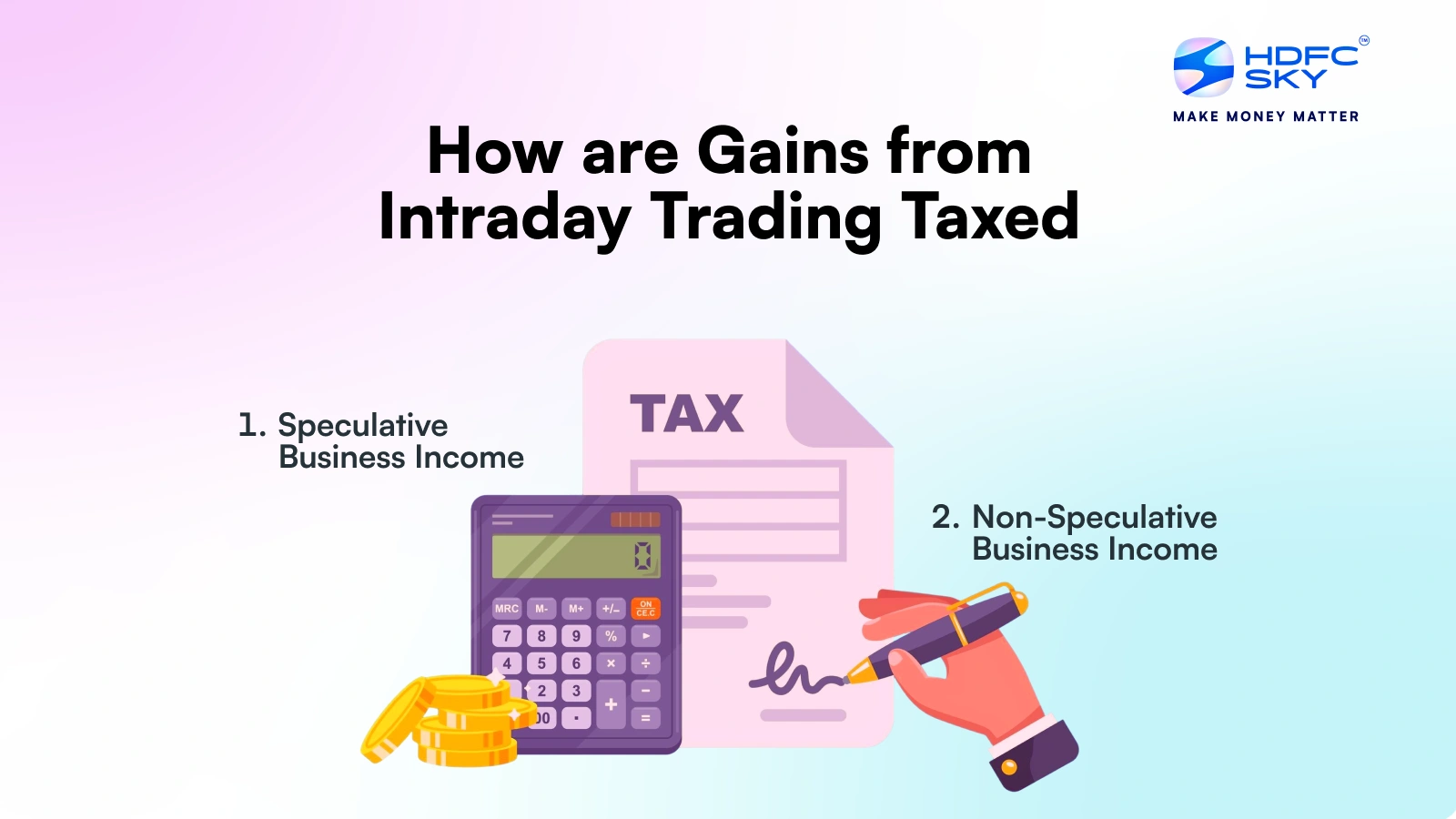
When talking about intraday trading and income tax, it’s important to know how your profits are classified. According to intraday trading taxes in India, intraday trading income is divided into the following two types:
- Speculative Business Income: In intraday share trading taxation, intraday transactions are regarded as uncertain. The gains are speculative business income, as you don’t actually receive delivery of the shares.
Taxes on intraday trading gains are levied according to your personal income tax bracket. If you incur losses on speculative transactions, you can adjust them against other speculative profits only. - Non-Speculative Business Income: All trades are not speculative. Stock delivery-based trades, futures and options contracts, commodity trades, and currency trades (where settlements occur later) are all classified under non-speculative transactions. These activities generate non-speculative business income.
In these scenarios, the tax rate on intraday trading gains also applies according to the normal income tax slab. However, losses in this case can be set off relatively easily against other business income classes.
Knowing if your gains are speculative is important for accurately determining taxes in intraday trading. Providing wrong information can invite penalties.
If you are not sure, you can always use an intraday trading tax calculator in India or consult a tax professional to report your income properly under income tax on intraday trading profit in India.
Tax Rules for Intraday Trades
It is important to know the rules for calculating taxes on intraday trading. Gains from purchasing and selling stocks without taking delivery come under the heading “”Profits and Gains from Business and Profession”” as speculative business income. This is because, for intraday transactions, you don’t keep the asset.
For filing purposes, intraday traders must use the ITR-3 form, since income is treated as business income. Along with that, you’ll need to prepare basic financial statements. Using the wrong form could cause trouble later.
As far as deadlines are concerned, if there is no requirement for a tax audit, you must submit your returns by 31st July. If there is a tax audit requirement, the deadline shifts to 31st October. Keep this in mind if you wish to avoid penalties for intraday trading tax in India.
Intraday Trading Tax Calculation
Understanding your total income is the first step in calculating taxes on intraday trading. In the old tax regime, profits from intraday trades were added to regular income since they were considered speculative business income.
So, your salary, interest income, and intraday trading profit tax all get combined to determine your final tax liability. There’s no distinct income tax rate for intraday trading. It follows the applicable income tax slab based on your total earnings.
Example:
A 32-year-old trader has:
- Salary income = ₹12 lakh
- Intraday trading income = ₹1.5 lakh
- F&O trading income = ₹2.5 lakh
- Bank interest = ₹1 lakh
First, compute total income (excluding capital gains):
Total regular income = ₹12 lakh + ₹1.5 lakh + ₹2.5 lakh + ₹1 lakh = ₹17 lakh
Now for Tax Calculation:
Regular income tax under the old tax regime slab:
| Income Slab | Tax Rate (in %) | Tax Amount |
| ₹0 – ₹2.5 lakh | 0 | ₹0 |
| ₹2.5 lakh – ₹5 lakh | 5 | ₹12,500 |
| ₹5 lakh – ₹10 lakh | 20 | ₹1 lakh |
| ₹10 lakh – ₹17 lakh | 30 | 30% of ₹7 lakh = ₹2.1 lakh |
Adding it: ₹0 + ₹12,500 + ₹1,00,000 + ₹2,10,000 = ₹3,22,500
Regular income tax under the new tax regime slab:
| Income Slab | Tax Rate (in %) | Tax Amount |
| ₹0 – ₹4 lakh | 0 | ₹0 |
| ₹4 lakh – ₹8 lakh | 5 | ₹20,000 |
| ₹8 lakh – ₹12 lakh | 10 | ₹40,000 |
| ₹12 lakh – ₹16 lakh | 15 | ₹60,000 |
| ₹16 lakh – ₹17 lakh | 20 | 20% of ₹1 lakh = ₹20,000 |
Adding it: ₹0 +₹20,000 + ₹40,000 + ₹60,000 + ₹20,0000 = ₹1,40,000
The table below shows the next steps of tax calculation under both regimes.
| Particulars | Old Regime | New Regime |
| Regular Income Tax | ₹3,22,500 | ₹1,40,000 |
| Cess (4%) | 4% 0f ₹3,22,500 = ₹12,900 | 4% of ₹1,40,000 = ₹5,600 |
| Total Tax Liability | ₹3,22,500 + ₹12,900 = ₹3,35,400 | ₹1,40,000 + ₹5,600 = ₹1,45,600 |
Thus, your taxation of intraday trading depends heavily on your overall income and the tax regime chosen. An intraday trading tax calculator in India can help you estimate your tax. Remember, taxes on intraday trading are different from capital gains taxation, and knowing the proper slab can save you from unnecessary penalties.
Old Tax Regime vs New Tax Regime for Intraday Trading
When we talk about intraday trading income tax, both the old tax regime and the new tax regime have different tax slab rates that determine how much tax you pay on your income. Here’s how they differ:
Old Tax Regime
In the old tax regime, your taxes on intraday trading are as per the following slab rates:
- Up to ₹2,50,000: No tax
- ₹2,50,001 to ₹5,00,000: 5%
- ₹5,00,001 to ₹10,00,000: 20%
- Above ₹10,00,000: 30%
In addition to these slabs, a 4% cess and any surcharge are added to the total tax. This implies that if your overall taxable income exceeds a certain level, your tax bracket may go up.
New Tax Regime
Since the new tax regime, which was altered following Budget 2025, the slabs for taxes on intraday trading have been revamped. Here’s how it goes:
- Up to ₹4,00,000: Nil
- ₹4,00,001 to ₹8,00,000: 5%
- ₹8,00,001 to ₹12,00,000: 10%
- ₹12,00,001 to ₹16,00,000: 15%
- ₹16,00,001 to ₹20,00,000: 20%
- ₹20,00,000 to ₹24,00,000: 25%
- Above ₹24,00,000: 30%
Under this regime, you don’t have the advantage of exemptions and deductions available under the old tax regime. Still, the reduced tax slabs sometimes mean a lower tax burden, depending on your income. Both tax structures apply a cess of 4% on the overall computed tax.
The decision between the two regimes depends on your tax level and whether you want to claim exemptions and deductions (old regime) or pay a basic, lower rate of tax (new regime).
Advanced Tax Considerations for Intraday Trades
For intraday traders who do not choose Presumptive Taxation, they are required to pay Advance Tax in four instalments throughout the year. The instalment schedule is as follows:
| Advance Tax | Due Date |
| 15% of the total tax due | By 15th June |
| 45% of the total tax due | By 15th September |
| 75% of the total tax due | By 15th December |
| 100% of the total tax due | By 15th March |
However, for traders opting for Presumptive Taxation, only one instalment of Advance Tax is due, which must be paid by 15th March. This makes the tax payment process simpler for those who qualify for this scheme.
Conclusion
Taxes on intraday trading are important for all traders to follow to comply with the income tax regulations for intraday trading in India. Regardless of whether you are computing your tax liability on the old or new tax regime, or paying advance tax in instalments, knowing the taxes will save you from penalties and enable you to make smart trading decisions. Always keep records of gains and losses, and avail yourself of a tax professional if necessary to facilitate easy tax filing.
Related Articles
FAQs on How Gains from Intraday Trading are Taxed?
How much are the taxes on intraday trading?
The tax in intraday trading is classified as speculative business income and taxed is levied as per the applicable income tax slab rates. The income is subject to the tax rate on intraday trading which can go up to 30%, depending on the total taxable income, along with any applicable cess and surcharge.
How can income tax be avoided on intraday trading?
It is not possible to avoid taxes on intraday trading entirely. However, traders can minimise tax liability by claiming expenses like brokerage fees and opting for the presumptive taxation scheme. Ensure you file returns correctly and on time to avoid penalties.
How to calculate intraday trading tax?
Calculating taxes on intraday trading keeps your overall speculative business income in view. It is added to other income sources and taxed as per the intraday trading income tax slab rates. Ensure you include all incomes and expenses pertaining to it, and then compute the tax based on the total income.
How much intraday income is tax-free?
Intraday trading income is not exempt from tax. Any profit earned from intraday trading is taxable under speculative business income, irrespective of the amount. The only tax-free income is below the threshold of the income tax slab, typically up to ₹2.5 lakh for individual taxpayers under the old regime and ₹4 lakh now as per the new regime.
What documents are needed for intraday trading tax filing?
For intraday trading tax filing, you will need documents like a profit and loss statement, transaction statements from brokers, the ITR-3 form, and financial statements. Ensure you keep records of your trades, expenses, and income for accurate tax filing.