- Offerings
- Tools & Platforms
Tools & Calculators
- Open API
- Calculators
- SIP Calculator
- CAGR Calculator
- Compound Interest Calculator
- FD Calculator
- RD Calculator
- EPF Calculator
- Retirement Calculator
- HDFC SIP Calculator
- Mutual Fund Return Calculator
- Lumpsum Calculator
- Step Up SIP Calculator
- ETF SIP Calculator
- Brokerage Calculator
- Equity Margin Calculator
- SWP Calculator
- EMI Calculator
- MTF Calculator
- Pricing
- SKY Learn
- Mutual Funds
- Margin Trading
- Financial Planning
- Personal Finance
- Share Trading
- IPO
- Derivatives
- Currencies
- Intraday Trading
- Trading Strategies
- Demat Account
- Commodity
- ETF
- What is the Timing for Intraday Trading in India?
- Should You Trade in the First Fifteen Minutes?
- Understanding Intraday Settlement Time
- Types of Intraday Trading Charts
- Why Are Intraday Trading Charts Important?
- Time Frames for Intraday Trading Success
- At What Time Does Intraday Trading End?
- Conclusion
- FAQs on Intraday Trading Timings in India
- What is the Timing for Intraday Trading in India?
- Should You Trade in the First Fifteen Minutes?
- Understanding Intraday Settlement Time
- Types of Intraday Trading Charts
- Why Are Intraday Trading Charts Important?
- Time Frames for Intraday Trading Success
- At What Time Does Intraday Trading End?
- Conclusion
- FAQs on Intraday Trading Timings in India
What is the Timing for Intraday Trading in India?
By HDFC SKY | Updated at: Jul 28, 2025 06:05 PM IST
Summary
- Market Hours: Intraday trading on Indian stock exchanges (NSE/BSE) is open from 9:15 AM to 3:30 PM (IST), Monday to Friday, excluding holidays.
- Pre-Open Session: From 9:00 AM to 9:15 AM, used primarily for price discovery and order matching; limited scope for traders.
- Best Time to Trade:
- First Hour (9:15 AM – 10:30 AM): High volatility; ideal for experienced traders who can capitalize on price swings.
- Mid-Session (10:30 AM – 1:30 PM): Market stabilizes; better for trend-followers and low-risk traders.
- Last Hour (2:30 PM – 3:30 PM): Re-emergence of volatility as traders square off positions.
- Key Consideration: Intraday trades must be squared off before 3:30 PM to avoid auto-execution by the broker, potentially at unfavorable prices.
- Market Strategy Insight: Time-based volatility awareness enhances decision-making and risk management for intraday traders.
Intraday trading time in India refers to the period during which traders can buy and sell stocks within the same trading day. On both NSE and BSE, this time spans from 9:15 AM to 3:30 PM, Monday to Friday, excluding public holidays. Understanding intraday trading time is crucial for planning entry and exit points, especially in a fast-moving market.
What is the Timing for Intraday Trading in India?
The intraday trading time in India aligns with the stock market’s operating hours, which are from 9:15 AM to 3:30 PM, Monday to Friday (except public holidays). During this period, traders must buy and sell securities within the same session. Intraday timing within these hours plays a critical role in determining the success of your trades.
Should You Trade in the First Fifteen Minutes?
The initial 15 minutes-from 9:15 AM to 9:30 AM-is the most volatile part of the intraday trading time in India. This period often sees unpredictable price swings as the market reacts to overnight global cues and pre-market activity.
While this may be the best time for intraday trading for experienced investors, beginners may prefer to wait for the market to stabilise.
Intraday Trading Time for Commodities
Unlike equities, intraday trading time in India for commodities extends much longer. Non-agricultural commodities like crude oil or gold can be traded from 9:00 AM to 11:55 PM, giving traders an extended time frame for intraday trading decisions.
Understanding Intraday Settlement Time
The market closes at 3:30 PM, if a trader hasn’t closed their position by then, the broker might do it at prevailing market rates, it may also result in unfavourable outcomes.
Types of Intraday Trading Charts
When it comes to intraday trading, charts act as essential tools, providing traders with a visual representation of market movements. They simplify decision-making by helping identify trends, patterns, and potential opportunities. Let’s take a closer look at the most commonly used intraday charts and their applications.
Hourly Charts
Hourly charts divide the trading day into one-hour intervals, making them ideal for traders focusing on broader trends rather than quick trades.
For instance, if a trader observes consistently higher highs and higher lows on an hourly chart, they might conclude that the stock is in an uptrend and plan trades accordingly.
5-Minute Charts
The 5-minute chart is a favourite among day traders, as it provides a detailed view of price movements during shorter intervals. It is especially useful for:
For example, if stock X shows a sudden spike in volume and price on a 5-minute chart, a trader might interpret it as a buying opportunity. and take a quick position.
Candlestick Charts
Candlestick charts are among the most popular tools for intraday traders, offering a wealth of information in a single glance. These charts are valuable for:
- Spotting Patterns: Candlestick patterns like Doji, Hammer, or Shooting Starprovide insights into potential reversals or continuations in price trends.
- Analysing Market Sentiment: The shape and colour of the candlesticks indicate whether buyers or sellers are dominating the market during the chosen timeframe.
- Identifying Breakouts and Reversals: Candlestick charts highlight points where prices break through resistance levels or reverse after hitting support.
For instance, if a bullish engulfing pattern forms on a candlestick chart, traders might anticipate a potential upward movement.
Why Are Intraday Trading Charts Important?
Intraday charts provide visual insights into stock movements, helping traders:
- Identify entry and exit points,
- Understand price trends,
- Anticipate market sentiment based on patterns like bullish or bearish signals.
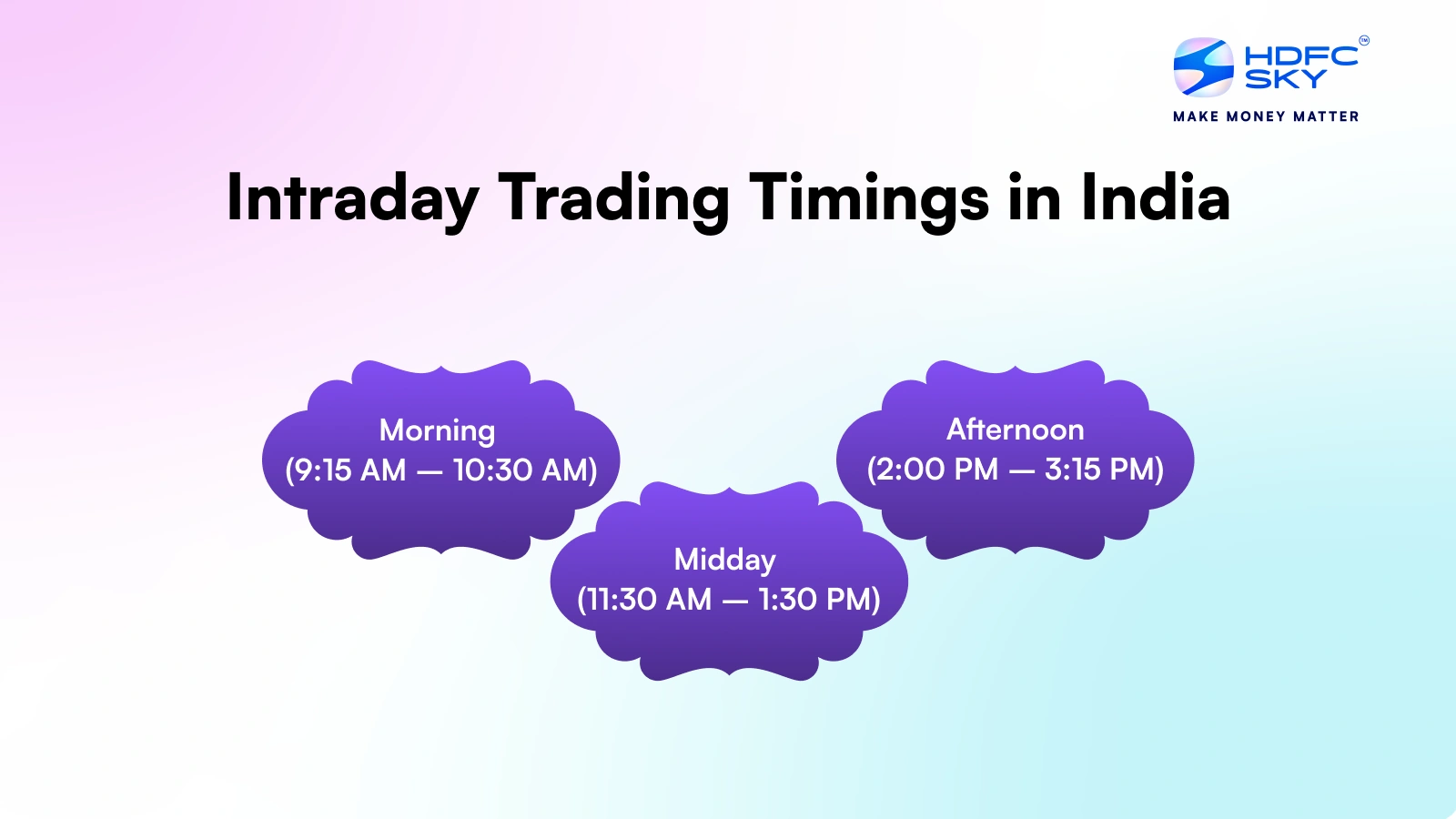
Time Frames for Intraday Trading Success
Different times during the trading session serve various purposes:
- Morning (9:15 AM – 10:30 AM): High volatility may makes it suitable for momentum trading.
- Midday (11:30 AM – 1:30 PM): Prices stabilise, potentially offering opportunities for trend-following strategies.
- Afternoon (2:00 PM – 3:15 PM): Traders typically focus on identifying end-of-day trends for quick profits.
At What Time Does Intraday Trading End?
In India, intraday trading closing time is 3:30 PM, but most brokers initiate square-off procedures by 3:15 PM. So, if you’re wondering “at what time intraday trading ends”, plan to exit your positions by 3:15 PM to avoid unexpected charges or unfavourable prices
Conclusion
Mastering intraday trading time and knowing which time frame is best for intraday trading helps you make better decisions. Always stay updated with intraday trading time in India, square off before the intraday trading closing time, and choose trading windows based on your strategy and experience level.
Related Articles
FAQs on Intraday Trading Timings in India
What is intraday trading time in India?
Intraday trading in India occurs between 9:15 AM and 3:30 PM, Monday to Friday. All trades must be closed within this window, as positions cannot be carried forward to the next session.
What is the intraday closing time?
The intraday trading closing time is 3:30 PM, but brokers often auto-square off positions between 3:15 PM and 3:20 PM to manage risks.
How do you select stocks for intraday trading?
Select stocks with high liquidity and price movement. Use tools like technical charts to analyse trends and ensure the stock aligns with your trading strategy.
How important is timing in intraday trading?
Intraday market timing is crucial as it helps traders align their strategies with market behaviour. For example, the morning session from 9:15 AM to 10:30 AM is highly volatile, while midday offers stability. Choosing the right timing can significantly impact trade outcomes.
What is the timing of intraday trading in India?
The timing of intraday trading in India is from 9:15 AM to 3:30 PM. All intraday trades must be squared off before the market closes, ensuring no open positions are carried forward to the next day.
How should beginners approach intraday trading stock selection?
Intraday trading stock selection for beginners should focus on:
- Liquidity: Choose stocks with high trading volumes.
- Volatility: Opt for stocks with significant price movements.
- Sector Trends: Align stock picks with positive industry trends to increase success probability.