
- Offerings
- Tools & Platforms
Tools & Calculators
- Open API
- Calculators
- SIP Calculator
- CAGR Calculator
- Compound Interest Calculator
- FD Calculator
- RD Calculator
- EPF Calculator
- Retirement Calculator
- HDFC SIP Calculator
- Mutual Fund Return Calculator
- Lumpsum Calculator
- Step Up SIP Calculator
- ETF SIP Calculator
- Brokerage Calculator
- Equity Margin Calculator
- SWP Calculator
- EMI Calculator
- MTF Calculator
- Pricing
- SKY Learn
- Mutual Funds
- Margin Trading
- Financial Planning
- Personal Finance
- Share Trading
- IPO
- Derivatives
- Currencies
- Intraday Trading
- Trading Strategies
- Demat Account
- Commodity
- ETF
What is LTP in Share Market & the Effect of LTP on Stock Prices?
By Shishta Dutta | Updated at: Sep 30, 2025 06:35 PM IST
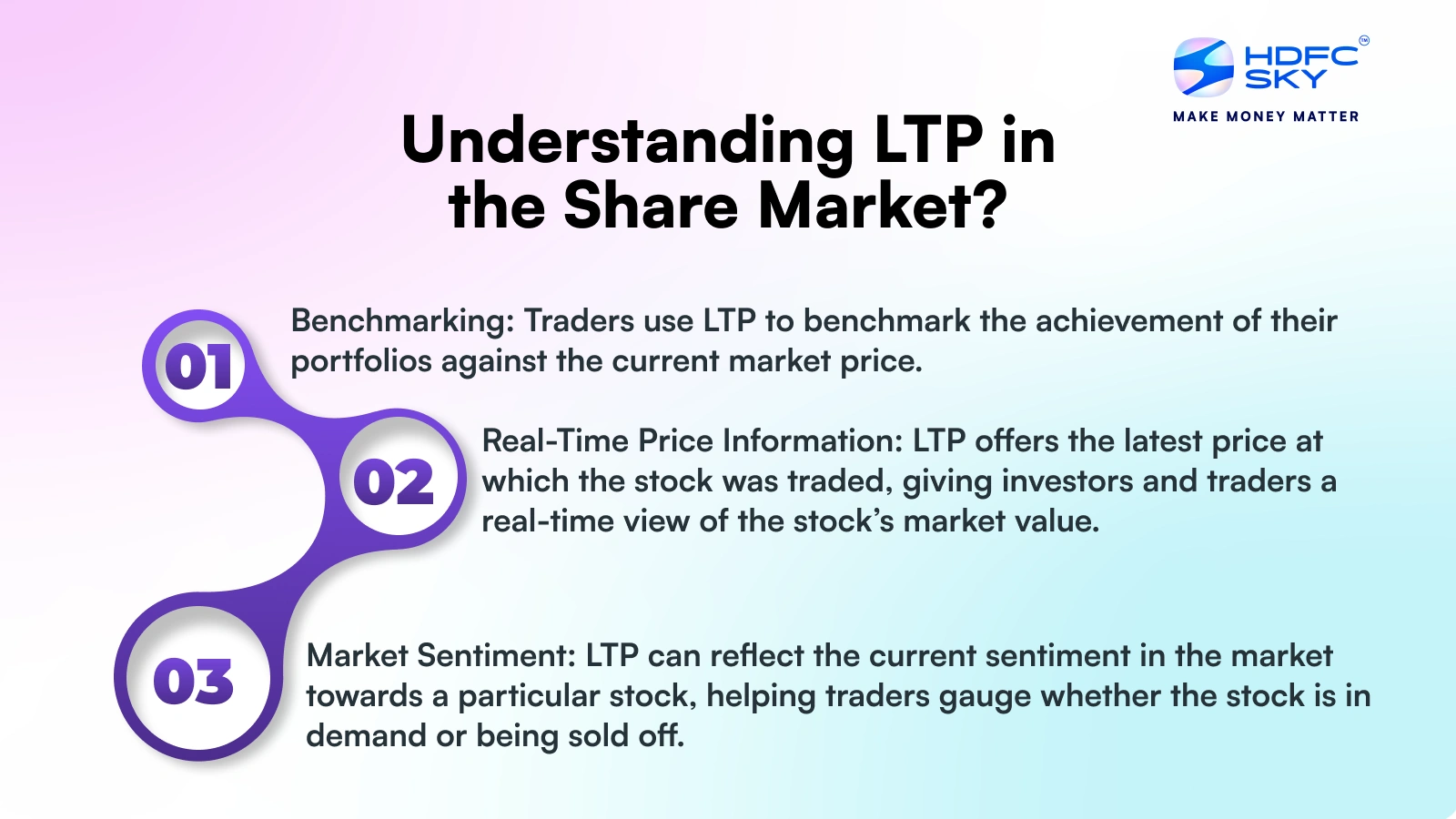
LTP or Last Traded Price refers to the most recent price at which a stock was bought or sold on the stock exchange. It constantly updates during market hours, reflecting real-time price movement based on supply and demand. LTP is a key metric for traders and investors to assess current stock value and make informed trading decisions
What is LTP in Share Market?
LTP full form is Last Traded Price. The LTP meaning in the share market refers to the most recent price at which a particular stock was bought or sold on the stock exchange. It is a real-time figure that updates with every trade, reflecting the current market value of the stock. LTP is important for traders and investors because it shows the price at which the latest transaction occurred, helping them assess market trends, price movements and trading opportunities. However LTP alone doesn’t show the overall demand or volume and should be considered with other indicators for better analysis.
Importance of LTP (Last Traded Price)
LTP shows the most recent transaction price of a stock, giving real-time insight into market activity. It is crucial for making timely trading decisions.
- Real-Time Price Indicator: LTP reflects the most recent transaction price, giving traders instant insight into a stock’s current market value.
- Helps in Decision-Making: Investors use LTP to place buy/sell orders and compare it with their target or stop-loss levels.
- Market Sentiment Gauge: Frequent changes in LTP indicate investor sentiment, demand and price momentum.
- Valuation Comparison: LTP can be compared with intrinsic value or book value to assess if a stock is overvalued or undervalued.
What is the Effect of LTP on Stock Prices?
LTP directly impacts stock prices and market perceptions in the following ways:
- Price Movement: Frequent updates in LTP can indicate a bullish or bearish trend in a stock’s price. If the LTP is consistently moving upwards, it suggests that the stock price is appreciating.
- Trading Decisions: Traders often use LTP to make quick trading decisions. For example a sudden spike in LTP might prompt a buy order.
- Market Volatility: Rapid changes in LTP can contribute to market volatility, affecting stock prices significantly within short time frames.
- Investor Behavior: Investors watch LTP to determine entry and exit points in their investments, influencing the stock’s demand and supply dynamics.
How is Trading Volume Used in Determining the LTP?
Trading volume plays a crucial role in confirming the LTP (Last Traded Price). While LTP shows the most recent price of a trade, volume indicates how significant or reliable that price move is.
- Higher Volume = Stronger LTP Validity: If LTP changes with high volume, it suggests strong market consensus and reliability.
- Low Volume = Weaker Signals: LTP changes on low volume may not reflect true market direction and can be misleading.
- Confirms Price Trends: Rising LTP with rising volume signals strength; falling LTP with rising volume may indicate selling pressure.
- Filters Noise: Volume helps distinguish between meaningful LTP changes and random price movements.
Why LTP is Important in Stock Market
LTP (Last Traded Price) is crucial in the stock market because it reflects the most recent price at which a stock was bought or sold. It helps investors and traders make real-time decisions.
- Real-Time Market Value: Shows the current trading price of a stock.
- Affects Order Placement: Guides where to place buy/sell orders.
- Indicates Market Sentiment: Rising or falling LTP signals bullish or bearish trends.
- Essential for Intraday Trading: Intraday traders rely heavily on LTP for timing trades.
- Used in Technical Analysis: LTP forms the basis for price charts and indicators.
In short LTP is the heartbeat of market activity, helping track stock performance moment by moment.
Difference Between Closing Price and Last Traded Price
LTP reflects the most recent transaction price and changes throughout the day, while the closing price is a more stable average used after trading hours for valuation purposes.
| Aspect | Last Traded Price (LTP) | Closing Price |
| Meaning | The price at which the most recent trade took place | The average of the stock’s prices during the last 30 minutes of trading |
| Timing | Updates constantly during market hours | Finalised after market closes |
| Fluctuation | Changes with every trade | Remains fixed after calculation |
| Use Case | Used for real-time trading decisions | Used for portfolio valuation and end-of-day reporting |
| Volatility Impact | Highly sensitive to short-term movements | Smoother, less affected by one-off trades |
Conclusion
The Last Traded Price (LTP) is an important metric in the share market offering real-time insights into a stock’s value. By understanding its importance, how it affects stock prices and the role of trading volume in determining LTP investors can make more informed decisions. Additionally distinguishing between the closing price and LTP can enhance your market analysis and trading strategies.
Disclaimer : This article is only for educational purposes. It does not make any recommendation to act.
Related Articles
FAQs
Is a higher LTP always better?
Not always. A higher LTP means the stock price is up, but it doesn’t guarantee better value. Investors should consider fundamentals and market trends too.
What is LTP risk?
LTP risk refers to the potential loss investors face due to sudden changes in the Last Traded Price of a stock, impacting the value of their investments.
What is limit order?
An limit order is a type of order where the trader specifies the highest price at which they are willing to buy or the lowest price at which they are ready to sell a stock, based on the LTP. This helps in controlling the price at which the trade is executed.
What is ATP and LTP in the share market?
ATP stands for Average Traded Price, which is the average price at which a stock has traded over a particular period. LTP is the Last Traded Price. Both metrics are used to analyse stock performance, but LTP gives the most recent transaction price, while ATP provides an average price over time.
What is meant by LTP in the stock market?
LTP in the stock market refers to the price at which the last transaction of a stock was executed. It is a real-time indicator of the stock’s market value at the most recent trade.




