- Offerings
- Tools & Platforms
Tools & Calculators
- Open API
- Calculators
- SIP Calculator
- CAGR Calculator
- Compound Interest Calculator
- FD Calculator
- RD Calculator
- EPF Calculator
- Retirement Calculator
- HDFC SIP Calculator
- Mutual Fund Return Calculator
- Lumpsum Calculator
- Step Up SIP Calculator
- ETF SIP Calculator
- Brokerage Calculator
- Equity Margin Calculator
- SWP Calculator
- EMI Calculator
- MTF Calculator
- Pricing
- SKY Learn
- Mutual Funds
- Margin Trading
- Financial Planning
- Personal Finance
- Share Trading
- IPO
- Derivatives
- Currencies
- Intraday Trading
- Trading Strategies
- Demat Account
- Commodity
- ETF
- What is Moving Average in Stock Market
- How to Calculate Moving Average
- Moving Average Formula
- Importance of Moving Average Method
- Different Types of Moving Averages
- Advantages of Moving Average Method
- Disadvantages of Moving Average Method
- Difference Between Simple Moving Average (SMA) vs Exponential Moving Average (EMA)
- How to Use Moving Averages in Trading
- Conclusion
- FAQs
- What is Moving Average in Stock Market
- How to Calculate Moving Average
- Moving Average Formula
- Importance of Moving Average Method
- Different Types of Moving Averages
- Advantages of Moving Average Method
- Disadvantages of Moving Average Method
- Difference Between Simple Moving Average (SMA) vs Exponential Moving Average (EMA)
- How to Use Moving Averages in Trading
- Conclusion
- FAQs
What is Moving Average in Stock Market? Meaning, Types & Formula
By HDFC SKY | Updated at: Oct 8, 2025 07:49 PM IST
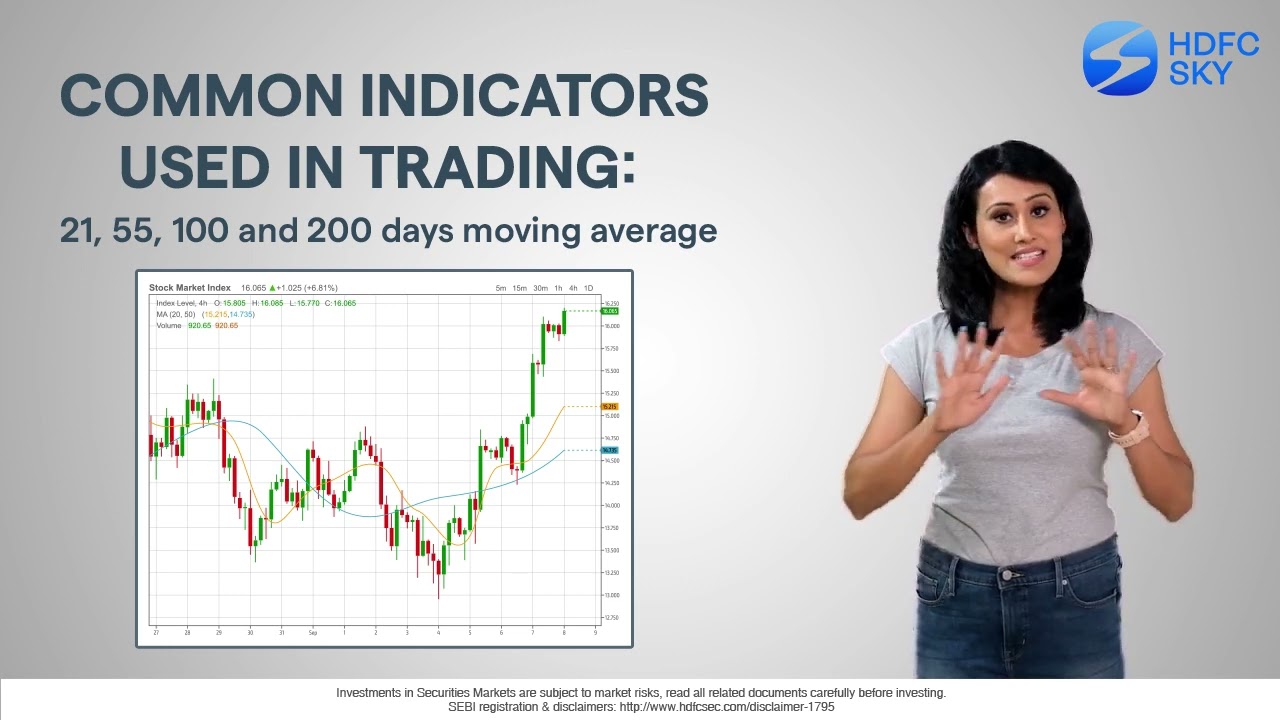
A Moving Average is a popular technical indicator used in the stock market to analyse and smooth out price trends over a specific period. It helps traders and investors filter out short-term price fluctuations making it easier to identify the overall direction of a stock or index. Moving averages are essential tools in trend analysis and are widely used in both short-term trading and long-term investing strategies.
What is Moving Average in Stock Market
Moving average meaning in the stock market refers to a widely used technical analysis tool that helps smooth out price data over a specific time frame to identify trends. It calculates the average price of a stock over a set number of periods (like 10, 50 or 200 days) updating continuously as new data becomes available. This helps investors understand the direction of the market or a particular stock by filtering out short-term volatility. Moving averages are commonly used to spot trend reversals, support/resistance levels and generate buy/sell signals.
How to Calculate Moving Average
The Moving Average (MA) is calculated by adding the closing prices of a stock over a specific number of days and dividing the sum by that number of days.
Formula:
Simple Moving Average (SMA) = (P1 + P2 + … + Pn) / n
Where:
- P1, P2…Pn = Closing prices for n number of days
- n = Total number of periods (days)
Example:
To calculate a 5-day SMA
If the closing prices for the last 5 days are:
₹100, ₹102, ₹104, ₹101, ₹103
SMA = (100 + 102 + 104 + 101 + 103) / 5 = 510 / 5 = ₹102
You can also calculate Exponential Moving Average (EMA) which gives more weight to recent prices but it’s more complex and uses a smoothing factor.
Moving Average Formula
The formula for a Simple Moving Average (SMA) is:
SMA = (Sum of closing prices over n periods) / n
Where:
- n = number of periods
- Closing prices = prices at the end of each period
- For example: A 5-day SMA sums the closing prices of the last 5 days and divides by 5.
For Exponential Moving Average (EMA) the formula gives more weight to recent prices:
EMA_today = (Price_today × Multiplier) + (EMA_yesterday × (1 – Multiplier))
Where:
- Multiplier = 2 / (n + 1)
- n = number of periods
EMA reacts faster to recent price changes compared to SMA.
Importance of Moving Average Method
The moving average method helps traders and investors identify trends by smoothing out price fluctuations over time. It reduces market noise and aids in making informed decisions.
- Highlights the overall market direction (trend-following tool)
- Helps identify support and resistance levels
- Useful for generating buy/sell signals through crossovers
- Minimises impact of short-term volatility
- Enhances clarity in price movement analysis
Different Types of Moving Averages
Moving averages help smooth out price data to identify trends. Here are the main types:
- Simple Moving Average (SMA)
- It’s the average of closing prices over a specific period.
- Example: 10-day SMA = sum of last 10 days’ prices ÷ 10
- Exponential Moving Average (EMA)
- Gives more weight to recent prices.
- Reacts faster to price changes than SMA.
- Weighted Moving Average (WMA)
- Assigns different weights to prices, with recent prices getting higher weight.
- More responsive than SMA but less than EMA.
Advantages of Moving Average Method
The moving average method simplifies complex price data, making trend identification easier for traders and investors.
- Smooths out short-term price fluctuations to reveal longer-term trends.
- Helps identify trend direction and potential reversal points.
- Simple to calculate and easy to understand for all traders.
- Customisable for different time frames (short-term or long-term).
- Reduces market noise, making analysis clearer.
- Provides useful entry and exit signals for trading decisions.
- Can be combined with other indicators to improve accuracy.
- Supports effective risk management and timing of trades.
Disadvantages of Moving Average Method
While useful moving averages often lag behind current market prices and can generate false signals, especially in volatile or sideways markets. Traders should use them with other tools for confirmation.
- Lags behind real-time price movements, causing delayed responses.
- Prone to false signals during periods of low volatility or sideways trends.
- May not perform well in sudden market reversals or sharp price changes.
- Different moving average periods can produce conflicting signals.
- Relies solely on past data, which may not always predict future trends accurately.
Difference Between Simple Moving Average (SMA) vs Exponential Moving Average (EMA)
Both SMA and EMA are popular moving average methods used in technical analysis to smooth price data but they differ in how they weight recent prices. Understanding their differences helps traders choose the right tool for market analysis.
| Feature | Simple Moving Average (SMA) | Exponential Moving Average (EMA) |
| Calculation | Average of closing prices over a specific period | Weighted average giving more importance to recent prices |
| Sensitivity | Less sensitive to recent price changes | More sensitive to recent price changes |
| Lag | Higher lag due to equal weighting | Lower lag due to exponential weighting |
| Use | Better for identifying long-term trends | Better for short-term trading and signals |
| Complexity | Easier to calculate | More complex calculation |
| Response to Market Changes | Slower to react | Faster to react |
How to Use Moving Averages in Trading
Moving averages help traders identify trends and potential entry or exit points. By smoothing price data, they filter out noise and reveal the market direction.
- Trend Identification: If price stays above the moving average, it signals an uptrend; below indicates a downtrend.
- Support & Resistance: Moving averages can act as dynamic support or resistance levels.
- Crossovers: When a short-term moving average crosses above a long-term one (golden cross), it signals a buy; the opposite (death cross) signals a sell.
- Confirmation: Used with other indicators to confirm signals and reduce false trades.
This method helps traders make informed decisions based on market momentum and trend strength.
Conclusion
The Moving Average is a simple yet powerful tool in technical analysis that helps traders and investors understand market trends more clearly. By smoothing out short-term price fluctuations, it highlights the overall direction of a stock or index. Whether using a Simple Moving Average (SMA) or an Exponential Moving Average (EMA), this indicator provides valuable insights into potential entry and exit points, support and resistance levels, and trend reversals. However since it is based on past data, it should be used alongside other indicators for more accurate trading decisions.
Related Articles
FAQs
How are moving averages analysed?
Moving averages are analysed by observing price crossovers, trend directions, and comparing different MAs (like 50-day vs 200-day) to identify buy/sell signals and market trends.
Which is better, the EMA or the SMA?
EMA reacts faster to recent price changes, making it better for short-term trading, while SMA gives equal weight to all data, suitable for long-term trends.
What is the purpose of moving average?
To smooth out price data, identify trends, and help traders make better buy or sell decisions by reducing market noise.
How to calculate moving average?
Add the closing prices of a set number of periods and divide by that number. For SMA, all prices are equally weighted.