- Offerings
- Tools & Platforms
Tools & Calculators
- Open API
- Calculators
- SIP Calculator
- CAGR Calculator
- Compound Interest Calculator
- FD Calculator
- RD Calculator
- EPF Calculator
- Retirement Calculator
- HDFC SIP Calculator
- Mutual Fund Return Calculator
- Lumpsum Calculator
- Step Up SIP Calculator
- ETF SIP Calculator
- Brokerage Calculator
- Equity Margin Calculator
- SWP Calculator
- EMI Calculator
- MTF Calculator
- Pricing
- SKY Learn
- Mutual Funds
- Margin Trading
- Financial Planning
- Personal Finance
- Share Trading
- IPO
- Derivatives
- Currencies
- Intraday Trading
- Trading Strategies
- Demat Account
- Commodity
- ETF
Mutual Fund Cut Off Time and Its Impact on Net Asset Value
By HDFC SKY | Published at: May 29, 2025 02:05 PM IST
Mutual funds are one of the most popular investment instruments in India. When you transact – buy or sell units – the price you get is based on the fund’s Net Asset Value (NAV). But have you ever wondered which day’s NAV applies to your transaction?
The answer lies in the Mutual fund cut off time. This seemingly simple timing rule is critically important as it determines the NAV you receive, which can directly impact your investment returns, especially in volatile markets. Many investors overlook how crucial the nav cut off time is, but understanding it can help you make more informed transaction decisions.
This article explains what the cut off time for mutual fund investments is, its impact on Nav in mutual fund applicability, the timings in India, and why it matters.
What is Mutual Fund Cut Off Time?
The cut off time for mutual fund is the time by which you have to submit your purchase or sell order in order to receive the NAV (Net Asset Value) of the same day. If your
transaction has been submitted prior to the mutual fund cut off time and the money is realised in the bank account of the fund in a timely manner, you’ll receive that day’s NAV. If not, you’ll receive the fund value valid on the next business day.
The cut-off time for purchase of a mutual fund is commonly 3:00 p.m. for the majority of schemes. For overnight and liquid funds, the deadline to submit purchase requests is set earlier at 1:30 p.m. Cut-off for redemption is 3:00 p.m. for all.
Since February 1, 2021, SEBI has implemented a rule which states: mere payment before the mutual fund cut off time is not sufficient. The money needs to reach the account of the mutual fund prior to the NAV cut off time to receive that day’s fund value.
Example:
Suppose you invest in an equity mutual fund on Monday at 2:45 PM. That is prior to the 3:00 PM cut-off. However, your bank is slow, and the money arrives in the mutual fund’s account at 4:30 PM. Though you paid before 3 PM, the AMC did not get the money within the deadline period.
Consequence? You will not receive Monday’s NAV. You will receive Tuesday’s NAV, the business day that comes after it. Therefore, the most important aspect is not only when you pay, but when the AMC receives your funds.
Why is Mutual Fund Cut Off Time Important?
Being aware of the cut off time for mutual fund NAV allows you to make prompt investment and redemption decisions aligned with your investment goals and market scenarios.
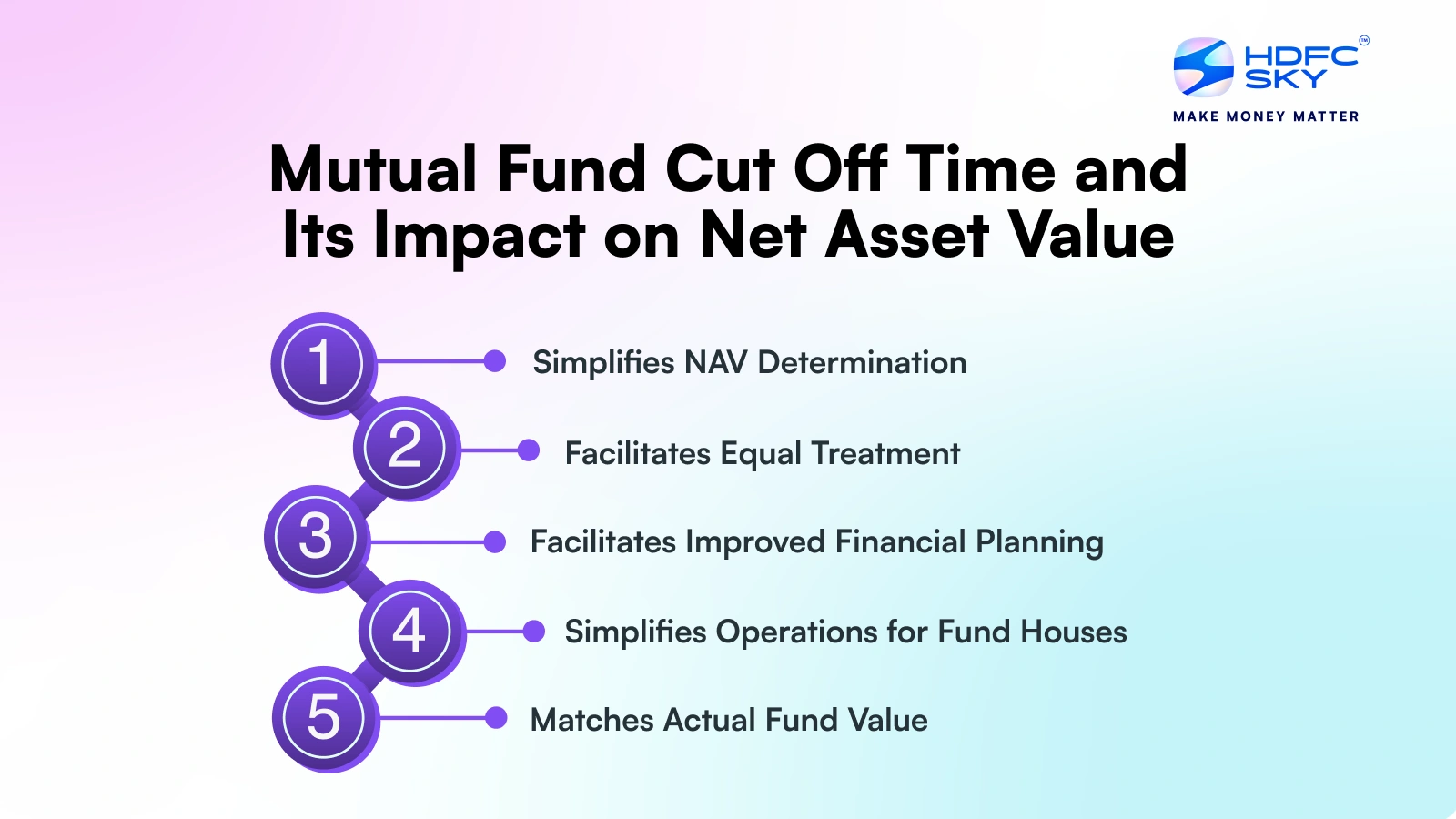
- Simplifies NAV Determination: The threshold time determines which day’s NAV to apply. If your funds arrive at the AMC ahead of the cut-off (3 PM is usual), you will receive the current-day NAV. Otherwise, the subsequent working day’s NAV will be used.
- Facilitates Equal Treatment: All who invest or redeem in the same window receive the same NAV. Such standardisation ensures the process is transparent and even for all investors.
- Facilitates Improved Financial Planning: You can plan redemptions or purchases, if you have one in mind, particularly when you’re planning a specific NAV or date for the transactions.
- Simplifies Operations for Fund Houses: Fixed cut-off time makes it easier for mutual fund houses to manage daily flows more efficiently and maintain smooth fund management.
- Matches Actual Fund Value: In line with SEBI guidelines, NAV is now implemented only after the AMC receives your money in reality, prior to the cut-off. Your transaction is thus executed on the basis of actual fund availability.
Mutual Fund Cut Off Time in India
In India, the mutual fund cut off time is governed by SEBI and depends on the nature of the fund and transaction—let’s dissect it section by section.
SEBI New Guidelines for Mutual Fund Cut off Time
SEBI regulation, which came into effect from February 1, 2021, states that for receiving the same day’s NAV, both your payment and your transaction should reach before the cut off time for mutual fund. Initiation of the payment is not sufficient. The amount should be credited to the bank account of the mutual fund before the NAV cut off time. This is applicable to all kinds of purchases, irrespective of the amount.
How Does Mutual Fund Cut Off Time Work?
Each trading day, mutual fund NAVs are announced after the market closes. Therefore, SEBI has set a particular NAV cut off time to determine on which day’s NAV an investor will receive. Let’s have a quick glance at cut-off timings and redemption rules:
| Type of Schemes | Transaction Type | Cut-Off Time |
| Liquid & Overnight Funds | Purchase (incl. Switch-in) | 1:30 PM |
| Redemption (including Switch-out) | 3:00 PM | |
| All Other Schemes (such as Equity, Debt) | Purchase (including Switch-in) | 3:00 PM |
| Redemption (including Switch-out) | 3:00 PM |
How Cut Off Time for Equity Mutual Fund work?
For equity mutual funds, the deadline for purchase is 3:00 PM. If you invest prior to 3 PM and your amount enters the fund house before that, you receive the NAV of that particular day. If the money arrives later, you will receive the subsequent day’s net fund value. Timing is critical, particularly in times of market fluctuations. Ensure to check with your investment partner for the cut-off timings followed by their platform.
Redemption Processing Time
The duration for you to get your money after redeeming a mutual fund varies based on the scheme type. Liquid and overnight funds are dispatched within one working day. Debt funds (excluding liquid and overnight) can take around two business days, while equity-oriented funds typically take three. These durations use the T+ format, where ‘T’ is the date when you make your redemption request. For example, if you redeem your equity mutual fund units on a Monday, you would generally see the money in your account by Thursday. Bank holidays or weekends may further slow down the payment process. Knowing the mutual fund NAV cut off time enables you to make wiser and better-timed investment choices.
Trivia Time:SEBI has suggested very recently on lengthening the mutual fund redemption cut off time for overnight funds to 7:00 PM. The thought is to assist investors in managing liquidity better and minimising overnight idle time. While not a done deal, this step may offer greater flexibility to investors requiring same-day redemption.
Understanding Net Asset Value (NAV) in Mutual Funds
We have been continuously using the term NAV. But, do you know how to calculate net asset value in a company?
NAV, or Net Asset Value, informs you about the cost of one mutual fund share. It is calculated once the market closes for the day. Mutual funds put money into a combination of assets such as stocks, bonds, and cash. The NAV fluctuates from day to day, based on how those investments do.
The net asset value formula is:
NAV = (Total Assets – Total Liabilities) ÷ Number of Outstanding Units
Suppose an Indian mutual fund is invested in stocks worth ₹500 crore, in bonds worth ₹300 crore, and in cash worth ₹50 crore. This means it has a total assets value of ₹850 crore. If total debt is ₹100 crore and its complete units are 3.75 crore, then NAV calculation is:
NAV = (₹850 – ₹100) / 3.75 = ₹750 / 3.75 = ₹200 per unit
Thus, if you invest now, you’ll purchase at ₹200 a unit (after excluding any fees). NAV allows you to monitor the worth of your investment and plays a crucial role in mutual fund transactions.
Impact of Mutual Fund Cut Off Time on Net Asset Value
The mutual fund cut off time immediately affects the NAV used for your transaction. The rules of SEBI ensure that both the transaction submission and realisation of the fund need to take place prior to the cut-off for same-day NAV to apply. Let’s see how NAV is used for various cases:
-
Purchase or SIP Transactions
| Condition Applicable | NAV |
| Transaction and money received prior to cut-off (3 PM for most funds) | Same working day NAV |
| Transaction prior to cut-off, money obtained after cut-off | NAV of the business day when money is obtained prior to cut-off |
| Money obtained prior to cut-off; transaction finished after cut-off | NAV of business day when transaction is done- prior to cut-off |
-
Switch Between Schemes
| Type | NAV Applied |
| Switch-out submitted prior to cut-off | Same business day NAV |
| Switch-in happens when funds are received before cut-off | NAV of the day funds will be credited to the new scheme |
This NAV cut off time is important because NAV is only calculated once a day, based on the aggregate value of a fund’s holdings after the close of markets, less liabilities. A brief delay can result in receiving another price. Knowing this allows you to you’re your trade more successfully and prevent surprises.
Conclusion
Knowing the mutual fund cut off time assists you in making good investment choices. Understanding these timings, the fund realization rule, and the Net asset value formula’s components helps investors transact efficiently, manage expectations, and potentially optimise their entry or exit points. A slight timing mistake may affect the NAV you receive. To keep yourself on track, follow your investment platform’s NAV cut off time guidelines and consult a financial advisor in case you are not certain about the procedure.
Related Articles
FAQs on Mutual Fund Cut Off Time
What does NAV mean in mutual funds?
Net Asset Value (NAV) represents the price assigned to a unit under the mutual fund. It’s what you pay to purchase or what you get when selling a fund unit. Similar to a company’s net worth, it’s the fund’s liabilities reduced from total assets, divided by units outstanding.
How do you determine the net asset value of a mutual fund?
You can check the daily NAV on the website of the respective Asset Management Company (AMC), the AMFI India website (amfiindia.com), major financial news portals, or your mutual fund investment app/platform (like HDFC Sky). NAVs are usually updated in the evening after market close.
What is the formula for NAV calculation?
The Net asset value formula is: NAV = (Total Assets – Total Liabilities) / Total Outstanding Units
What makes the deadline important for ELSS fund transactions?
Cut-off time, i.e. deadline specifies on which working day’s NAV your ELSS investment will be considered. Missing it will see your transaction done using the following business day’s NAV, which can be different based on market fluctuations. For large investments, this difference in NAV could have a noticeable effect on returns.
How to calculate net asset value of mutual fund with bonds?
Sum up the market value of all bonds and other assets as of the date, deduct liabilities, and then divide by the number of units to arrive at the NAV.
What is unique about net asset value compared to valuation?
Net Asset Value (NAV) provides a clean, up-to-date picture of the single investment unit of a mutual fund based on its current market value of assets less liabilities. In contrast with wider company valuations that might include future earnings potential or intangible assets, NAV only considers current, tangible asset values.