- Offerings
- Tools & Platforms
Tools & Calculators
- Open API
- Calculators
- SIP Calculator
- CAGR Calculator
- Compound Interest Calculator
- FD Calculator
- RD Calculator
- EPF Calculator
- Retirement Calculator
- HDFC SIP Calculator
- Mutual Fund Return Calculator
- Lumpsum Calculator
- Step Up SIP Calculator
- ETF SIP Calculator
- Brokerage Calculator
- Equity Margin Calculator
- SWP Calculator
- EMI Calculator
- MTF Calculator
- Pricing
- SKY Learn
- Mutual Funds
- Margin Trading
- Financial Planning
- Personal Finance
- Share Trading
- IPO
- Derivatives
- Currencies
- Intraday Trading
- Trading Strategies
- Demat Account
- Commodity
- ETF
- What is NSE?
- How Does the NSE Operate?
- Core Functions of NSE
- Features of NSE
- Market Segments of the National Stock Exchange
- Benchmark Index of the NSE
- Major Indices Traded on NSE
- Benefits of Listing with the National Stock Exchange of India
- 10 Companies on NSE by Market Capitalisation
- Conclusion
- FAQs on What is National Stock Exchange?
- What is NSE?
- How Does the NSE Operate?
- Core Functions of NSE
- Features of NSE
- Market Segments of the National Stock Exchange
- Benchmark Index of the NSE
- Major Indices Traded on NSE
- Benefits of Listing with the National Stock Exchange of India
- 10 Companies on NSE by Market Capitalisation
- Conclusion
- FAQs on What is National Stock Exchange?
What is NSE (National Stock Exchange)? Features, Meaning & Function
By Ankur Chandra | Updated at: Oct 23, 2025 06:42 PM IST
Summary
- Overview: The article provides a detailed introduction to the National Stock Exchange (NSE) of India, highlighting its history, purpose, and major contributions to the Indian financial ecosystem.
- Establishment & Evolution:
- NSE was founded in 1992 and commenced operations in 1994.
- It introduced electronic trading systems in India, replacing the traditional open outcry method.
- Key Objectives:
- Improve transparency, efficiency, and investor accessibility.
- Provide a fully automated screen-based trading platform nationwide.
- Market Segments:
- Includes Equities, Equity Derivatives, Debt, Currency Derivatives, and Mutual Funds.
- Notable indices: NIFTY 50 and sector-specific indices used as market benchmarks.
- Technological Advancements:
- NSE has consistently upgraded its trading infrastructure for high-speed, high-frequency trading.
- It pioneered online trading for retail investors in India.
- Regulation & Compliance:
- Regulated by SEBI (Securities and Exchange Board of India).
- Ensures robust risk management, surveillance, and investor protection mechanisms.
- Investor Education:
- Offers resources and courses to educate retail investors and promote financial literacy.
The NSE full form is National Stock Exchange of India, one of the largest and most advanced stock exchanges in the country. Established to bring transparency and efficiency to the financial markets, NSE offers a fully automated electronic trading platform for equities, derivatives, and debt instruments. It plays a crucial role in shaping India’s capital markets by providing a reliable and transparent marketplace for investors and companies alike.
What is NSE?
NSE meaning refers to the National Stock Exchange of India, a leading stock exchange that provides a transparent and efficient platform for trading stocks, derivatives, and other securities. It plays a vital role in the Indian financial market by enabling investors to buy and sell securities electronically with ease and speed.
How Does the NSE Operate?
Unlike traditional markets where buyers and sellers haggle over prices, NSE operates through a fully automated system called NEAT+ (National Exchange for Automated Trading). Imagine an advanced matchmaking system that pairs buyers with sellers at the best possible prices, all happening in microseconds.
The NSE trading hours are as follows:
- Pre-opening session: 9:00 AM to 9:08 AM (warm-up period)
- Regular trading: 9:15 AM to 3:30 PM (main market hours)
- Closing session: 3:40 PM to 4:00 PM (wrap-up period)
Core Functions of NSE
The National Stock Exchange plays a vital role in India’s financial system by enabling transparent trading and efficient capital formation.
1. Trade Facilitation
At its core, NSE serves as India’s largest digital marketplace for financial products. Just as Amazon connects buyers with sellers of products, NSE connects investors with companies through its advanced electronic trading platform to invest in NSE listed companies.
2. Clearing and Settlement
Think of NSE’s clearing function as a trusted middleman ensuring both buyers and sellers keep their promises. When you buy shares of a company:
- The exchange verifies the buyer has enough money
- Confirms the seller owns the shares
- Ensures the transfer happens within one working day (T+1 settlement)
3. Market Surveillance
NSE acts like a vigilant security system monitoring a shopping mall. Its advanced surveillance systems:
- Track every trade in real-time
- Flag suspicious price movements immediately
- Prevent unfair trading practices.
4. Investor Education
Just as a good teacher helps students learn, NSE works to educate investors about making informed financial decisions. The exchange:
- Conducts over 1,000 investor awareness programs annually
- Provides free online learning resources
- Offers certification programs for serious investors
5. Market Data Services
NSE serves as the central source of reliable market information, similar to a news agency but for financial data. It provides:
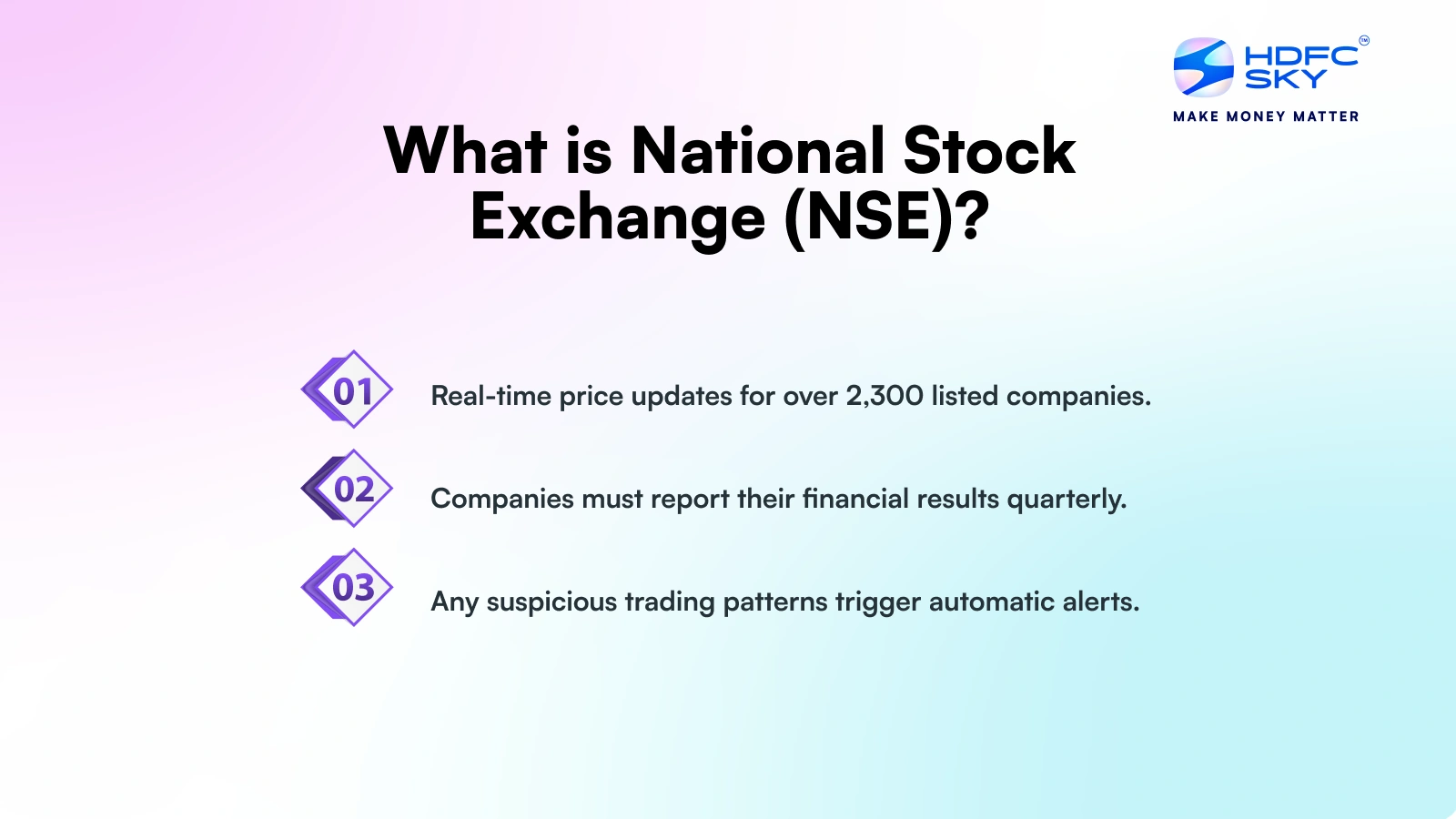
- Real-time price updates for over 2,300 listed companies
- Trading volumes and market trends
- Corporate announcements and financial results
Features of NSE
The National Stock Exchange (NSE) is India’s leading stock exchange known for its advanced technology and transparency. It revolutionized trading with electronic systems.
- Electronic Trading System: NSE uses a fully automated screen-based system ensuring fast, transparent, and efficient trading.
- Pan-India Network: It connects investors across the country through a strong digital infrastructure.
- Wide Range of Instruments: NSE facilitates trading in equities, derivatives, currencies and debt instruments.
- Benchmark Index – Nifty 50: This index reflects the performance of the top 50 listed companies.
- Efficient Clearing & Settlement: Managed by NSCCL, ensuring smooth trade settlements.
- SEBI-Regulated: Operates under SEBI’s framework to promote investor protection and market integrity.
Market Segments of the National Stock Exchange
The NSE operates across multiple market segments, catering to the diverse needs of investors, traders, and corporations. These segments include:
1. Wholesale Debt Market
The Wholesale Debt Market provides a platform for trading various fixed-income securities, such as:
- Government bonds
- Corporate bonds
- Treasury bills and certificates of deposit
This market segment enables institutional investors like banks, insurance companies and mutual funds to trade large volumes of debt instruments.
2. Capital Market Division
The Capital Market Division is the primary platform for trading equity and related instruments. It facilitates:
- Equity Shares: Buying and selling shares of listed companies.
- Exchange-Traded Funds (ETFs): Funds that track specific indices or sectors, offering diversification to investors.
- Preference Shares: Special shares with fixed dividends.
- Retail Government Securities: Safe and accessible options for retail investors to invest in government-backed securities.
This division forms the backbone of NSE’s operations, enabling efficient and transparent equity trading.
Benchmark Index of the NSE
The NIFTY 50 is the benchmark index of the National Stock Exchange. Launched in 1996, the NIFTY 50 represents the top 50 companies listed on the exchange based on their market capitalisation and liquidity. Covering over 12 sectors of the economy, it serves as the barometer for the Indian stock market’s overall health and performance.
Features of NSE Index – NIFTY 50:
- Free-Float Market Capitalisation: Only shares available for public trading are considered in the index calculation.
- Performance Indicator: It captures approximately 54% of the NSE’s free float market capitalisation as of September 30, 2024.
- Diversification: Companies across sectors like banking, IT, FMCG, and energy are included.
Apart from the NIFTY 50, other major indices on NSE include NIFTY 100, NIFTY Midcap 100, and NIFTY Bank, providing investors insights into specific segments of the market.
Major Indices Traded on NSE
Market indices tell us about the health of different parts of our economy. NSE’s indices help investors, from seasoned professionals to newcomers, understand how various sectors of the Indian economy are performing.
The NIFTY 50 is NSE’s most-watched index, working like a thermometer for India’s economic temperature. When you hear news anchors say “The market is up today,” they’re usually talking about the NIFTY 50. This index tracks India’s 50 largest companies, which together represent about 54% of the free float market capitalisation of the stocks listed on NSE as on September 30, 2024. Think of these companies as the Indian economy’s premier league – they include industry leaders from the technology, banking, energy, and consumer goods sectors.
For example, if the NIFTY 50 crossed 23,000 points in the near future, these top 50 companies would collectively grow stronger, often reflecting increased profits, better economic conditions, or positive investor sentiment. This matters because when these companies do well, they generally create more jobs, pay more taxes, and contribute more to India’s growth.
The NIFTY Bank index tells an equally important story. Banks are like the blood vessels of our economy – they help money flow where it’s needed. This index tracks 12 of India’s largest banks, both government-owned and private. When these banks show strong performance, it usually means businesses are growing (taking loans) and people are prospering (saving money).
Benefits of Listing with the National Stock Exchange of India
Listing on the NSE offers companies enhanced visibility, credibility, and access to a broad investor base, boosting growth opportunities.
- Wide Market Access: Connects companies to a large pool of domestic and international investors.
- Improved Liquidity: NSE’s high trading volumes ensure better liquidity for listed stocks.
- Enhanced Transparency: Strict regulatory norms increase investor confidence and corporate governance.
- Efficient Price Discovery: Real-time trading leads to fair market valuation of securities.
- Cost-Effective Process: Competitive listing fees and streamlined procedures benefit issuers.
- Brand Recognition: Association with NSE strengthens a company’s brand and market reputation.
10 Companies on NSE by Market Capitalisation
Here is the list of companies listed on NSE India:
| Rank | Company Name | Current Market Price (₹) | Market Cap (₹ Crore) |
|---|---|---|---|
| 1 | Reliance Industries Ltd | ₹2,750 | ₹18,00,000 |
| 2 | Tata Consultancy Services | ₹3,300 | ₹13,00,000 |
| 3 | HDFC Bank | ₹1,700 | ₹9,50,000 |
| 4 | Infosys | ₹1,600 | ₹7,50,000 |
| 5 | ICICI Bank | ₹950 | ₹6,50,000 |
| 6 | Hindustan Unilever Ltd | ₹2,500 | ₹6,00,000 |
| 7 | State Bank of India | ₹600 | ₹5,50,000 |
| 8 | Bharti Airtel | ₹800 | ₹4,50,000 |
| 9 | Kotak Mahindra Bank | ₹1,900 | ₹4,00,000 |
| 10 | Larsen & Toubro | ₹2,200 | ₹3,50,000 |
Note: Prices and market caps are indicative and can fluctuate daily.
Conclusion
The National Stock Exchange (NSE) is more than just a marketplace for trading securities; it is the backbone of India’s financial markets. From enabling companies to raise capital to providing a reliable platform for investors, the NSE has transformed the way India trades. Its robust technology, transparency, and efficiency have made it the preferred choice for millions of traders and investors.
Related Articles
FAQs on What is National Stock Exchange?
Who is the owner of NSE?
The National Stock Exchange is not owned by the government but operates as a private corporation. Founded in 1992 by leading financial institutions, including IDBI, IFCI, and LIC, NSE functions as a professionally managed organisation. While it’s privately owned, the exchange operates under the regulatory oversight of SEBI, ensuring it maintains high standards of market integrity and investor protection.
Is NSE private or government?
NSE operates as a private entity, not a government institution. However, it works closely with regulatory authorities, particularly SEBI, to maintain market integrity. The exchange’s private status allows it to operate efficiently while still serving the public interest through strict regulatory compliance and transparent operations that protect investor interests.
How many sectors are in NSE?
The NSE covers approximately 12 major economic sectors through its various indices, particularly in the NIFTY 50. These sectors represent the breadth of India’s economy, including banking, information technology, energy, consumer goods, automobiles, pharmaceuticals, and more. This diverse sector representation helps investors access various segments of the Indian economy through a single platform.
How did the National Stock Exchange form?
The formation of the NSE came from recommendations by the Pherwani Committee to establish a modern, technology-driven stock exchange in India. It was conceived as a solution to modernise India’s capital markets and provide nationwide access to trading. The exchange was established with the backing of leading financial institutions and introduced several innovations, including the country’s first electronic trading system.
What is the history of stock exchange in India?
India’s stock market history took a significant turn with NSE’s establishment in 1992. While the Bombay Stock Exchange (BSE) had operated since 1875, NSE brought revolutionary changes by introducing electronic trading, nationwide connectivity, and professional management to India’s financial markets. NSE’s creation marked the beginning of modern, transparent, and efficient market operations in India, setting new standards for trading and market accessibility.
What is the difference between Bombay Stock Exchange vs National Stock Exchange?
The BSE and NSE are India’s two main stock exchanges, both based in Mumbai. The BSE, established in 1875, is Asia’s oldest exchange and uses the Sensex index. The NSE, founded in 1992, is more modern, with fully electronic trading and uses the Nifty 50 index. While both are SEBI-regulated, the NSE typically sees higher trading volumes.