
- Offerings
- Tools & Platforms
Tools & Calculators
- Open API
- Calculators
- SIP Calculator
- CAGR Calculator
- Compound Interest Calculator
- FD Calculator
- RD Calculator
- EPF Calculator
- Retirement Calculator
- HDFC SIP Calculator
- Mutual Fund Return Calculator
- Lumpsum Calculator
- Step Up SIP Calculator
- ETF SIP Calculator
- Brokerage Calculator
- Equity Margin Calculator
- SWP Calculator
- EMI Calculator
- MTF Calculator
- Pricing
- SKY Learn
- Mutual Funds
- Margin Trading
- Financial Planning
- Personal Finance
- Share Trading
- IPO
- Derivatives
- Currencies
- Intraday Trading
- Trading Strategies
- Demat Account
- Commodity
- ETF
What is PEG Ratio?
By Shishta Dutta | Updated at: May 15, 2025 05:36 PM IST
Investors seeking to navigate the complexities of the stock market often rely on various financial metrics to make informed decisions. One such crucial metric is the PEG ratio. Understanding the PEG ratio can significantly enhance your investment strategies by providing a more nuanced view of a company’s value. This blog will delve into the intricacies of the PEG ratio, including its calculation, advantages, disadvantages, and interpretation, to help you grasp its relevance and utility in the share market.
What is Price Earning to Growth (PEG) Ratio?
The Price Earning to Growth (PEG) ratio is a financial metric that expands upon the Price to Earnings (P/E) ratio by factoring in the company’s earnings growth rate. While the P/E ratio simply compares a company’s share price to its earnings per share (EPS), the PEG ratio provides a more comprehensive picture by incorporating future growth potential. This makes the PEG ratio particularly valuable for investors who are interested in understanding not just the current valuation of a company but also its growth prospects.
How to Calculate the PEG Ratio?
Calculating the PEG ratio is straightforward. The formula is:
PEG Ratio = P/E Ratio
—————————
Earnings Growth Rate
To break it down:
- P/E Ratio: This is the contemporary stock price divided by the earnings per share (EPS).
- Earnings Growth Rate: This is the expected annual growth rate of the company’s earnings.
For example, if a company has a P/E ratio of 20 and an expected earnings growth rate of 10%, the PEG ratio would be:
PEG Ratio will be: 20/10 = 2
This simple calculation can provide deeper insights into whether a stock is fairly valued, overvalued, or undervalued when considering its growth prospects.
Advantages of the PEG Ratio
The PEG ratio offers several advantages over other valuation metrics:
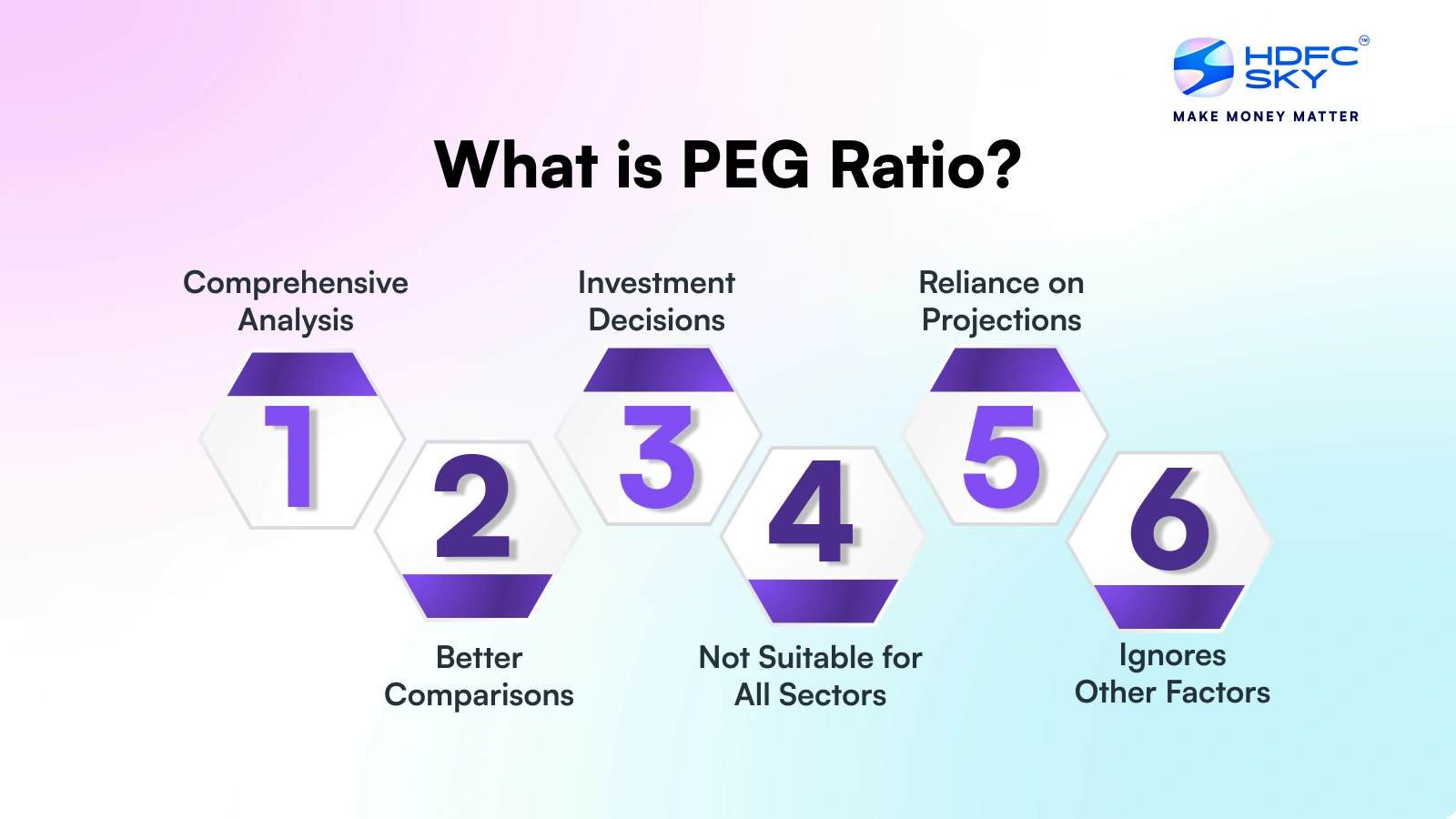
- Comprehensive Analysis
The PEG ratio provides a more complete picture by considering the earnings growth rate alongside the P/E ratio. This helps investors understand if a high P/E ratio is justified by strong earnings growth.
- Better Comparisons
It allows for better comparisons between companies in different industries or sectors. For instance, a tech company with high growth potential can be compared to a mature company with slower growth.
- Investment Decisions
The PEG ratio helps investors make more informed investment decisions by identifying stocks that are undervalued or overvalued based on their growth prospects.
Disadvantages of the PEG Ratio
Despite its benefits, the PEG ratio has some limitations:
- Reliance on Projections
The accuracy of the PEG ratio depends on reliable earnings growth projections, which can be uncertain and subject to change.
- Not Suitable for All Sectors
The PEG ratio may not be suitable for evaluating companies in industries with highly unpredictable earnings growth, such as startups or cyclical industries.
- Ignores Other Factors
The ratio does not consider other important factors such as debt levels, management quality, and market conditions, which can also impact a company’s stock performance.
How to Interpret the PEG Ratio
Interpreting the PEG ratio involves understanding its value in relation to 1. Generally, a PEG ratio of 1 is considered ideal, indicating that the company’s market value is in line with its expected growth. Here are some scenarios:
- PEG Ratio < 1: A PEG ratio less than 1 suggests that the stock may be undervalued relative to its growth rate, making it potentially a good investment.
- PEG Ratio = 1: This indicates that the stock’s price may be fairly valued in relation to its earnings growth rate.
- PEG Ratio > 1: A PEG ratio greater than 1 might indicate that the stock is overvalued, implying that investors are paying more for the company’s future growth than what it may be worth.
Conclusion
The PEG ratio is a valuable tool for investors seeking to balance the price of a stock with its growth prospects. By understanding the PEG ratio relevance, how to calculate it using the price earnings to growth formula, and interpreting it correctly, investors can make more informed decisions. Remember, while the PEG ratio is a powerful metric, it should be used in conjunction with other financial analyses and not as the sole basis for investment decisions.
Related Articles
FAQs
What is a good PEG ratio to buy?
A good PEG ratio to buy is generally less than 1. This suggests that the stock may be undervalued compared to its growth prospects, offering the potential for a better return on investment. However, it’s critical to consider other elements and conduct thorough research before making any investment decisions.
How is the PEG ratio calculated?
The PEG ratio is calculated by dividing the P/E ratio by the earnings growth rate. The formula is:
PEG Ratio = P/E Ratio
—————————
Earnings Growth Rate
This simple formula helps investors understand how a company’s valuation compares to its growth potential.
3. What Is Better One, a Higher or Lower PEG Ratio?
In general, a lower PEG ratio is considered better as it may indicate that the stock is undervalued relative to its growth rate. However, it’s crucial to assess why the PEG ratio is low and ensure that there are no underlying issues with the company.




