- Offerings
- Tools & Platforms
Tools & Calculators
- Open API
- Calculators
- SIP Calculator
- CAGR Calculator
- Compound Interest Calculator
- FD Calculator
- RD Calculator
- EPF Calculator
- Retirement Calculator
- HDFC SIP Calculator
- Mutual Fund Return Calculator
- Lumpsum Calculator
- Step Up SIP Calculator
- ETF SIP Calculator
- Brokerage Calculator
- Equity Margin Calculator
- SWP Calculator
- EMI Calculator
- MTF Calculator
- Pricing
- SKY Learn
- Mutual Funds
- Margin Trading
- Financial Planning
- Personal Finance
- Share Trading
- IPO
- Derivatives
- Currencies
- Intraday Trading
- Trading Strategies
- Demat Account
- Commodity
- ETF
Share Appreciation Rights (SARs): Types, Benefits, and Examples
By HDFC SKY | Published at: May 28, 2025 02:05 PM IST
Share Appreciation Rights (SARs) allow employees to benefit from the appreciation in a company’s stock without purchasing it. They receive the difference between the stock’s market value at exercise and its initial value. SARs come in different types like equity appreciation rights and employee stock appreciation rights.
The share appreciation rights involve sharing the benefits of an employer’s growth without owning stock. For example, if a stock rises from ₹50 to ₹70, the employee gains ₹20 per SAR. SARs provide tax advantages, require no initial investment, and align employee interests with company success in a stock appreciation rights scheme.
In the following article, we will explore the various types of SARs, such as equity appreciation rights and employee stock appreciation rights, and delve into the benefits they offer both to employees and employers in incentivising performance and retention.
What are Share Appreciation Rights and How Do They Work?
Share Appreciation Rights (SARs) are a type of employee compensation that allows employees to benefit from the increase in a company’s stock price over time, without owning the stock. When granted, SARs give employees the right to receive the difference between the market price of the company’s stock at the time of exercise and the stock price when the SARs were initially granted.
There are two main types of SARs: Equity appreciation rights and Cash-settled SARs. Theseallow employees to receive actual shares of the company, while cash-settled SARs provide a cash payment equivalent to the appreciation in the stock price.
SARs work by allowing employees to profit from stock price increases without needing to buy the stock. For example, if an employee is provided SARs when the price of the stock is ₹ 50, and the price of the stock increases to ₹70, the employee receives ₹20 per SARs. Employees can use SARs and get benefits, either as stock or cash.
These rights are often part of a stock appreciation rights scheme, which is used to encourage employees by aligning their interests with the company’s performance. Share appreciation rights help companies attract and retain talent while offering employees an opportunity to benefit from the company’s growth without needing to purchase the stock directly.
Types of Share Appreciation Rights
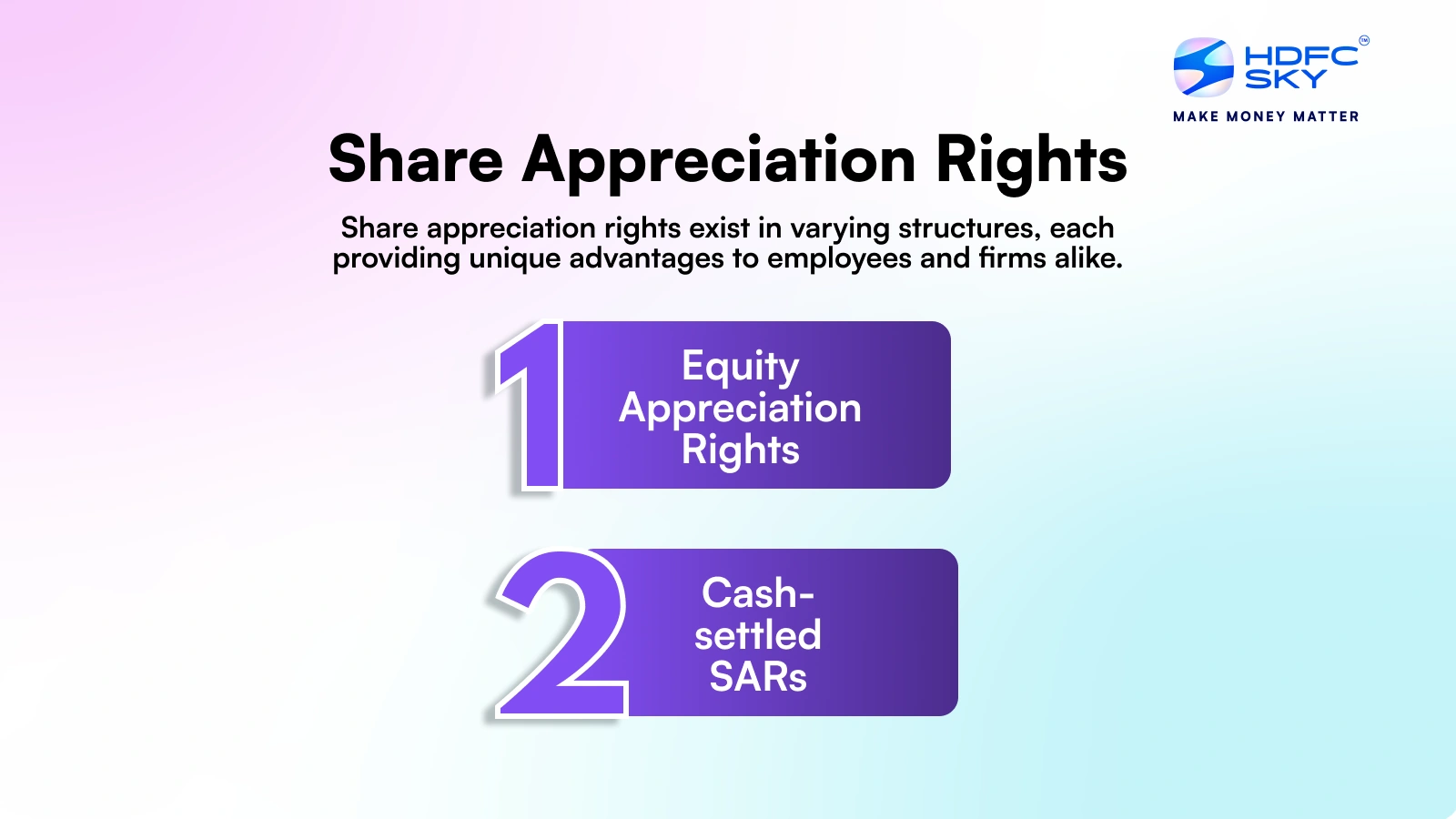
Share appreciation rights exist in varying structures, each providing unique advantages to employees and firms alike. Equity appreciation rights and cash-settled SARs are the two major categories of SARs.
- Equity Appreciation Rights: These SARs enable employees to be awarded actual shares of the company based on the value appreciation of stock. The employee gains from the difference between the stock price at the grant and the exercise price.
- Cash-settled SARs: In this form, employees are paid a cash amount equivalent to the stock value appreciation instead of actual shares. This is liquidity without needing the employee to buy stock.
Both models are meant to align employee rewards with business expansion, providing different alternatives depending on compensation choice. Through the comprehension of these types, employees and businesses can decide on the optimum incentive form.
Advantages and Disadvantages of SARs
Share appreciation rights are a widely used method of employee remuneration, but like all benefits, they have advantages as well as disadvantages.
Advantages
- No Upfront Cost: No shares need to be purchased by employees, which makes SARs a risk-free means of taking advantage of appreciation in the share price.
- Aligns Interests: SARs aligns employee interests with business growth, encouraging them to help it succeed.
- Tax Benefits: SARs can provide tax deferral upon exercise, which allows for potential tax benefits.
Disadvantages
- No Dividends: There are no dividends on SARs, as employees don’t own the underlying stock.
- Limited Control: Different from stock options, holders of SARs have no voting rights.
- Taxation at Exercise: SARs are taxed at the time of exercise, creating a large tax burden.
Overall, share appreciation rights have much to offer, yet knowledge of their drawbacks assists employees in making wise choices regarding their compensation plan.
Example of Share Appreciation Rights
To understand how share appreciation rights work, consider this simple example:
An employee is granted 1,000 SARs when the company’s stock price is ₹100. After three years, the stock price rises to ₹150. The appreciation per share is ₹50. Upon exercising the SARs, the employee receives ₹50,000 (1,000 SARs × ₹50), either in cash or company shares, depending on the SAR plan.
This stock appreciation rights example shows how employees can benefit from company growth without purchasing shares. Such employee stock appreciation rights help align employee efforts with company performance in a structured stock appreciation rights scheme.
SARs Taxation
The taxation of stock appreciation rights differ for employees and employers.
- For employees, the gains received upon exercising SARs are treated as perquisite income and are taxed under the head of ‘Salary’ in the year of exercise. This means the value of the benefit, whether received in cash or shares, is added to their taxable income and taxed at applicable income tax rates.
- On the other hand, for employers, the payout made to employees under SARs is considered a deductible business expense, reducing the company’s taxable income.
Conclusion
Share Appreciation Rights (SARs) provide a flexible way to reward employees based on stock performance without the need for share ownership. They align employees’ goals with the success of the company, offering potential financial benefits. Understanding the share appreciation rights meaning, types, taxation, and structure, such as equity appreciation rights and SAR stock option plans, helps employees make informed decisions and optimise the value of their compensation.
Related Articles
FAQs on Share Appreciation Rights (SARs)
What is the difference between Stock Appreciation Rights and Employee Stock Options?
Stock Appreciation Rights (SARs) allow employees to receive the value gained from stock appreciation without purchasing shares. In contrast, employee stock options require buying shares at a fixed price. SARs typically result in cash or stock payouts, while options involve ownership and potential voting rights upon purchase.
How do I know when to exercise my SARs compensation?
You can consider exercising your SARs when the market price of the company’s stock is significantly higher than the grant price. Review the stock appreciation rights scheme terms, including vesting and expiration. Financial goals, tax implications, and company performance should also guide your timing decision.
What happens when you exercise stock appreciation rights?
When you exercise share appreciation rights, you get paid the amount between the price of the stock at the time and the price of the grant. You either get paid cash or stock, as stated in the plan. You get taxed on the amount like ordinary income, and are taxed upon exercise.
Do stock appreciation rights expire?
Yes, stock appreciation rights do expire, and generally, it is mentioned in the grant agreement. Unless exercised within the given time frame, the SARs become worthless. You have to keep an eye on the expiry date and the market scenario to avoid losing the opportunity to gain any appreciation in the value of the shares of the company. You have to plan and act quickly to take the best advantage of SARs.