- Offerings
- Tools & Platforms
Tools & Calculators
- Open API
- Calculators
- SIP Calculator
- CAGR Calculator
- Compound Interest Calculator
- FD Calculator
- RD Calculator
- EPF Calculator
- Retirement Calculator
- HDFC SIP Calculator
- Mutual Fund Return Calculator
- Lumpsum Calculator
- Step Up SIP Calculator
- ETF SIP Calculator
- Brokerage Calculator
- Equity Margin Calculator
- SWP Calculator
- EMI Calculator
- MTF Calculator
- Pricing
- SKY Learn
- Mutual Funds
- Margin Trading
- Financial Planning
- Personal Finance
- Share Trading
- IPO
- Derivatives
- Currencies
- Intraday Trading
- Trading Strategies
- Demat Account
- Commodity
- ETF
What are Smart Beta Funds and How Do They Work?
By HDFC SKY | Published at: May 28, 2025 05:21 PM IST
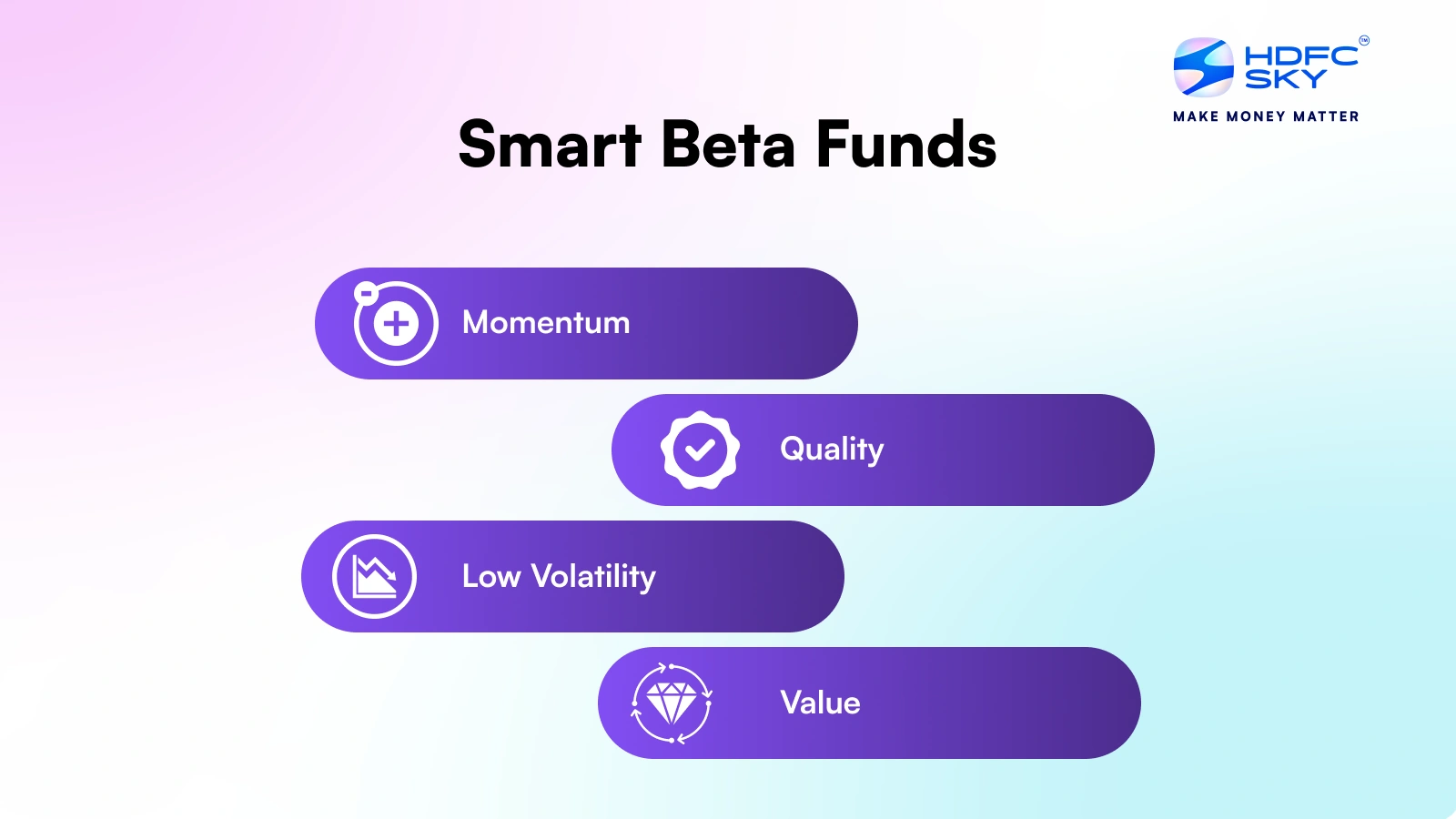
Smart beta funds have gained popularity in India very quickly, providing a strong alternative to conventional index and actively managed funds. During the last ten years, assets under management for smart beta funds in India increased significantly, indicating increasing investor interest in systematic and rules-based strategies that seek to provide better risk-adjusted returns.
These funds combine the transparency and affordability of passive investment with the goal-oriented strategy of active management and are especially sought after by Indian investors looking to maximise their portfolios. The Indian market today includes a wide range of smart beta index funds (including smart beta exchange traded funds), created to capitalise on factors such as value, momentum, quality, and low volatility.
What are Smart Beta Funds?
Smart beta funds are the name given to investment funds that utilise different weighting techniques, departing from the traditional market capitalisation method. Rather than merely tracking indices such as the Nifty 50 or Sensex, these funds adopt smart beta strategies like equal weighting, fundamental weighting, or factor-based selection to build their portfolios. The aim is to beat conventional benchmarks by methodically focusing on drivers of returns historically, such as value, quality, momentum, and low volatility. In India, both smart beta mutual fund products and smart beta ETF products are on offer, offering investors convenient access to these new strategies.
How Do Smart Beta Funds Work?
Smart beta funds work by using a rules-based approach to select and weight stocks based on particular factors instead of market capitalisation only. For example, a smart beta index fund might overweight stocks with good fundamentals or low volatility and underweight stocks with greater risk or poorer finances. This is a systematic method that ensures transparency and consistency because the choice criteria are predetermined and not subject to human prejudice. Regular rebalancing is an important aspect, keeping the desired factor exposure and likely improving long-term returns.
Performance of Smart Beta Funds – Returns and Risks
The performance of smart beta funds in India has been impressive, with several indices beating the benchmark Nifty 50 in recent years. For instance, the Nifty 50 posted a five-year annualised return of 16.8%, and up to nine smart beta strategies beat this record. The Nifty100 Low Volatility 30 Index, which is a well-known smart beta exchange traded fund, recorded a compound annual growth rate of around 24.1% during the same period.
This excess performance comes from the specialised exposure to factors that have performed better in the past or been less risky. Yet, it should be noted that smart beta strategies are not completely protected from market slumps. While low-volatility funds will hold up relatively better during corrections, momentum funds might lag during bear markets. Also, increased turnover and rebalancing charges can affect net returns, and the absence of long-term performance history for certain strategies in India calls for careful examination.
Advantages and Disadvantages of Smart Beta Funds
Smart beta funds have many advantages.
- They yield the possibility of more risk-adjusted returns than market cap-weighted funds due to their selective factor exposure.
- The transparent, rules-based method minimises emotional decision-making and maximises consistency.
- Comparatively lower expenses than active funds make them an economically beneficial option, with more diversification helping distribute risk over more assets.
- The ability to position themselves against individual investment objectives, such as growth, value, or income, further enhances their appeal.
Nevertheless, There are some drawbacks as well,
- Smart beta funds have the potential to underperform regular benchmarks, especially in the short term or during adverse market cycles.
- Construction complexity and the requirement for periodic rebalancing result in increased turnover and trading charges.
- The absence of a consistent long-term record for certain strategies within India complicates evaluation.
- Sector concentration and factor breakdown risk further highlight the value of diversification and cautious selection when investing in smart beta funds.
Conclusion
Smart beta funds represent a major step forward in the Indian investment ecosystem, combining the best features of active and passive approaches. Though they can potentially deliver higher returns and better risk control, investors must scrutinise the underlying factors, expenses, and market situation. With the Indian market for smart beta funds continuing to grow, these products will become an increasingly vital component of diversified, goal-based portfolios.
Related Articles
FAQs on Smart Beta Funds
How should I invest in smart beta funds?
To invest in smart beta funds, register a demat and trading account with a registered broker or a mutual fund platform, find available smart beta ETF or smart beta mutual fund options, pick a fund that fits your objectives, invest, and constantly check your investment’s performance.
How is smart beta a blend of active and passive funds?
A smart beta fund brings passive investing’s rules-based, index-following methodology into play along with active investing’s selection of factors. It follows a tailored index constructed using active strategies, such as value, momentum, or quality, to outperform regular indices, with an emphasis on transparency, reduced costs, and the systematic construction of portfolios.
When does investing in smart beta funds make sense?
Smart beta funds are suitable for investors who seek improved risk-adjusted returns compared to standard index funds, especially in turbulent or sideways markets. They are suitable for investors with a long-term time frame, a moderate risk tolerance, and a preference for systematic, factor-based investment methods over strictly active or passive investment strategies.
Are smart beta funds liquid funds?
Smart beta funds are not categorised as liquid funds. Although smart beta ETF units can be sold on exchanges and are typically liquid, they do not provide the overnight redemption and ultra-short maturity profile of conventional liquid funds, which are meant for very short-term parking of excess funds.