- Offerings
- Tools & Platforms
Tools & Calculators
- Open API
- Calculators
- SIP Calculator
- CAGR Calculator
- Compound Interest Calculator
- FD Calculator
- RD Calculator
- EPF Calculator
- Retirement Calculator
- HDFC SIP Calculator
- Mutual Fund Return Calculator
- Lumpsum Calculator
- Step Up SIP Calculator
- ETF SIP Calculator
- Brokerage Calculator
- Equity Margin Calculator
- SWP Calculator
- EMI Calculator
- MTF Calculator
- Pricing
- SKY Learn
- Mutual Funds
- Margin Trading
- Financial Planning
- Personal Finance
- Share Trading
- IPO
- Derivatives
- Currencies
- Intraday Trading
- Trading Strategies
- Demat Account
- Commodity
- ETF
Statistics and predictions: What must you be careful about
By HDFC SKY | Updated at: Apr 8, 2025 02:52 PM IST
Summary
From predicting the financial performance of a company in the coming quarter to figuring out the direction of interest rates — earning a profit in the financial markets depends a lot on your ability to foretell the future correctly. While retail investors work with lesser information compared to stock market analysts, it is important to take a step back and assess if anybody in the markets even with all the required information can actually get such forecasts right.
Consider this study which asked CFOs of large American companies to predict the performance of S&P 500 over the next year. The study collected a total of 11,600 such predictions and examined their accuracy. The outcome was analysed and it was noted that the correlation between the estimates given by CFOs and the actual market returns was negative. Put simply, this meant that when CFOs expected the market to go up in the coming year, it actually went down, and vice versa.
The human obsession with forecasts
Behavioral finance has shown that making right predictions about the future is almost always a matter of chance. These predictions are often based on events and data which might not even be relevant in the prediction exercise.
Further, given the randomness caused by a million market participants buying and selling products, one can argue that market movements are simply random and cannot be predicted with any degree of certainty. As a result, if you assume that there is a pattern in movements of the markets and search for them, you are doing an exercise in futility.
Researchers in domains such as biology, evolution and psychology seem to agree that the urge to assume and try to find patterns even in areas where they might not exist is an outcome of the history of the human species.
In the early ages, the problems which our brain was wired to solve were straightforward and short-term evidence was sufficient for us to arrive at conclusions based on smaller sample sets.
For example, such problems included the ability to spot fresh water sources nearby, look out for hints of coming rainfall and finding shelter. As a result, fragmentary evidence, such as the sound of flowing water or thunder, was enough for early humans to spot a pattern and plan accordingly. This heavy reliance on short-run factors is what researchers believe pushes people to rely on fragmentary evidence to spot patterns even today, even when they don’t show the whole picture.
Overall, even though the human brain is well-trained to solve prehistoric problems, it struggles in making sense of complex systems, such as stock markets where prices are affected by nearly unlimited factors. The effects of dopamine and reliance on recent events are critical in understanding the human obsession with forecasts.
Dopamine and its impact on investing behavior
Dopamine is a chemical in the brain which helps in judging what actions you should take to get rewards in a timely manner. The flow of dopamine through the brain have been known to have a major impact on investment decisions of people.
A large supply of dopamine in the brain has a satisfying effect on the human brain, while a lower level is usually related to restlessness and depression. So, for instance, if you expected to profit from a trade and you did profit, the dopamine levels in your brain may remain unchanged.
However, if you did not expect a profit and yet made it, your dopamine levels will spike making you feel happy. Similarly, if a reward that you expected is not realised, your dopamine levels will suddenly drop, leading to a loss of motivation.
There’s another interesting pattern. The rush of dopamine is more when you are anticipating a happy event than the event itself. Scientists who researched the brain of kids looking forward to Christmas found that the children were much excited on the day of Christmas itself.
What does this mean? Say you spotted a stock form a specific chart pattern and earned a quick profit from the trade. The profit gave you a dopamine rush. The next time, chances are your dopamine rush will come just by seeing a similar pattern being formed on the charts, even before you take any action or profit from a trade.
Reliance on recent information
In addition to the dopamine, another psychological factor which heavily influences investment decisions is an inclination of people to allow more recent experiences to have a more significant impact on their decisions, as compared to experiences longer ago.
For example, say you are playing 10 rounds of Blackjack and lose the first five rounds but go on to win the sixth and the seventh rounds. Before the cards for the eighth round are dealt, your brain will make you think that the probability of another win is significantly higher now, simply because it has experienced wins more recently. In such cases, the first five losses are completely ignored and almost all assessment of the probability of another win is based on more recent rounds. It is because of this factor that people end up buying stocks aggressively if their recent bets have paid off well.
So, how do you make reasonable forecasts?
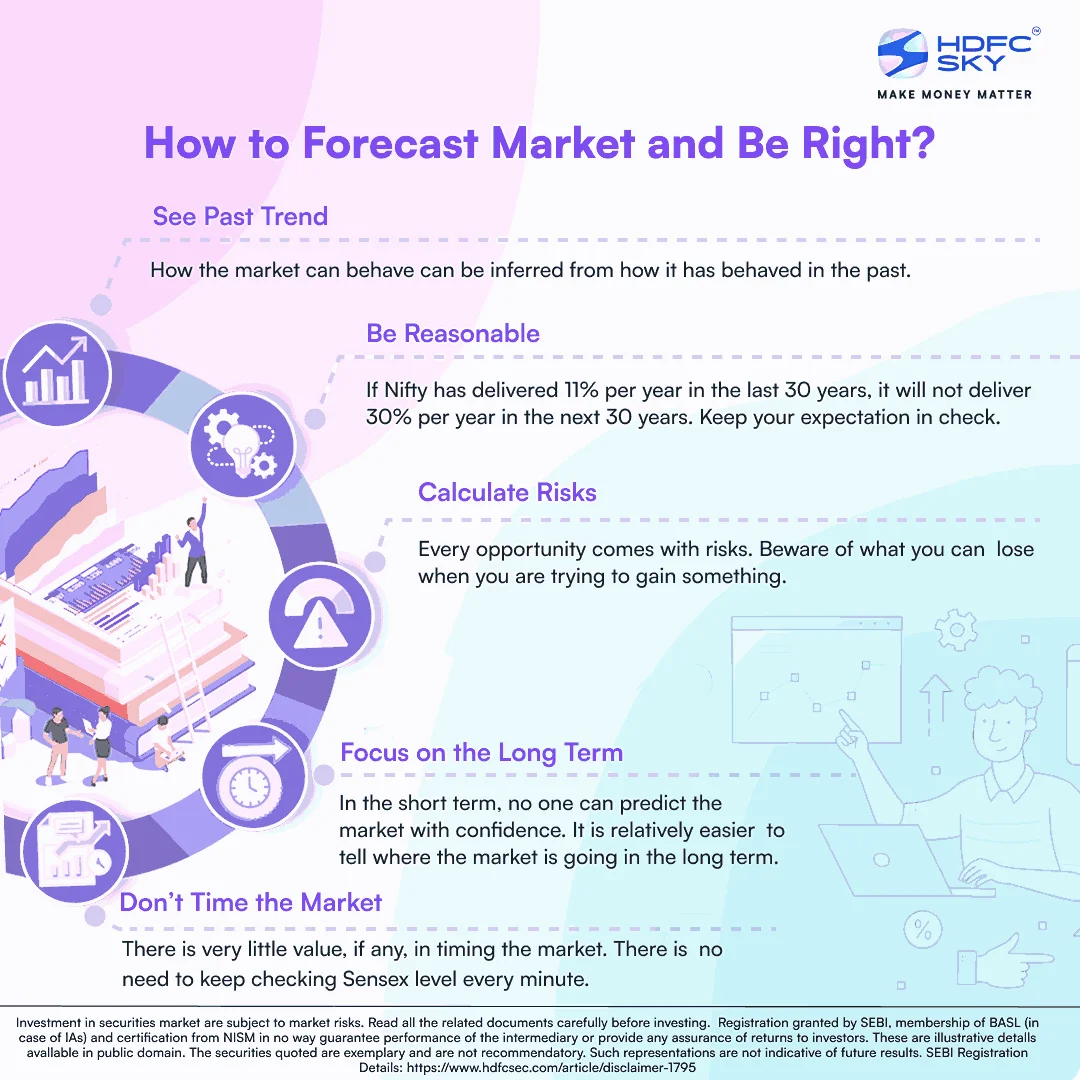
It is important for you to stay aware of the impacts of factors such as the dopamine rush or bias towards recent experience. Being cognisant of these biases of the human brain and acting accordingly can help you cut losses. It will help to keep the following in mind:
1. Keep realistic expectations:
Major indices across the world give returns in either high single digits or early double-digits over the long run. Setting expectations of returns close to the average might help in avoiding any disappointment. For example, FTSE 100 has given 7.75% annualised returns from 1984 to 2019 and the S&P 500 has given average return of 10.5% between from 1957 to 2021.
2. Be aware of the risks:
Whenever you try to estimate what you might make if you get the investment decision right, do not forget to consider what is at stake and what you might lose in case things do not go as planned.
3. Avoid trying to predict short-term movements:
When viewing almost any dataset, the human mind is hard-wired to try and identify patterns. Financial markets are no different in this regard. The brain tries to predict short-term movements, and these could prove wrong. A good approach is to research well and buy the right stocks and hold them for longer durations.
4. Refrain from watching stock tickers all day:
There is very little value, if any, in trying to time the markets. Price action and movements have almost no information about the health of an underlying business, and hence, looking at stock price charts all day is unlikely to earn you any money and might trick your brain into “spotting” another pattern which simply does not exist.
Related Articles