- Offerings
- Tools & Platforms
Tools & Calculators
- Open API
- Calculators
- SIP Calculator
- CAGR Calculator
- Compound Interest Calculator
- FD Calculator
- RD Calculator
- EPF Calculator
- Retirement Calculator
- HDFC SIP Calculator
- Mutual Fund Return Calculator
- Lumpsum Calculator
- Step Up SIP Calculator
- ETF SIP Calculator
- Brokerage Calculator
- Equity Margin Calculator
- SWP Calculator
- EMI Calculator
- MTF Calculator
- Pricing
- SKY Learn
- Mutual Funds
- Margin Trading
- Financial Planning
- Personal Finance
- Share Trading
- IPO
- Derivatives
- Currencies
- Intraday Trading
- Trading Strategies
- Demat Account
- Commodity
- ETF
- What are Indian Stock Market Timing
- Indian Stock Market Timings for Trade is Divided Into Three Segments
- Stock Market Closing Time in India Can be Divided into Two Sessions
- Aftermarket Orders and Muhurat Trading
- Significance of Stock Market Timings
- Currency Market Timings in India
- Indian Commodity Market Timings
- How to Invest in the Stock Market?
- Conclusion
- FAQs on Stock Market Timings in India
- What are Indian Stock Market Timing
- Indian Stock Market Timings for Trade is Divided Into Three Segments
- Stock Market Closing Time in India Can be Divided into Two Sessions
- Aftermarket Orders and Muhurat Trading
- Significance of Stock Market Timings
- Currency Market Timings in India
- Indian Commodity Market Timings
- How to Invest in the Stock Market?
- Conclusion
- FAQs on Stock Market Timings in India
Share Market Timings in India: NSE & BSE Trading Hours Explained
By HDFC SKY | Updated at: Oct 30, 2025 08:37 PM IST
Summary
- Indian Stock Market Timings are divided into three sessions: Pre-opening (9:00–9:15 AM), Regular (9:15 AM–3:30 PM), and Post-closing (3:30–4:00 PM).
- Pre-opening session (9:00–9:15 AM)is further split into:
- Order entry (9:00–9:08 AM): Investors can place, modify, or cancel orders.
- Order matching & confirmation (9:08–9:12 AM): Orders are matched based on price-time priority.
- Buffer period (9:12–9:15 AM): Transition to the regular market session.
- Regular trading hours (9:15 AM–3:30 PM) see active participation across equity, F&O, and currency segments.
- Post-closing session (3:30–4:00 PM)involves:
- Closing price calculation based on the weighted average price of the last 30 minutes.
- Post-close order placement until 3:40 PM at a closing price only.
- After Market Orders (AMO) can be placed outside market hours via broker platforms, particularly for working individuals.
- Market holidays and half trading days are announced by NSE/BSE annually, with trading sessions closed on specific dates.
- Understanding timing slots is vital for traders to plan strategies efficiently and avoid order rejections.
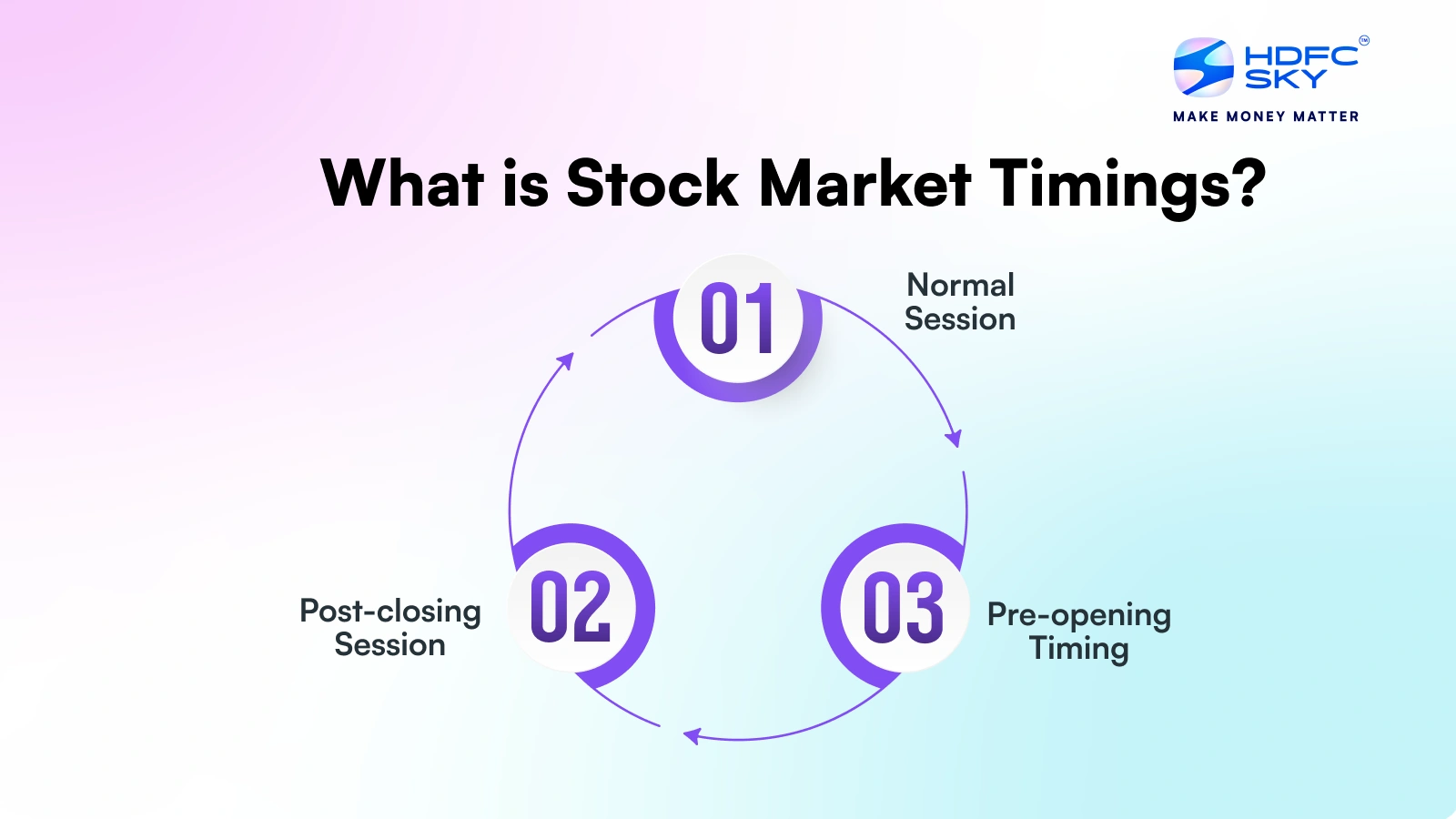
Share market timings in India define the specific hours during which trading takes place on stock exchanges like NSE and BSE. Understanding these timings is crucial for investors and traders to effectively plan their buying and selling activities. The market operates on weekdays with designated sessions for pre-opening, regular trading and post-closing ensuring a structured environment for smooth and transparent transactions.
What are Indian Stock Market Timing
The Indian stock market operates from Monday to Friday with regular trading hours from 9:15 AM to 3:30 PM. Before the official opening, there is a pre-opening session between 9:00 AM and 9:15 AM allowing traders to place orders and establish the opening price based on demand and supply. Additionally there is a post-closing session called the closing price session from 3:40 PM to 4:00 PM for price determination
Stock Market Open Time in India
The Indian stock market officially opens at 9:15 AM and closes at 3:30 PM (Indian Standard Time) from Monday to Friday. This timing applies to both the National Stock Exchange (NSE) and the Bombay Stock Exchange (BSE).
There is also a pre-opening session starting at 9:00 AM to 9:15 AM, which helps determine the opening price of stocks.
Stock Market Close Time in India
The Indian stock market closes at 3:30 PM (Indian Standard Time) from Monday to Friday. After market hours, the post-closing session runs until 4:00 PM for order matching and trade confirmation.
Indian Stock Market Timings for Trade is Divided Into Three Segments
The Indian stock market follows a schedule for different transactions. It has divided its timing into three main sessions: pre-opening, normal trading and post-closing.
1. Pre-opening Timing
It is a short 15-minute window before the market opens. This window helps evaluate the buy and sell orders to decide the market’s opening price. The timings are 9:00 AM to 9:15 AM.
This small session is further divided into three parts.
- 9.00 AM to 9.08 AM: Buy and Sell orders are placed in this period.
- 9.08 AM to 9.12 AM: Orders placed are matched in this period to determine the opening prices.
- 9.12 AM to 9.15 AM: The buffer period before the market opens.
2. Normal Session
This is the main stock market session in India where an investor can buy or sell a share. This is between 9:15 AM (the stock market open time in India) and 3:30 PM (closing time of stock market in India)
This is where you can track live prices, execute orders in real-time and create strategies for intraday or any other type of investment.
3. Post-closing Session
The post closing session is held between 3:40 p.m. and 4 p.m. Buy and Sell orders can be placed and trades can be done in this period at the closing price of the day. Orders for the pre-opening session of the next day may also be placed in this period.
The stock market timings in India are mainly divided into these three parts with the sole intention of facilitating investors’ convenience and ensuring the proper functioning of the market.
The markets are closed on Saturday, Sunday and all public holidays. The details for these holidays which include festivals and other important dates of national significance can be checked on the NSE India website.
Stock Market Closing Time in India Can be Divided into Two Sessions
The stock market closes for any transactions after 3:30 PM; however the stock market close time in India can be further divided into two parts.
3.30 PM to 3.40 PM
This is the time when the market decides the final price of a stock after evaluating the day’s buy/sell orders. Traders cannot place any new orders here but they can use the final stock prices as a reference for the next day.
3.40 PM to 4 PM (Post-Closing Session)
This is the final session of the day known as the post-closing session. It lasts from 3:40 PM to 4:00 PM and only market orders for the equity segment can be placed at the closing prices of the day.. In this session no limit orders can be placed and traders cannot execute any new trades outside of market orders.
Aftermarket Orders and Muhurat Trading
- Aftermarket Orders: Traders can place orders here using a special feature called AMO (aftermarket orders). This feature lets you place a buy /sell an order after the market closes. The orders placed in AMO category are executed the next day..
- Muhurat Trading: Diwali is considered one of the most auspicious days in India. If you are starting something new or planning to invest, there is no better day for Indians. To encourage this emotion the market opens on Diwali for one hour, which is called muhurat trading.
It actively sees participation from traders and investors. The timings of muhurat trading are announced by the exchange usually one day before Diwali.
Significance of Stock Market Timings
Stock market timings are crucial as they define when investors can buy or sell securities, ensuring smooth market operations. These timings help maintain liquidity and market stability.
- Enables orderly trading sessions
- Helps investors plan their transactions effectively
- Ensures market transparency and fairness
- Aids in managing market volatility
- Synchronises global trading activities
Currency Market Timings in India
Foreign currency derivates that are offered on different exchanges in India follow the usual market timings of that exchange for. Currency Market Timing, globally, are available 24 hours in a day.
Indian Commodity Market Timings
The commodity market timings in India are divided into two sessions: the Morning Session, which runs from 9:00 AM to 5:00 PM and the Evening Session, which operates from 5:00 PM to 11:30 PM or 11:55 PM, depending on US daylight saving time. For agricultural commodities, the market operates from 9:00 AM to 5:00 PM. These extended hours give traders more flexibility to engage with the market throughout the day including after regular stock market hours.
This is probably the trickiest trade in the market; the investor has to be totally aware of all the global and economic events that have a big impact on its prices.
This is where you trade in gold, silver, platinum and other precious metals. Some other crucial commodities like crude oil and natural gas are also traded here.
How to Invest in the Stock Market?
Investing in the stock market allows individuals to grow wealth by buying shares of companies. Understanding the basics and following a clear strategy is key to successful investing.
- Open a Demat and Trading account with a registered broker
- Research and choose stocks or mutual funds wisely
- Start with small investments and diversify your portfolio
- Monitor market trends and company performance regularly
- Use long-term investment strategies to minimise risks and maximise returns
Conclusion
Having a clear understanding of Indian stock market timings can be useful in making investment and trading decisions. The market offers an array of instruments for trading and investing but it’s extremely important that the trader is cautious and keeps updated on global and economic events.
The market also offers some special features such as the Muhurat trading and after market order. If done the right way the market has a lot to offer but one has to be cautious and make informed decisions after evaluating the global and economic news.
Related Articles
FAQs on Stock Market Timings in India
What are the share market timings in India?
The Indian stock market operates from Monday to Friday, with regular trading hours between 9:15 AM and 3:30 PM, and pre-opening from 9:00 AM to 9:15 AM.
What is Muhurat trading?
Muhurat trading is a special one-hour trading session held on Diwali, considered an auspicious occasion for new investments.
Are the Trading Timings the Same for the NSE and BSE?
Yes, the trading times for the National Stock Exchange and the Bombay Stock Exchange are the same, from 9:15 AM to 3:30 PM, Monday to Friday. They both have pre-opening and post-closing features, making it easier for the trader.
Can I Buy Stocks after Market Hours?
You can place your order after the market closes using the AMO (after market orders) feature, but it gets executed the next day when the market opens.
How Many Stocks Can I Trade in a Day?
There is no limit on the stocks you can trade in a day , it all depends on your available funds and margin provided by the broker.
Is the Share Market Open on Saturday?
No, the market is closed on Saturdays and Sundays.
Is the Stock Market Open for 7 days?
No, the market is open from Monday to Friday, and it is closed on public holidays as well.
Is there a Limit to Day Trading Stocks?
No, there is no limit to day trading stocks , it all depends on your available balance and margin provided by the broker.
What is Overnight Trade?
Instead of closing your trade on the same day, you close it the next day. This is called an overnight trade.
Who is Allowed to Trade After Hours?
In India every retail and institutional investor can trade when the market closes. By using the after market order feature, they can place a buy or sell order but the same gets executed the next day when the market opens.