- Offerings
- Tools & Platforms
Tools & Calculators
- Open API
- Calculators
- SIP Calculator
- CAGR Calculator
- Compound Interest Calculator
- FD Calculator
- RD Calculator
- EPF Calculator
- Retirement Calculator
- HDFC SIP Calculator
- Mutual Fund Return Calculator
- Lumpsum Calculator
- Step Up SIP Calculator
- ETF SIP Calculator
- Brokerage Calculator
- Equity Margin Calculator
- SWP Calculator
- EMI Calculator
- MTF Calculator
- Pricing
- SKY Learn
- Mutual Funds
- Margin Trading
- Financial Planning
- Personal Finance
- Share Trading
- IPO
- Derivatives
- Currencies
- Intraday Trading
- Trading Strategies
- Demat Account
- Commodity
- ETF
What are E-Mini Futures? How to Trade E-mini Futures?
By HDFC SKY | Updated at: Jul 24, 2025 06:16 PM IST
Summary
- E-mini futures are electronically traded futures contracts that represent a fraction of the value of standard futures, primarily offered on major stock indices like the S&P 500.
- These contracts are traded on the Chicago Mercantile Exchange (CME) and are popular for their lower margin requirements, high liquidity, and accessibility for individual traders.
- E-minis cover various asset classes, including equity indices, commodities, and currencies, making them versatile for hedging or speculation.
- Due to their reduced size, they enable greater flexibility and portfolio diversification, especially for retail investors.
- The article explains key terms like contract size, tick size, and margin requirements, making it beginner-friendly.
- E-mini futures offer almost 24-hour trading, allowing investors to react to global events in real-time.
- Their popularity stems from the balance they strike between risk, cost, and exposure in futures trading.
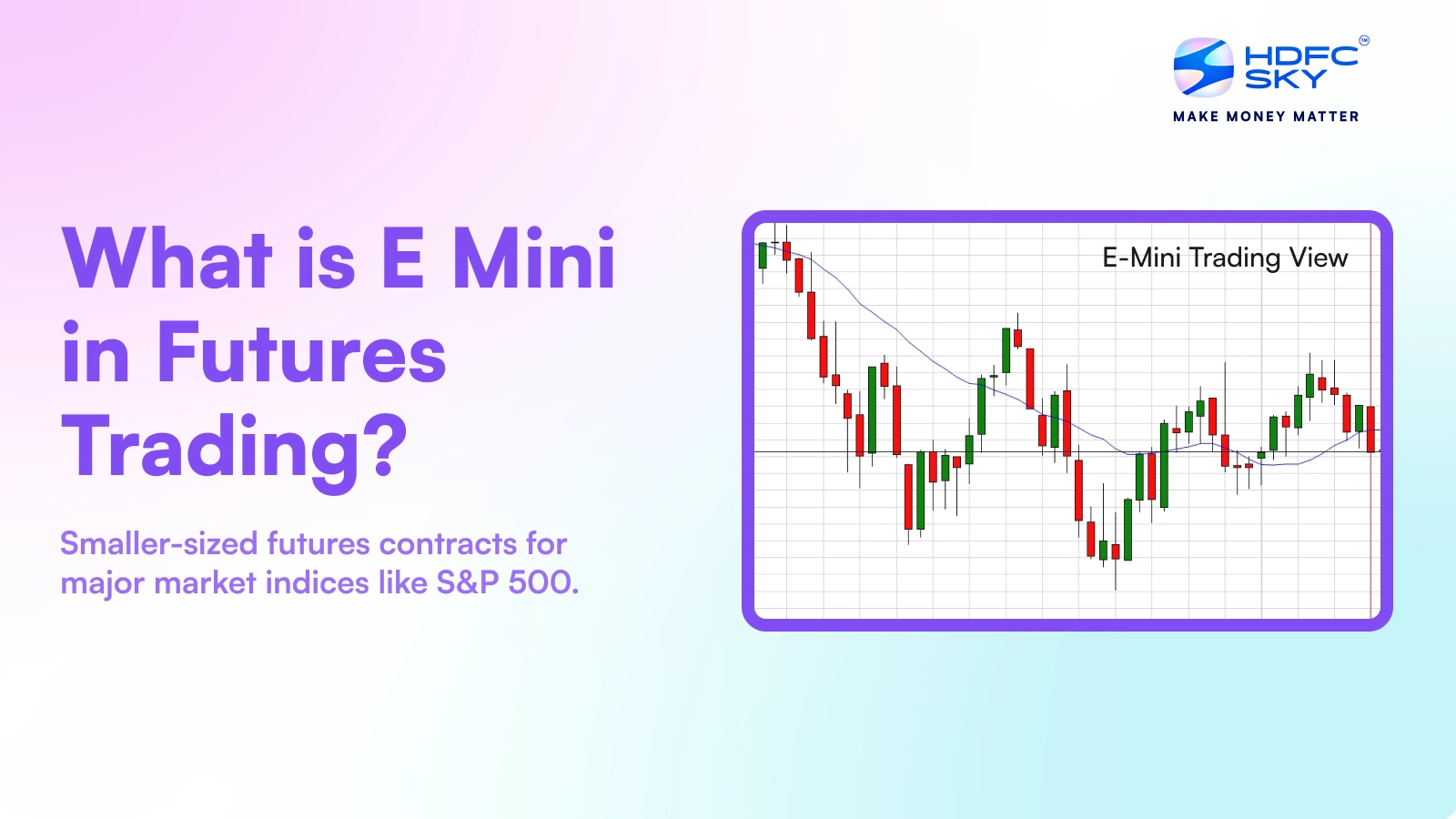
E-mini are electronically traded futures contracts that are a fraction of the size of the standard contracts. The size of the standard contracts are made smaller in an E-mini contract so that more investors and traders can take positions in them as a lesser amount of money is required for taking positions in them. E-Mini contracts are mainly traded on Chicago Mercantile Exchange.
An e-mini is an electronically traded futures contract that is broken down into a fraction of the standard futures contract. It is ideal for trading quite diverse types of assets, including indices, currencies and commodities. However, the most common type of assets traded with e-minis are indices.
In this article, we will learn about the E mini meaning, how to trade micro e mini futures, and their advantages and disadvantages.
What are E Mini Futures?
E-mini means a futures contract and represents a fraction or a part of the complete value of the standard futures contract.
How much is one E Mini futures contract?
Ideally, when you break down your standard futures contract into several fractions, each fraction represents one e mini futures contract.
S&P 500’s E Minis are electronically traded with ticker ES across the Chicago Mercantile Exchange (CME). ES is the most common and actively traded stock index futures contract in the world. Other E Mini’s that are traded include S&P Midcap 400, Russell 2000, NASDAQ 100, Commodities Index, Currencies (FX) and Dow Jones futures.
Origins and evolutions of e mini futures can be traced back to 1997. These are generally traded in the US dollars. Since September 2011, Indian traders have traded in E-mini futures through the NSE International exchange. This feature benefits traders because of its high liquidity and lower margin requirements.
CME facilitates 24-hour trading, where each participant trades during the official trading hours in their home countries. The 24-hour window is due to the difference in the time zones worldwide.
After understanding ‘what are e minis’, let’s now explore how e-mini futures trading works.
How Does E Mini Works?
Your e-mini futures trading is just like your futures trading. You take a long or short position in the e-mini futures contract; there is the underlying asset which is usually a stock market index; and settlement is done on a daily mark-to-market basis.
Once the transaction is complete, you can close your position and start a new one. The selling and buying prices of your e-minis will determine whether you incur profits or losses.
One key reason for the increasing popularity of e-mini is higher leverage. This feature is particularly attractive to investors as it increases their chances of accessing future contracts and opens up the possibility of significant gains. However, high leverage also increases your loss potential, so it is recommended to keep stop loss.
You can efficiently utilise your E mini futures to protect against declining stock markets. Upon selling your E mini and with the fall of S&P, you can generate profits. In this way, leveraging helps you to earn significantly with the equivalent risk of losses.
Example of an E mini S&P 500:
Let us study an example of the E-mini S&P 500 trading here. Assume it is trading at 5,900. You expect the index to rise further to 6500 in the next one month. So you take a long or buy position in an E-Mini futures contract with a price of Rs 6500 one month from now. Now settlement will be done on a daily basis. So if on the second day of the contract, the price rises to 6000. You, the buyer side, in this case will gain. The seller side will pay you $ 100 at the end of the day. On the third day the value of the index drops to 5,800. You ,the buyer side, will lose in this case. You will pay $200 (6000 – 5800) to the seller side at the end of the trading day. This way settlement will be done on a daily basis till the end of the contract.
How to Trade E-mini Futures?
Here are the steps on how to trade e mini S&P 500 options effectively –
Select the right trading platform
The first step to your e mini trading is to find the right and reliable platform.
Understanding the specifications of the E mini contracts
Understand fully the various specifications of the E mini futures contract in which you want to take a position. For example, Emini futures on S&P 500, that are traded on Chicago Mercantile Exchange contracts are $50 times the S&P 500 index with a tick size of 0.25 (equivalent to $12.50 per contract).
Calculating your contract value
Every index point change results in a $50 gain or loss, with a tick size set at 0.25 points. The cost structure of E-mini S&P 500 contracts is calculated by multiplying the index value of the current S&P 500 by $50. This means that each index price movement represents a price change of $50 on futures contracts. The tick size (minimum fluctuation value) is set at 0.25 points.
Set your initial margin
To start with Emini futures trading, you need an initial margin of around 5% of your original contract value. However, your daily trading margins could be as low as 1-2%. Check with your broker for credit lines and margin funding. These provisions may further reduce your initial margin requirement.
Implementing risk management
Implementing a robust risk management strategy is crucial in the event of uncertain scenarios. This strategy not only safeguards your capital but also gives you a sense of control and security in your online trading activities.
These are a few steps to trade e-mini futures effectively. Now, let’s explore their advantages and disadvantages.
Advantages and Disadvantages of E-mini Futures
Advantages of E-mini Futures Trading
There are several advantages of micro e-mini futures and their significance –
International Exposure
What is e mini s&p 500 futures? E mini S&P 500 futures trading allows access to global companies. You can either buy a position for short or long term. Your position selection depends on how you see the company performing in the short and long run.
High liquidity
Due to their small size, these E-Mini futures are more liquid than standard contracts. This is perhaps one of the most common reasons why they are traded more.
E minis are diverse
As you are dealing with an index futures contract, you have exposure to many stocks. This diversification and flexibility are key advantages of e-mini futures trading, empowering you to make strategic investment decisions.
Lower margins
The margins are relatively low in the case of E-mini futures trading. It also means that you have the advantage of leveraging the opportunities in a better way. Lower margins offer you the flexibility to acquire more significant positions. This diversification facilitates you in minimising risk.
Disadvantages of E-mini Futures Trading
Like advantages, E mini futures trading has its set of disadvantages too –
Volatility
An E-mini futures contract on S&P 500 can be more volatile. Global companies are exposed to several international events. If either part of the globe faces adversity, it will likely affect the fortunes of all global companies in the S&P 500 trading. So, you, as a trader in this domain, should be aware of keeping an eye on international developments to stay firm on the winning side.
Leverage
Lower margins offer more significant advantages. You can use this leverage to acquire substantial positions. However, you may also incur significant losses if things do not go in the right direction.
Conclusion
This article explores what is an e mini futures contract. Investors are mostly attracted to the liquidity and convenience that E-Mini futures trading offers. It is popular for its simplicity, versatility, global exposure, lower margins, hedging opportunities, and risk management.
E-mini futures on an index like S&P 500 can be your gateway to accessing international companies by offering you a hedge against all changes in their fortunes. E-mini futures are quite similar to your standard futures contract. E mini S&P 500 in particular offers several advantages related to affordability, trading ease, and liquidity. It is one of the potent tools for hedging or trading the index movement of S&P 500.
Related Articles
FAQs on What are E-Mini Futures?
How can you trade or invest in E mini S&P 500 futures contract?
E-mini futures are mini futures contracts on S&P 500 index. They are mainly traded in Chicago Mercantile exchange. You need to have a demat and trading account with a broker who is a member of Chicago Mercantile Exchange in order to take position in E mini futures contract. As an Indian investor you can invest up to $250,000 in a year in foreign assets or securities , without needing RBI permission for it. Many brokers in India have tie-ups with foreign brokers. You can invest in S&P 500 futures contracts by having a trading account with these brokers.
What are some advantages of E-mini futures ?
Some advantages of E mini futures are:
- Increased accessibility
- Global Outreach
- New asset classes
- Micro E minis
Why are futures referred to as minis?
Future contracts are referred to as E mini future contracts as they are a part or fraction of the value of a standard future contract. For example, ES or E mini on S&P 500 is 1/5th of the value of Standard S&P 500 Index futures Contract.