
- Offerings
- Tools & Platforms
Tools & Calculators
- Open API
- Calculators
- SIP Calculator
- CAGR Calculator
- Compound Interest Calculator
- FD Calculator
- RD Calculator
- EPF Calculator
- Retirement Calculator
- HDFC SIP Calculator
- Mutual Fund Return Calculator
- Lumpsum Calculator
- Step Up SIP Calculator
- ETF SIP Calculator
- Brokerage Calculator
- Equity Margin Calculator
- SWP Calculator
- EMI Calculator
- MTF Calculator
- Pricing
- SKY Learn
- Mutual Funds
- Margin Trading
- Financial Planning
- Personal Finance
- Share Trading
- IPO
- Derivatives
- Currencies
- Intraday Trading
- Trading Strategies
- Demat Account
- Commodity
- ETF
Understanding Emerging Market Indices: A Beginner’s Guide
By Shishta Dutta | Updated at: Jun 20, 2025 01:45 PM IST
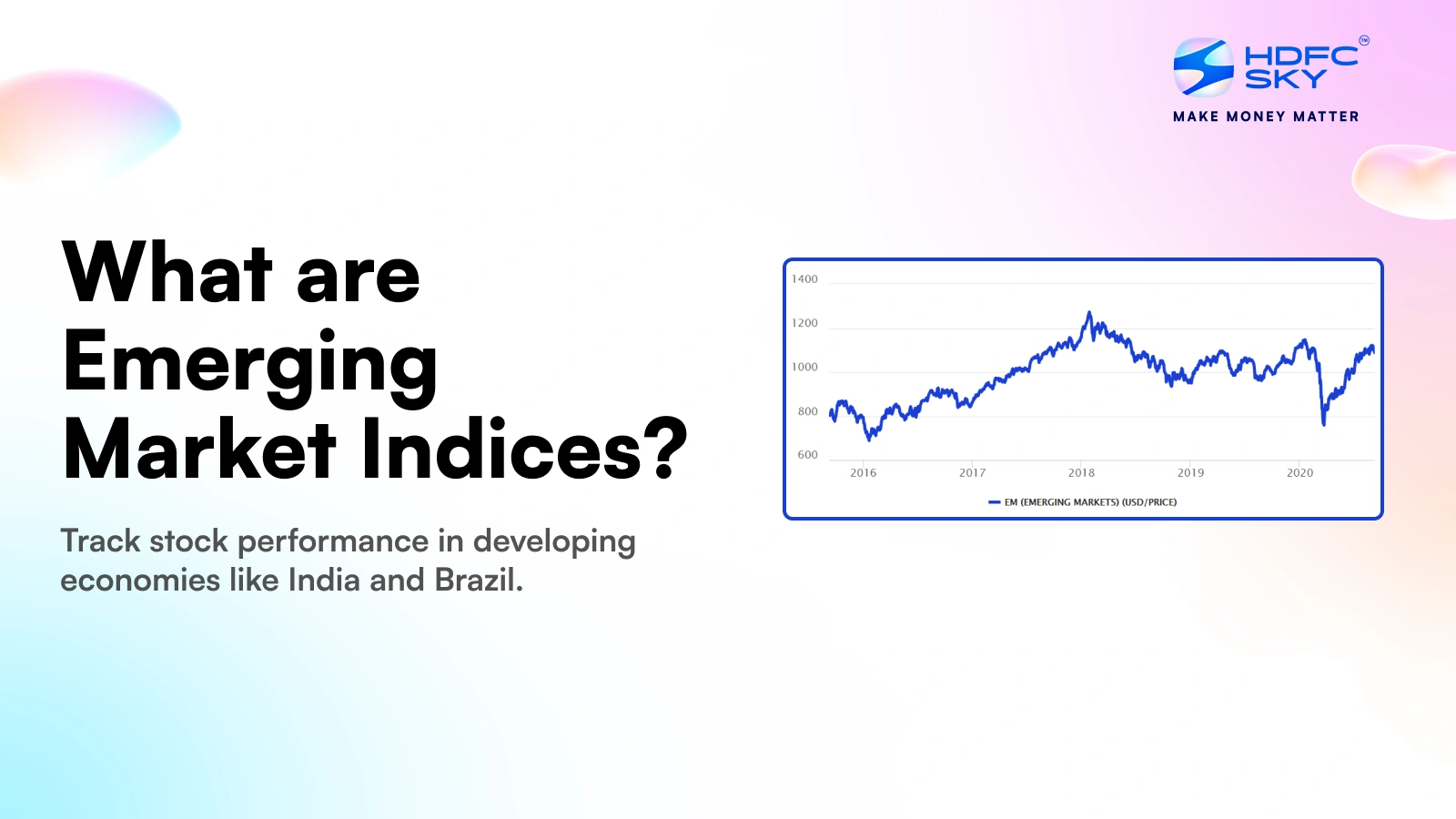
Despite the stock market indices from emerging economies becoming popular amongst seasoned investors, as a beginner you may wonder what these market indices are exactly. These are indices that track stocks listed on the stock exchanges of developing countries.
Some of these developing countries include Brazil, Russia, India, China, and South Africa (also known as the BRICS countries). This is the main reason such indices are often referred to as BRICS indices.
BRICS Indices and Rising Economic Powerhouses
Since the BRICS countries are rapidly developing, they are experiencing industrialisation and urbanisation at a fast pace, making them attractive international investment opportunities for various multinational businesses. Moreover, these countries (like Brazil, Russia, India, China, and South Africa) together constitute the largest portion of the global population, making them the biggest target markets for multinational corporations (MNCs).
In fact, emerging market investments by these MNCs are so profitable because these countries together produce about 25% of the entire world’s gross domestic product (GDP).
- For example, Brazil has experienced recent significant growth in its agriculture and natural resources industries, catapulting it from an underdeveloped nation to a developing nation.
- On the other hand, China has recently become a technological manufacturing hub putting it at the precipice of global trade.
- Moreover, Russia and South Africa, being extremely rich in natural resources have made a name for themselves for exporting these resources, resulting in a spike in their GDP.
- Coming to India, its technology sector (especially software) has experienced a significant boom, making it a pivotal technology partner for several large MNCs.
It is for these reasons that investors should seriously consider investing in the BRICS indices to both diversify their investments globally and spread the overall risks in their portfolios.
Emerging Market Indices: Why Should Indian Investors Care?
Emerging market investment should be on your investment agenda because it offers global diversification and also opens up both opportunities and risks in the global market.
For example, investing in the stock market indices of emerging economies like China and India can allow you to invest in stocks with rapid growth potential. Whereas, investing in resource-rich emerging economies like Brazil and Russia can allow you to diversify your investments across commodities like precious metals.
Benefits of Investing in Emerging Market Indices
So, if you are planning to invest in BRICS Indices, here are some benefits that you can expect that will help you boost your investment game.
- Diversification: When you invest in the stock market indices of emerging economies, you are essentially reducing your risk exposure to a single country. This diversification helps you spread your risk across different geographical markets, thereby reducing it to some extent.
- Growth Potential: Emerging markets like the BRICS nations are known for their fast growth rates in industrialisation and urbanisation. This can translate to significantly higher returns for investors.
- Access to Multiple Sectors: Emerging market indices track a variety of sectors starting from agriculture to technology and finance. This exposure to multiple sectors can help you spread and reduce your overall risk.
Here is a table that shows the different growth prospects if you choose to invest in the stock market indices of BRICS nations.
| Country | Key Industry Focus | Growth Prospects |
| Brazil | Natural Resources | Agricultural exports leading the economy |
| Russia | Energy and Resources | Oil and gas dominate exports |
| India | Technology | Growing tech and service sectors |
| China | Manufacturing, Tech | Strong tech innovation and export power |
| South Africa | Mining | Global leader in mineral production |
How to Invest in Emerging Market Indices?
Having learnt about the benefits of investing in stock market indices in emerging economies, you may be enticed into investing in them. A Mutual Funds Return Calculator can help you project potential returns based on past performance and market trends. We suggests that you invest in exchange-traded funds (ETFs) and mutual funds that track the indices in these countries. In doing so, you need to dwell upon the complexities involved in directly trading stocks in these countries. You can also use a SIP Calculator to estimate potential returns while investing in mutual funds or ETFs that track BRICS indices. You can just rely on the price movements of entire market indices of these countries by choosing ETFs. The HDFC SIP Calculator can assist in mapping out your investment schedule to make the most of your SIPs in emerging market funds.
Risks to Consider
However, when investing in emerging market indices, you should be aware of the risks involved. The table below summarises these risks in a way that makes it simple to understand.
| Risk | Impact |
| Political Instability | There is a potential for sudden market changes |
| Currency Fluctuations | There may be changes in exchange rates affecting returns |
| Market Volatility | There could be unpredictable and significant price swings |
If you think you have the risk appetite to handle these, then you should go forward and invest in these emerging market indices from BRICS nations without hesitation. Nevertheless, we advise that you should always compare and contrast the risks versus benefits before doing so.
Conclusion
Despite being a seasoned investor, you may often overlook the benefits of investing in emerging market indices. But there are several benefits these indices offer, for both experienced and beginner investors.
Related Articles
FAQs on What is an Emerging Market Indices
What other emerging market indices should investors consider?
You can also consider MSCI Emerging Markets, FTSE Emerging Markets, and S&P Emerging Markets.
What are the risks associated with investing in emerging market indices?
Some of the associated risks include political instability, currency fluctuations, market volatility, and regulatory changes.
What factors influence the performance of emerging market indices?
Economic growth, political stability, currency exchange rates, commodity prices, and global investor sentiment are some factors influencing their performance.




