
- Offerings
- Tools & Platforms
Tools & Calculators
- Open API
- Calculators
- SIP Calculator
- CAGR Calculator
- Compound Interest Calculator
- FD Calculator
- RD Calculator
- EPF Calculator
- Retirement Calculator
- HDFC SIP Calculator
- Mutual Fund Return Calculator
- Lumpsum Calculator
- Step Up SIP Calculator
- ETF SIP Calculator
- Brokerage Calculator
- Equity Margin Calculator
- SWP Calculator
- EMI Calculator
- MTF Calculator
- Pricing
- SKY Learn
- Mutual Funds
- Margin Trading
- Financial Planning
- Personal Finance
- Share Trading
- IPO
- Derivatives
- Currencies
- Intraday Trading
- Trading Strategies
- Demat Account
- Commodity
- ETF
What are Mid-Cap Stocks?
By Shishta Dutta | Updated at: May 15, 2025 05:21 PM IST
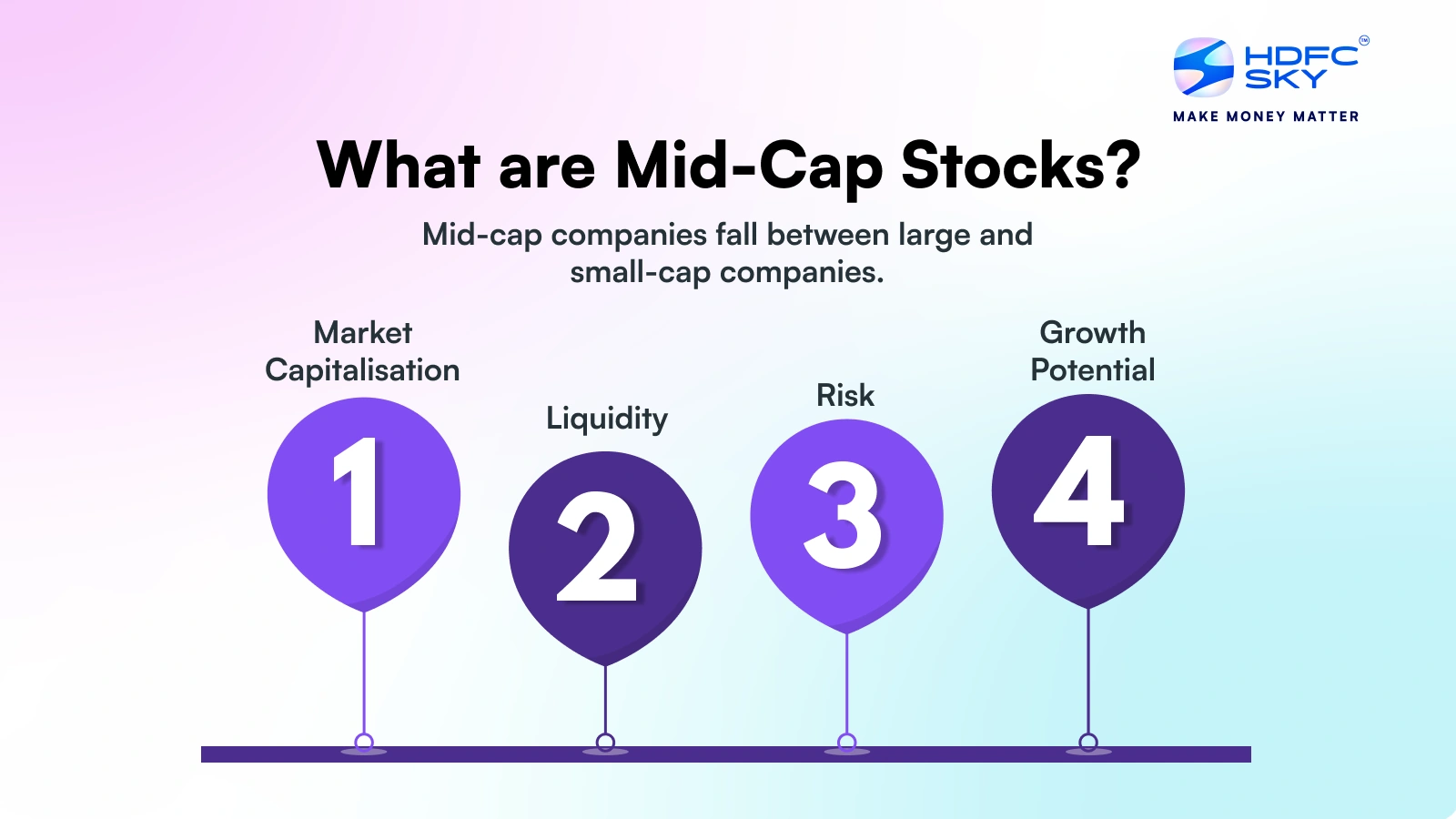
A company’s stock classification depends on its market capitalisation. One such classification is mid-cap stocks.
In this article, we will discuss mid-cap stocks in detail – their meaning, how the classification is done, why you should consider investing in mid-cap stocks and much more.
What is Market Capitalisation?
To understand mid-cap stocks, we need to understand market capitalisation first. Market capitalisation is the market value of any company, which is calculated by multiplying the total amount of outstanding shares by the present value of each share. Primarily, companies are categorised into three types based on market capitalisation:
-
Large Cap
These are big corporations with good market reputations and proven track records. They are known to provide regular dividends. Their market capitalisation is usually over Rs. 20,000 crores.
-
Mid Cap
Mid cap companies are those whose market capitalisation is less than that of large cap companies but greater than that of small cap companies. There is no hard and fast rule but companies with a market capitalisation of between Rs 5000 crore and Rs 20,000 crore are considered to be mid cap companies.
-
Small Cap
As the name suggests, small cap companies are those that have small market capitalisation. Again, there is no hard-and-fast rule but companies with a market capitalisation of less than Rs 5000 crore are considered to be small cap companies.
What is Mid-Cap Stock Market Cap?
Mid-cap stocks refer to mid-sized companies with a market capitalisation between Rs. 5,000 crore and 20,000 crores. Mid-cap companies fall between large and small-cap companies.
Why should you invest in mid-cap stock?
There can be many reasons to invest in mid-cap companies such as:
-
Growth potential
Mid-cap companies may have good growth potential.
-
Portfolio Diversification
Investing in mid-cap stocks may allow you to diversify your portfolio.
-
Market Reputation
Many mid-cap companies have a good track record, and people know their names because they are in a growth phase and have a good market presence.
Features of Mid-Cap Stock
The following are the features of mid-cap stocks:
-
Market Capitalisation
Mid-cap companies have a market capitalisation between Rs. 5,000 crores and Rs. 20,000 crores. They are positioned between large-cap and small-cap companies in terms of market capitalisation.
-
Liquidity
Mid-cap stocks tend to be more liquid than small-cap stocks because they have a strong track record, and buyers and sellers can trade their shares easily.
-
Risk
Mid-cap stocks may be comparatively riskier than large-cap companies but they may be risky than small-cap companies.
-
Growth Potential
Many Mid-cap stocks may offer high growth potential because they may have a higher chance of increasing their profitability and market share in their industry, which can be reflected in the stock price.
What Are the Risks Associated with Mid-Cap Stocks?
Apart from all the reasons to invest in mid-cap companies, there are also risks associated with mid-cap companies:
-
Volatile Stock Price
As mentioned earlier, many mid-cap stocks may be more volatile than large-cap stocks, which can be a risk for conservative investors or new investors who are not used to the stock market’s volatility.
-
Liquidity
In some instances, mid-cap stocks with lower trading volume may face liquidity issues, making it challenging to sell them.
-
Limited Information Available
This applies to some mid-cap companies that are growing, but these companies may not be adequately tracked by analysts. There may not be enough information available for them publicly.
-
Management Issues
Some Mid-cap companies may face internal management difficulties in executing growth strategies and creating disputes that may impact their stock prices.
-
Industry Related Risk
The industry to which a specific mid-cap stock belongs may face issues that can impact the stock price. For example, EVs are booming in India, which has changed how the automobile industry works. Many companies are affected by this boom; some are doing well and innovating new products, while some are struggling to cope with the market. These things are also reflected in the stock price.
Things You Should Know Before Investing In Mid-Cap Stock
-
Finances of the Company
While you invest in a mid-cap company, you must check its finances, such as profits, cash flow, investment activities, etc., which gives you an overview of the company’s performance.
-
Management
Management plays a crucial role in the growth of mid-cap companies. If there is a continuous change in company management or facing disputes internally, it may be a risk. Conversely, if the company’s management is stable and helping to grow, it can take the company to new heights. You must select a mid-cap stock that has stable management.
-
Risk Tolerance
Mid-cap stocks may be riskier than large-cap stocks. If you are an aggressive investor and do not mind taking a slightly higher risk, you can proceed with mid-cap stocks. But, they can be risky for conservative investors who prefer regular dividends and stable growth.
-
Investment Horizon
Mid-cap stocks may be suitable for an investor depending on her unique risk profile and investment horizon.
-
Diversification
It may be good to have a diversified portfolio that has stocks from across all market capitalization categories.
Conclusion
Lastly, investing in mid-cap stocks can be lucrative in the long term if you follow the right strategy. Always thoroughly research the company’s fundamentals, growth potential, and industry future. This will give you a broader view of the stock’s potential. Consult a financial advisor before making any investment decisions. Happy Investing!
Open your demat account with HDFC Sky and upgrade to a better investing experience.
Related Articles




