
- Offerings
- Tools & Platforms
Tools & Calculators
- Open API
- Calculators
- SIP Calculator
- CAGR Calculator
- Compound Interest Calculator
- FD Calculator
- RD Calculator
- EPF Calculator
- Retirement Calculator
- HDFC SIP Calculator
- Mutual Fund Return Calculator
- Lumpsum Calculator
- Step Up SIP Calculator
- ETF SIP Calculator
- Brokerage Calculator
- Equity Margin Calculator
- SWP Calculator
- EMI Calculator
- MTF Calculator
- Pricing
- SKY Learn
- Mutual Funds
- Margin Trading
- Financial Planning
- Personal Finance
- Share Trading
- IPO
- Derivatives
- Currencies
- Intraday Trading
- Trading Strategies
- Demat Account
- Commodity
- ETF
What is an SME IPO? Meaning, Process, Features & Key Differences
By Shishta Dutta | Updated at: Jun 5, 2025 04:50 PM IST
Small and Medium Enterprises (SMEs) play a crucial role in India’s economy. They represent 96% of industrial units, contributing 40% to industrial production and 42% to exports. As of February 2024, with a total of 633.9 lakh Micro, Small, and Medium Enterprises (MSMEs), over 99% of which are micro-enterprises, SMEs are the backbone of the Indian economy. These numbers highlight the significant role SMEs play in generating employment and fostering economic growth. The data indicates the immense growth potential and significance of SMEs in India.
Now, did you know you can own shares in these SMEs as well? SMEs often raise capital by offering shares to the public through SME IPOs. These IPOs allow investors to buy shares in these growing companies, offering them a stake in their success. In this blog, we will run you through all the important information on SME IPOs.
What is SME?
SME stands for Small and Medium Enterprises. These businesses are typically characterised by their smaller scale in terms of assets, revenue and number of employees. SMEs play a crucial role in the economy, operating across various sectors like manufacturing and services. They are essential contributors to economic growth and job creation. In India, to be classified as an SME, there are specific cut-off levels, which are given below:
| Type of Enterprise | Investment Amount (in Rs) | Turnover Amount (in Rs) |
| Small Enterprise | 1 crore – 10 crores | 5 crores – 50 crores |
| Medium Enterprise | 10 crores – 20 crores | 50 crores – 100 crores |
What is an SME IPO?
SME IPOs are similar to regular mainboard IPOs. The main difference is that these are IPOs by small and medium enterprises. These SMEs turn to IPOs when they need more funding than what private investors can provide. Through an IPO, public investors can buy shares of the SME and become stakeholders. Unlike regular IPOs that have strict guidelines, SME IPOs have more flexible rules, allowing even smaller companies to raise capital from the public.
After the IPO allotment is done, the SME stock is listed and traded on a separate stock exchange platform dedicated to SMEs. They are not listed on the Bombay Stock Exchange or the National Stock Exchange. This is because SMEs are smaller in size compared to other companies.
Also Read: IPO Process: How Initial Public Offerings Work
SME IPO Eligibility Criteria
In order to be eligible to go public through IPO and be listed on the SME stock exchange platform, the SMEs have to meet certain criteria, which are:
- The SME must be registered under the Companies Act, 1956
- The (post-issue paid-up capital) of the SME should not be more than Rs 25 crores
- The net asset value of the SME should be at least Rs 1.5 crores
- Partnership/proprietorship/LLP firms converting to SME must have a minimum track record of 3 years
- The SME must have a functioning website
- There should be no change in the promoters of the SME for at least one year after filing the IPO
- The SME must be willing to trade Demat securities
- The SME must enter into a contractual agreement with depositories
Apart from the above, the following conditions have to be adhered to be listed on the exchange –
- Public shareholding should be at least 25%
- A minimum of 25 traders members
- There must be a minimum subscription of 50 investors in the IPO
- A minimum trading lot of Rs 1 lakhs for retail investors and Rs 5 lakhs for non-retail investors
- 100% compulsory underwriting, of which 15% is to be done by the merchant banks in their own account
- Market makers must be registered in the exchange for at least 3 years
- Though not subject to SEBI observation, the offer document has to be released
- If the application is rejected, the SME cannot reapply for an IPO for at least 6 months
How Does SME IPO Work?
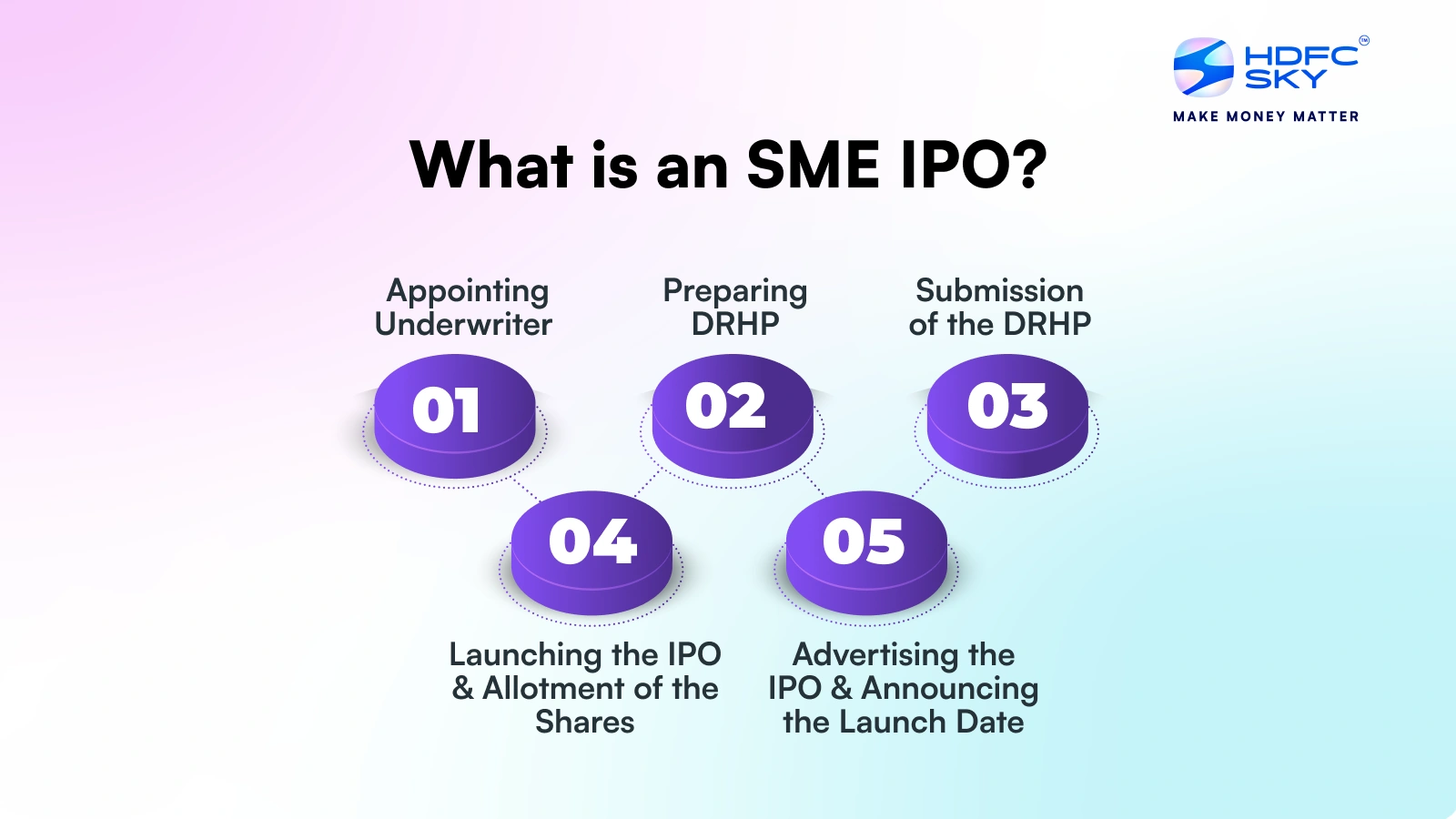
In this section, we will discuss the steps that should be followed by an SME to be listed in the exchange:
- Appointing Underwriter – Similar to the mainboard IPO, selecting an underwriter or a merchant banker is the first step in initiating the SME IPO. An underwriter is a specialist in market expectations. Drafting the IPO-related documentation, which includes information regarding the face value and selling price of the shares, is the responsibility of the underwriters. The designated merchant banks are required to carry out due diligence to guarantee that the information provided by the SME is precise and error-free.
- Preparing DRHP – Before an SME raises capital from them, the potential investors will like to know about the operations and prospects of the SME. A draft of the Red Herring Prospectus (DRHP) is curated by the underwriter. The DRHP contains all the relevant details of the company’s financials, its industry, its plans and likewise. This document helps prospective investors to assess the SME vis-à-vis the market and make an informed investment decision.
- Submission of the DRHP – Companies submit the DRHP to the Securities and Exchange Board of India (SEBI) when they apply for a normal IPO. SMEs, however, are required to submit and have the stock exchange validate the DRHP.
- Advertising the IPO & Announcing the Launch Date– After the stock exchange approves the draft, the underwriters set the IPO opening and closing dates, issue price, and other details like when the IPO will be launched. At this point, only the underwriters, banks, and the stock exchange know about the company’s plan to go public. So, the next step is to advertise and market the new IPO to attract public investors.
- Launching the IPO & Allotment of the Shares – Launching the IPO on the opening day is the final step. Before the closing date, investors may subscribe for a minimum lot of shares. At this stage, a limited group of investors get share allocations during the allotment stage. Once the IPO is formally launched in the primary market, the SME becomes a public company and shares are allotted to investors. Also, at this point, shares are available for purchase on the secondary market by other investors.
Also Read: Types of IPO: A Comprehensive Guide
Features of SME IPOs
In addition to the discussion above, listed below are some features of SME IPOs to help you understand the prerequisites of SME IPOs:
- To list and trade stocks on an SME platform, an SME must declare an IPO through an exchange.
- The post-issue paid-up capital of the SME must not exceed ₹25 crore, as mentioned before.
- Directors, promoters, and investors for SME IPO must meet the same eligibility requirements as for a regular IPO. Thus, they cannot be defaulters, offenders, or disqualified from accessing capital markets.
- In 2012, NSE and BSE launched two exchanges dedicated to SME IPO listings – the BSE SME platform by the Bombay Stock Exchange and NSE EMERGE by the National Stock Exchange.
What is the Difference Between IPO & SME IPO
There are a multitude of similarities and differences between a regular IPO and an SME IPO. While similarities make the understanding of the topic easier, differences can make it confusing.
Here is a tabular description of the difference between IPO and SME IPO to provide you with an easy guide on the difference between the two:
| Particulars | SME IPO | Mainboard IPO |
| Post-issue Paid-up Capital | Rs 1crore – 25 crores | Minimum Rs 10 crores |
| Application Size | At least Rs 1 lakh for 1 lot | Between Rs 10,000 – 15,000 |
| Underwriting Requirements | Mandatory 100% underwriting with Merchant Banker underwriting 15% | No mandatory IPO underwriting. Under 50% underwriting to Qualified Institutional Buyers (QIBs) |
| Regulatory Body | Stock Exchange reviews the offer document | SEBI reviews the offer document |
| Timeframe | 3 – 5 months | 6 – 12 months |
| Documents Required | The SME has to submit half-yearly reports | The company has to submit quarterly reports |
| Number of allottees | Minimum 50 allottees | Minimum 1000 allottees |
| Listing | On the BSE SME Platform and NSE Emerge | On BSE and NSE |
How to Invest in SME IPO?
So, if you are planning to invest in an SME IPO, here is a step-by-step guide on how to invest in an SME IPO:
- Step 1: Open Demat account and trading account with a registered stockbroker
- Step 2: Check the IPO’s minimum application value, which is often > Rs. 1 lakh for retail investors
- Step 3: Ensure you meet the eligibility criteria set by the SME and the stock exchange
- Step 4: Apply for the IPO through your stockbroker or the online platform provided by the exchange
- Step 5: Go to the “SME IPO” section and select the IPO you want to invest in
- Step 6: Enter how many lots you want to apply for
- Step 7: Make the payment from your linked account
- Step 8: Monitor the IPO subscription status and allotment process
- Step 9: After allotment, the shares will be credited to your Demat account, and you can start trading them on the SME platform
- Step 10: When selling SME shares, traders and investors must sell in lots or multiples of lot
- Step 11: Investors and traders can sell the lots only on the exchange where the SME shares are listed
Advantages of SME IPO
By far we have discussed the SME IPO process, its eligibility criteria, other requirements, and how it is different from a mainboard IPO. Basis all the information, one may wonder why should they invest in an SME IPO. Consider the following:
- Potential for High Returns: SMEs have growth potential, and investing early through IPOs can yield high returns as the company grows.
- Diversification: SME IPOs offer an opportunity to diversify your investment portfolio beyond large-cap stocks.
- Contributing to SME Growth: Investing in SME IPOs provides crucial funding for small businesses, supporting their growth and expansion.
- Access to New Opportunities: SME IPOs allow investors to access new and innovative businesses that may not yet be available on the main stock exchanges.
SMEs are Backed by the Government: Because SMEs are one of the biggest catalysts of economic growth and job creation, the Government of India now and then comes up with various policies and programs to support SMEs.
Related Articles
FAQs
What is the SME market?
The market segment that caters to small and medium-sized businesses is known as the SME market. Usually, these companies employ less than 250 people and have restricted access to conventional finance options like bank loans.
What is an SME IPO in the share market?
SME IPO is an IPO specifically meant for small and medium enterprises. This allows them to raise capital from people.
How to sell SME in IPO shares?
Following the IPO allotment, you can sell your shares through your broker on the SME exchange where they are listed once they are credited to your Demat account.
How to buy SME IPO shares?
To buy SME IPO shares, open a Demat account, access the IPO platform on your broker’s site, select the desired IPO, enter the number of lots, and confirm and pay through UPI/ASBA. After allotment, the SME IPO shares will be credited to your Demat account.
Is SME IPO good for investments?
If SME IPOs are fundamentally sound and have significant growth potential, they can yield healthy returns. But there’s always a danger when applying to IPOs, therefore before applying for an SME IPO, always research the financial health and growth prospects of the company.




