- Offerings
- Tools & Platforms
Tools & Calculators
- Open API
- Calculators
- SIP Calculator
- CAGR Calculator
- Compound Interest Calculator
- FD Calculator
- RD Calculator
- EPF Calculator
- Retirement Calculator
- HDFC SIP Calculator
- Mutual Fund Return Calculator
- Lumpsum Calculator
- Step Up SIP Calculator
- ETF SIP Calculator
- Brokerage Calculator
- Equity Margin Calculator
- SWP Calculator
- EMI Calculator
- MTF Calculator
- Pricing
- SKY Learn
- Mutual Funds
- Margin Trading
- Financial Planning
- Personal Finance
- Share Trading
- IPO
- Derivatives
- Currencies
- Intraday Trading
- Trading Strategies
- Demat Account
- Commodity
- ETF
- What is Asset Allocation Fund in Mutual Funds?
- Types of Asset Allocation Funds
- Benefits of Asset Allocation Funds
- Who Should Invest in Asset Allocation Funds?
- Factors to Consider Before Investing in Asset Allocation Funds
- Examples of Asset Allocation Funds
- Conclusion
- FAQs on What is Assets Allocation Funds
- What is Asset Allocation Fund in Mutual Funds?
- Types of Asset Allocation Funds
- Benefits of Asset Allocation Funds
- Who Should Invest in Asset Allocation Funds?
- Factors to Consider Before Investing in Asset Allocation Funds
- Examples of Asset Allocation Funds
- Conclusion
- FAQs on What is Assets Allocation Funds
What is Asset Allocation Fund? Meaning, Types, Benefits and Taxation
By HDFC SKY | Updated at: Jul 25, 2025 03:13 PM IST
Summary
- Asset Allocation Funds are mutual funds that invest across asset classes like equity, debt, and sometimes gold or real estate, depending on market conditions.
- These funds aim to balance risk and return by dynamically shifting allocations based on market opportunities and economic trends.
- Categories include Dynamic Asset Allocation Funds, Multi Asset Allocation Funds, and Balanced Advantage Funds, each differing in allocation strategy and investment flexibility.
- Ideal for investors seeking diversification, risk moderation, and exposure to multiple asset classes in a single investment.
- Asset Allocation Funds are professionally managed, making them suitable for those who prefer not to monitor or rebalance portfolios regularly.
- These funds also help in reducing volatility during market fluctuations, making them a prudent choice for medium to long-term goals.
- They offer the advantage of automatic rebalancing, tax efficiency, and potential for optimized returns over time.
- Investors should assess their risk profile and investment horizon before choosing such a fund.
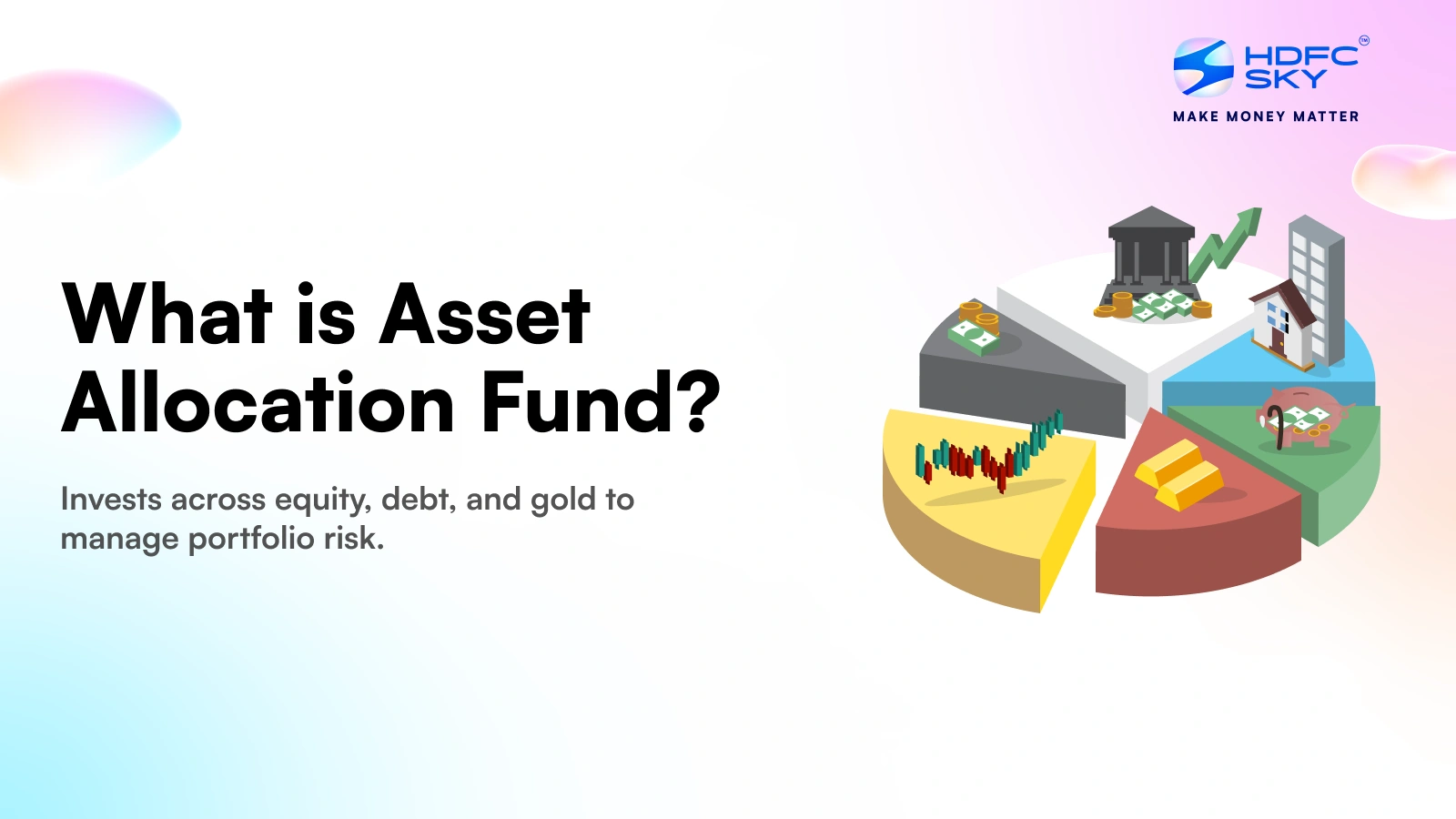
Asset allocation mutual funds have emerged as a smart investment tool for novice and experienced investors. These funds distribute investments across asset classes like equities, bonds, and cash equivalents, providing diversification and reducing risks. But what exactly are these funds, and why should they be part of your portfolio? Let’s explore the asset allocation fund meaning, its types, benefits, features, and more.
What is Asset Allocation Fund in Mutual Funds?
Asset allocation funds are mutual funds that invest across multiple asset classes, such as equities, bonds, and cash, based on a predefined strategy. The allocation can be fixed or dynamic, depending on market conditions and the fund’s objectives.
Asset allocation examples:
- Consider a fund allocating its investment 60% to equities and 40% to bonds for a moderate risk-reward profile.
- If the stock market is expected to outperform, the allocation to equities may increase dynamically, boosting potential returns.
These funds are managed by professional fund managers who analyse market trends and adjust the portfolio accordingly to maximise returns while managing risks.
Types of Asset Allocation Funds
Asset allocation funds cater to various investment goals and risk appetites. Here are the primary types:
Target-Date Funds
Also known as life-cycle funds, these are designed with a specific maturity date in mind, often used for goals like retirement planning.
- Features:
- Starts with a higher equity allocation for growth.
- Gradually shifts to bonds and other conservative assets as the target date approaches.
- Suited for investors with long-term goals.
Example:
An investor planning to retire in 2045 may invest in a Target-Date 2045 Fund.
That means the fund will invest heavily in equities and transition to bonds as 2045 approaches to align with investor’s objectives.
Dynamic Asset Allocation Funds
These funds adjust their asset mix dynamically based on market conditions, optimising returns and managing risks.
- Features:
- Actively managed to take advantage of market opportunities to make quick gains.
- Increases allocation to asset classes expected to perform better.
- Reduces exposure to underperforming assets.
Example:
If equities are expected to outperform bonds due to favourable market conditions, the fund manager may increase equity allocation, boosting potential returns.
Static Asset Allocation Funds
These maintain a fixed allocation ratio among asset classes, providing consistency and simplicity.
- Features:
- The allocation is predetermined and does not change with market conditions.
- Balanced funds are a popular type, with 60% in equities and 40% in bonds.
Example:
A static fund may consistently maintain a 50-50 split between equities and bonds, appealing to investors seeking consistent returns and minimal adjustments.
To understand how periodic investments can help meet these goals, use the SIP Calculator.
Benefits of Asset Allocation Funds
The advantages of investing in asset allocation mutual funds extend far beyond simple diversification:
Diversification
Diversification is the cornerstone of asset allocation funds. By spreading investments across multiple asset classes like equities, bonds, and cash equivalents, these funds reduce the dependence on any single asset class’s performance. This ensures that even if one class underperforms, the others can potentially offset the loss.
- Why It Matters: Diversification protects investors from the inherent risks of putting all eggs in one basket, making it a safer choice for both seasoned and novice investors.
Market Volatility Control
The financial markets are unpredictable, you may witness market volatility that can create negative sentiments among investors. Asset allocation funds manage this by diversifying across asset classes with varying risk profiles, thereby reducing the effect of volatility on the overall portfolio.
- Example: During a market correction, while equities may decline sharply, bonds or cash equivalents in the portfolio can maintain stability, ensuring steadier returns.
- How It Helps: This feature makes these funds especially appealing to investors seeking to navigate turbulent markets with minimal stress.
Professional Management
One of the standout benefits of asset allocation mutual funds is the expertise of professional fund managers. These managers actively monitor market trends and economic indicators to adjust the portfolio composition in real time, aligning it with market conditions.
- Example: If the equity market is poised for a rally, the fund manager might increase equity exposure. Conversely, if bonds are expected to perform better due to falling interest rates, the allocation may shift accordingly.
- Investor Advantage: These funds are managed by professional management. These professionals adjust investors’ portfolios based on market trends, making asset allocation funds ideal for investors who lack the time or expertise to track.
Potential for Returns
Combining asset classes with different growth potentials allows asset allocation funds to create a balanced risk-reward profile. Equities provide growth opportunities, while bonds and cash equivalents offer stability.
- Example: An investor in an asset allocation fund earns higher returns compared to a debt-only fund during a bull market, as the equity portion generates significant growth.
- Outcome: This balance ensures that even conservative investors can benefit from equity market growth without taking on excessive risk.
To estimate your potential wealth accumulation through periodic investments, consider the HDFC SIP Calculator.
Who Should Invest in Asset Allocation Funds?
Asset allocation mutual funds are suitable for a broad audience:
Risk-Averse Investors
These funds are ideal for individuals seeking steady returns without excessive risk exposure. The mix of asset classes ensures that market fluctuations have a limited impact on the portfolio.
Novice Investors
Beginners looking for a diversified and professionally managed portfolio can benefit from these funds. They eliminate the need for in-depth market knowledge or active involvement.
Medium-Term Investors
Investors planning for goals 5-10 years away can also benefit from these funds. For example, someone saving for a child’s college education could choose a fund that balances growth through equity exposure and stability with bonds as the timeline progresses.
Long-Term Investors
Investors with goals like retirement or children’s education find these funds particularly useful. Target-date funds, for instance, adjust allocations dynamically as the target date approaches, ensuring reduced risk near maturity.
Factors to Consider Before Investing in Asset Allocation Funds
Before getting into asset allocation examples, consider these crucial factors:
- Risk Tolerance: If you’re more comfortable with higher risks, choose funds with greater equity exposure; for lower risks, opt for funds with more bonds.
- Investment Horizon: Your investment timeline matters. Short-term goals might favor funds with conservative allocations, focusing on stability. For long-term goals, funds with a mix of growth (equity) and stability (bonds) offer a balanced strategy.
- Costs: Be mindful of expenses like management fees, entry/exit loads, and performance incentives. Higher costs can eat into returns, so it’s essential to assess whether the benefits justify the charges.
- Tax Implications: Short-term gains from these funds are taxed as per the investor’s income slab, while long-term gains are taxed at 20% with indexation. Knowing the tax treatment helps in better financial planning.
Examples of Asset Allocation Funds
Let’s explore how different investors might approach asset allocation through examples:
Scenario 1: The Conservative Retiree’s Portfolio
Rajesh, 65, is retired and focuses on protecting his savings while earning steady income. His portfolio looks like this:
- Portfolio Composition:
- 30% in large-cap equity funds for moderate growth
- 45% in government bonds for safety
- 25% in corporate bonds for higher returns
- A small cash reserve for emergencies
- Why This Works:
Rajesh’s limited equity exposure helps offset inflation, while the bond-heavy allocation ensures stability. This portfolio typically delivers returns aligned with historical averages (6-8%) while minimising volatility. - In Inflationary Conditions:
Bonds provide steady interest despite rising costs, and equities offer some growth to counter inflation’s effects.
Scenario 2: The Growth-Oriented Young Professional
Priya, 28, has a long investment horizon of 30 years. She opts for a dynamic allocation fund that adjusts based on market conditions:
- Key Highlights:
- Higher equity allocation during bull markets to maximise growth
- Increased bond exposure during bear markets to manage risk
- A small portion in gold for diversification
- Why This Works:
Priya’s portfolio prioritises growth in her early earning years while gradually becoming more conservative closer to retirement. The fund’s dynamic adjustments help navigate market highs and lows effectively, aiming for returns comparable to historical equity averages (10-12%) over the long term.
Taxation of Asset Allocation Funds
Taxation depends on the proportion of equity and debt investments:
- Short-Term Capital Gains (STCG):
Taxed as per the investor’s income slab for holding periods under three years. - Long-Term Capital Gains (LTCG):
Taxed at 20% with indexation benefits for holdings over three years.
Example:
If you earn ₹50,000 in long-term gains from an asset allocation fund after three years, tax is levied at 20% after indexation adjustments.
Conclusion
Asset allocation funds combine the benefits of diversification, risk management, and professional oversight, making them a versatile investment option. By tailoring portfolios to individual goals and risk appetites, these funds cater to a wide range of investors. Evaluate expected returns with a Mutual Funds Return Calculator. Whether you’re planning for long-term goals or seeking stability in volatile markets, asset allocation funds offer a structured and balanced approach to wealth creation.
Related Articles
FAQs on What is Assets Allocation Funds
Is an asset allocation fund good?
An asset allocation fund can be a good option for investors seeking diversification across different asset classes, such as stocks, bonds, and cash. These funds offer professional management, risk diversification, and steady returns by spreading investments across multiple asset classes. However asset allocation funds often have higher fees compared to traditional equity or debt funds and may not align with your objectives in volatile markets.
What is the key difference between balanced funds and asset allocation funds?
Balanced funds maintain fixed ratios like a recipe that never changes. Asset allocation funds, however, can adjust these proportions based on the investor’s objective.
What are the 4 types of asset allocation?
The four main types of asset allocation are: Strategic (fixed long-term mix), Tactical (short-term adjustments), Dynamic (market-responsive changes), and Insured (protecting against significant losses). Each serves different investment needs and risk preferences.
Why invest in asset allocation?
These funds work like a financial shock absorber, smoothing out market bumps while keeping you on track toward your goals. They provide professional management, automatic diversification, and consistent returns without requiring constant portfolio adjustments with minimal risks.
What are the golden rules of asset allocation?
Success in asset allocation follows three key principles: spread investments across different assets (diversification), maintain your target mix (regular rebalancing), and align your strategy with personal goals and comfort with risk.