- Offerings
- Tools & Platforms
Tools & Calculators
- Open API
- Calculators
- SIP Calculator
- CAGR Calculator
- Compound Interest Calculator
- FD Calculator
- RD Calculator
- EPF Calculator
- Retirement Calculator
- HDFC SIP Calculator
- Mutual Fund Return Calculator
- Lumpsum Calculator
- Step Up SIP Calculator
- ETF SIP Calculator
- Brokerage Calculator
- Equity Margin Calculator
- SWP Calculator
- EMI Calculator
- MTF Calculator
- Pricing
- SKY Learn
- Mutual Funds
- Margin Trading
- Financial Planning
- Personal Finance
- Share Trading
- IPO
- Derivatives
- Currencies
- Intraday Trading
- Trading Strategies
- Demat Account
- Commodity
- ETF
What is Cut-off Price in IPO? Know the Types of Types of IPO Pricing
By HDFC SKY | Published at: May 28, 2025 02:09 PM IST
Initial Public Offerings (IPOs) represent a significant opportunity for investors in India to become shareholders in companies listing on the stock exchanges for the first time. While the excitement around new IPOs is often high, understanding the pricing mechanism behind them is crucial.
For IPOs following the Book Building method, a term that frequently comes up is the “cut-off price”. Knowing what is cut-off price in IPO is vital for potential investors, especially those applying in the retail category, as it directly impacts their application strategy and chances of allotment.
Simply put, the final price at which investors purchase the IPO of a company is termed the cut-off price in IPOs. At the time of the IPO announcement, only the price band is mentioned. Once the bidding is over, the company announces the final price known as the cut-off price. Let’s get into the details to understand what exactly the cut-off price is in an IPO and how it is determined.
What is the Cut-off Price in an IPO?
The cut-off price in IPO means the final price per share at which the company’s shares are allotted to investors in a Book Building IPO. It is the single price discovered through the book-building process at which the total demand for shares matches the number of shares offered by the company. The cut-off price is typically fixed at the upper end of the price band set by the company. However, the cut-off price remains within the band price.
When you apply for a Book Building IPO as an investor in India, you are usually given the option to bid at a specific price within the price band or to select the “cut-off price” option. Choosing the cut-off price means you are willing to pay whatever the final determined price (the cut-off price) turns out to be, provided it is within the announced price band. This is a key element of the Book Building process regulated by SEBI, designed to help determine the optimal price based on market demand.
Types of IPO Pricing
Initial Public Offerings (IPOs) can be announced in two ways. The final price may or may not be released during the IPO announcement. These are the two types of IPO pricing:
-
Fixed Price IPO
Under fixed price IPO pricing, the company declares the final price per share of the IPO during the announcement. So, investors have clarity on the exact price of the IPO shares. However, in this model, investors do not receive daily updates on the number of people applying for IPO shares. Details of retail and institutional investors are made public after the IPO closes.
-
Book Building IPO
This is a price discovery mechanism where the company announces a price band (a minimum or ‘floor’ price and a maximum or ‘cap’ price) and invites bids from investors within this band. The final price is determined after the bidding period based on the demand received at various price points. This is where the concept of the IPO cut-off price applies.
Most large IPOs in India today utilise the Book Building method to gauge market sentiment and arrive at an optimal share price. However, in this model, the data of subscribers is made transparent to the investors daily till the IPO application period.
Key Factors Influencing Cut-off Prices
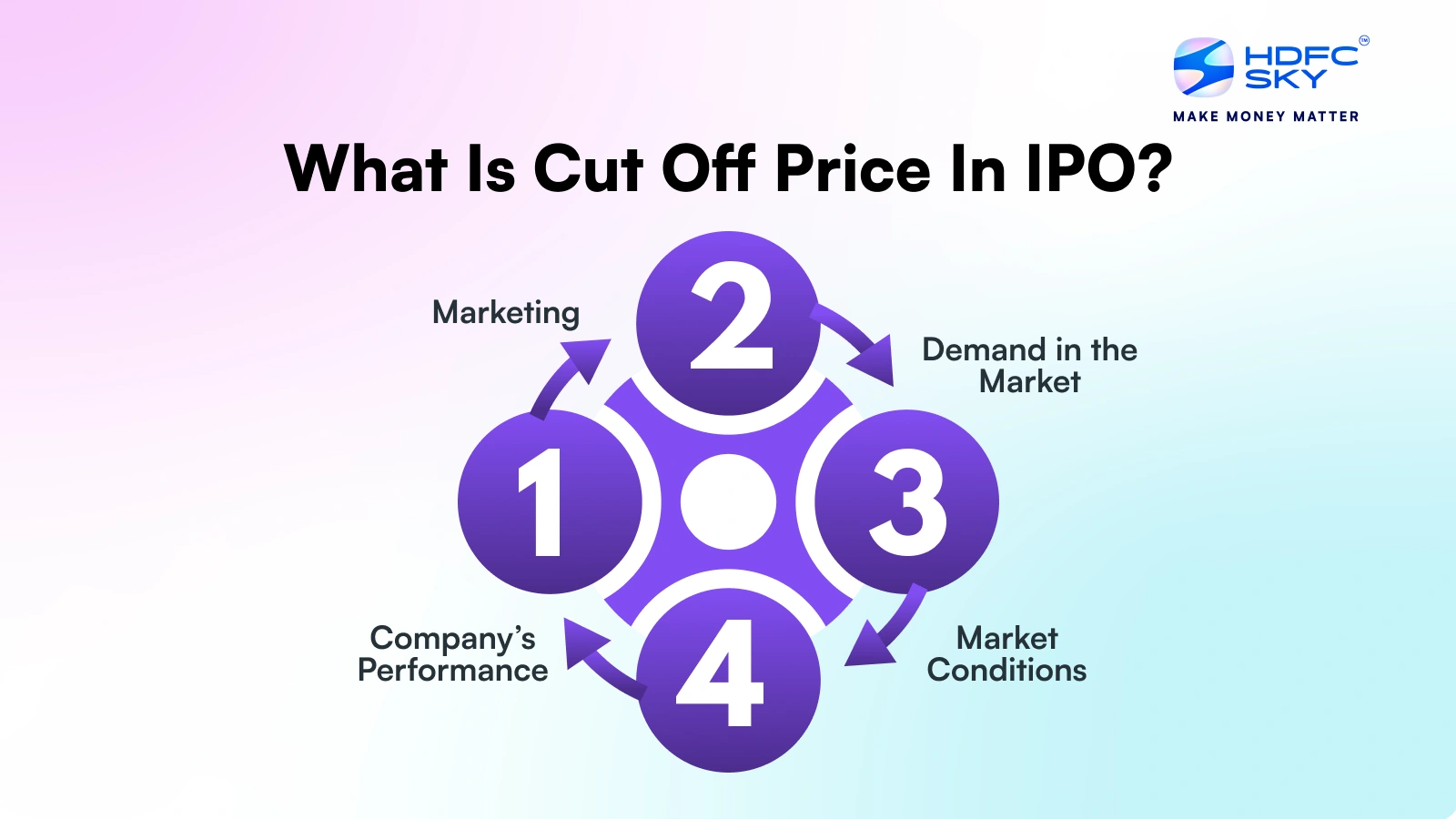
Now that you know what is the bid price and cut-off price in an IPO, it is crucial to understand what factors may affect the cut-off prices in an IPO. These may be:
-
Demand in the Market
Depending on the demand by the investors, the calculation of cut-off price may be done by the company. If the market shows strong demand, the cut-off price may be higher, and vice versa. Large participation of institutional and retail investors can push the cut-off price towards the higher end.
-
Market Conditions
The overall performance of the national and global economy can also play a crucial role. If the market is showing signs of recession, it may indicate a lower end of the cutoff price. However, in a positive market condition, the cut-off price may be higher.
-
Company’s Performance
When an IPO is launched, the company’s fundamentals also play a role in its demand. For instance, a company with positive past performance, revenue growth, high profitability, etc., may create a positive impact on the investors and thus create high demand in the market.
-
Marketing
The impact of marketing in business cannot be overlooked. The marketing and promotional strategies of a company and their ability to impact investors can affect the overall demand for IPO shares in the share market.
Significance of Cut-off Price in IPO
The significance of cut-off price in an IPO is multi-faceted. For the issuing company, it represents the price at which they successfully raised capital from the public. For investors, especially retail investors in India, understanding the meaning of cut-off price in an IPO is crucial for strategising their application.
Choosing the cut-off price option when applying essentially means you agree to pay the final discovered price, whatever it may be within the price band. This is often considered beneficial for retail investors because SEBI regulations often mandate a certain percentage of the issue be reserved for retail investors (currently 35% in most cases), and allotment often favours those who bid at the cut-off price, particularly in heavily oversubscribed issues.
It ensures that a retail investor’s bid is considered valid regardless of where the final price settles within the band, as long as they have sufficient funds blocked via ASBA to cover the application amount at the cap price. The Role of cut-off price in IPO is thus central to the price discovery process and critical for retail investor participation strategy.
Cut-off Price Calculation Process using a Formula
It is important to clarify that the cut-off price in IPO formula is not something an individual investor calculates. The cut-off price is the outcome of the collective bidding process during the book-building phase, determined by the company and its underwriters based on investor demand.
The process that leads to the determination of the cut-off price involves:
- Collecting Bids: Investors submit bids specifying the number of shares and the price within the band (or opt for cut-off).
- Aggregating Demand: The merchant bankers aggregate the total demand (number of shares bid for) at each price point within the band and for the cut-off option.
- Analysing the Book: They analyse the “book” of demand across all price points and investor categories (QIB, NII, Retail).
- Determining the Final Price: Based on where the maximum sustainable demand is located, the company, in consultation with the merchant bankers, fixes the final issue price. This price is the cut-off price.
For instance, if the price band is ₹100-₹110 and the demand is strongest at ₹110 across categories, especially with significant retail subscription opting for cut-off, the final price (cut-off price) will likely be fixed at ₹110. If the demand is weaker and concentrated at lower levels, the price might be fixed closer to the floor price, but this is less common in popular, oversubscribed IPOs in India, where the cut-off price is almost invariably the cap price.
So, while there’s no simple cut-off price in IPO example calculation for investors, the process is driven by supply (shares offered) and demand (bids received) across the price band. The Calculation of cut-off price is effectively a market discovery process, not a mathematical formula applied by investors.
But if you still need a formula then you can probably use the below equation for reference purposes:
Cut-Off Price = Lowest price at which ∑(Demand at each price level) ≥ Total available shares
How to Improve Chances of Getting an IPO allotment?
Understanding ‘what is cut-off price in an IPO’ is not enough. Securing your IPO shares in a book-building method is somewhat like a lucky draw. The company may or may not finalise the price in favour of your bidding.
However, there are still some ways in which you may increase your probability of getting IPO allotment. These are:
- Try to bid early when the IPO bidding starts at the cut-off price. This ensures your bid is considered valid irrespective of where the final price is fixed within the band.
- Try to bid for a single lot, as it may improve your chances of securing the share.
- Using multiple demat accounts of friends and family and bid at the cutoff price to improve your chances of allocation.
Conclusion
The cut-off price in an IPO is a fundamental concept within the Book Building mechanism used for most major public offerings in India. It represents the market-determined price at which shares are finally allotted, reflecting the collective demand from investors.
For retail investors, opting to apply at the cut-off price is often the recommended strategy to maximise the chances of getting an allotment in a popular issue. By understanding the types of IPO pricing, the factors influencing the cut-off price, and the best practices for applying, Indian investors can participate in IPOs with greater confidence and clarity.
Related Articles
FAQs on Cut-off Price in IPO
How is the cut-off price determined?
The cut-off price is determined by the company and merchant bankers at the end of the book-building process based on the aggregate demand received from all investor categories at various price points within the announced price band.
What happens if I apply at the cut-off price?
When you apply at the cut-off price then you make yourself eligible for allotment at any issue price, which is discovered through the book-building process. However, keep in mind that as an HNI (High Net worth Individual) applicant, you cannot select the cut-off price.
What is the role of the cut-off price in IPO?
The cut-off prices play a significant role in the launch of an IPO. The cut-off price is the price at which the company shares are offered. This price, therefore, can play a major role in attracting investors. Also, when an investor applies for this price, they are no longer allowed to enter a different price.
How does a cut-off price benefit retail investors?
Cut-off price in an IPO increases the chances of investors receiving an IPO allotment. It also simplifies the IPO bidding process, while allowing investors to pay a lesser amount as compared to the IPO’s maximum set price in case it is undersubscribed.
Why select the cut-off price?
The cut-off price plays a significant role in the price discovery mechanism. When you bid at the cut-off price, you have a higher probability of acquiring the shares, as your application will not get rejected because of a low bid price. The cut-off price serves as a point of reference to calculate the minimum investment required.