- Offerings
- Tools & Platforms
Tools & Calculators
- Open API
- Calculators
- SIP Calculator
- CAGR Calculator
- Compound Interest Calculator
- FD Calculator
- RD Calculator
- EPF Calculator
- Retirement Calculator
- HDFC SIP Calculator
- Mutual Fund Return Calculator
- Lumpsum Calculator
- Step Up SIP Calculator
- ETF SIP Calculator
- Brokerage Calculator
- Equity Margin Calculator
- SWP Calculator
- EMI Calculator
- MTF Calculator
- Pricing
- SKY Learn
- Mutual Funds
- Margin Trading
- Financial Planning
- Personal Finance
- Share Trading
- IPO
- Derivatives
- Currencies
- Intraday Trading
- Trading Strategies
- Demat Account
- Commodity
- ETF
- Demat Full Form
- What is Demat Account?
- How Does Demat Account Work?
- How to Open Demat Account Online
- Features of Demat Account
- Types of Demat Accounts
- Benefits of Demat Account
- Eligibility Criteria for Opening a Demat Account Online
- Documents Required to Open a Demat Account
- Demat Opening Charges
- Factors to Consider While Opening a Demat Account
- Conclusion
- FAQs on What is Demat Account?
- Demat Full Form
- What is Demat Account?
- How Does Demat Account Work?
- How to Open Demat Account Online
- Features of Demat Account
- Types of Demat Accounts
- Benefits of Demat Account
- Eligibility Criteria for Opening a Demat Account Online
- Documents Required to Open a Demat Account
- Demat Opening Charges
- Factors to Consider While Opening a Demat Account
- Conclusion
- FAQs on What is Demat Account?
What is Demat Account & How Does Demat Account Work?
By HDFC SKY | Updated at: Nov 3, 2025 07:39 PM IST
A Demat account, short for Dematerialised account, is an essential tool for investors in the stock market. It allows individuals to store and manage their shares and other securities in electronic format eliminating the risks and hassles of physical certificates. With a Demat account, trading becomes more secure, faster and convenient for both new and experienced investors.
Demat Full Form
A Demat account, Stands for Dematerialised Account, is an online repository that securely stores an investor’s shares and other financial securities in electronic form. It eliminates the need for handling or trading in physical share certificates, streamlining the investment process.
What is Demat Account?
A Demat account meaning dematerialised account is a digital account that holds stocks, bonds, ETFs and other securities in electronic form. It simplifies trading by eliminating the need for physical share certificates, making transactions seamless, secure and faster for investors.
How Does Demat Account Work?
A Demat account works like a digital locker that holds your shares and securities electronically. It helps in the smooth settlement of trades made in the stock market.
- Opening the Account: You open a Demat account with a depository participant (DP) linked to CDSL or NSDL.
- Buying Shares: When you buy shares via a trading platform, they get credited to your Demat account after settlement (T+1 or T+2 days).
- Selling Shares: When you sell, shares are debited from your Demat account and transferred to the buyer.
- Corporate Actions: Bonuses, dividends and rights issues are credited directly to your Demat account.
- Secure Record Keeping: It maintains your holdings with real-time updates and reduces paperwork.
How to Open Demat Account Online
Opening a Demat account online is simple, convenient and pocket-friendly. You can simply follow these six steps:
- Choose a Depository Participant (DP): A DP is a bank, stockbroker or financial institution that offers Demat services. Therefore, you must first select this based on benefits offered, Demat account opening charges and more.
- Visit the website of the Depository Participant or Download the mobile app: You can go to the official website of the depository participant of your choice or download the application from Android Play Store and iOS App Store.
- Fill in the Application Form: Then complete the application form for Demat facility filling in the necessary details like PAN number, Aadhar number and bank details. Next, you can select a nominee for your Demat account.
- Submit Documents Required for Demat Account: Upload scanned copies of the necessary address and identity verification documents along with a selfie.
- E-Signature: Some DPs offer e-signing options. If not, you can physically sign and submit your forms.
- Verification: The DP will verify the details. Once approved, the Demat account will be activated, Once opened your Demat account can be used to buy and sell securities.
Features of Demat Account
A Demat account offers secure and paperless holding of financial securities. It simplifies the process of buying, selling and transferring shares.
- Electronic Storage: Securities are held in digital form.
- Safe and Secure: Eliminates risks of theft, loss or damage.
- Easy Transfer: Quick transfer of shares during trading.
- Access to Multiple Securities: Holds shares, bonds, mutual funds, etc.
- Nomination Facility: Allows nomination for account ownership transfer.
- Corporate Benefits: Auto-credit of dividends, bonuses and rights issues.
- Reduced Paperwork: No physical certificates or delivery needed.
- Low Cost: Minimises handling and transaction charges.
Types of Demat Accounts
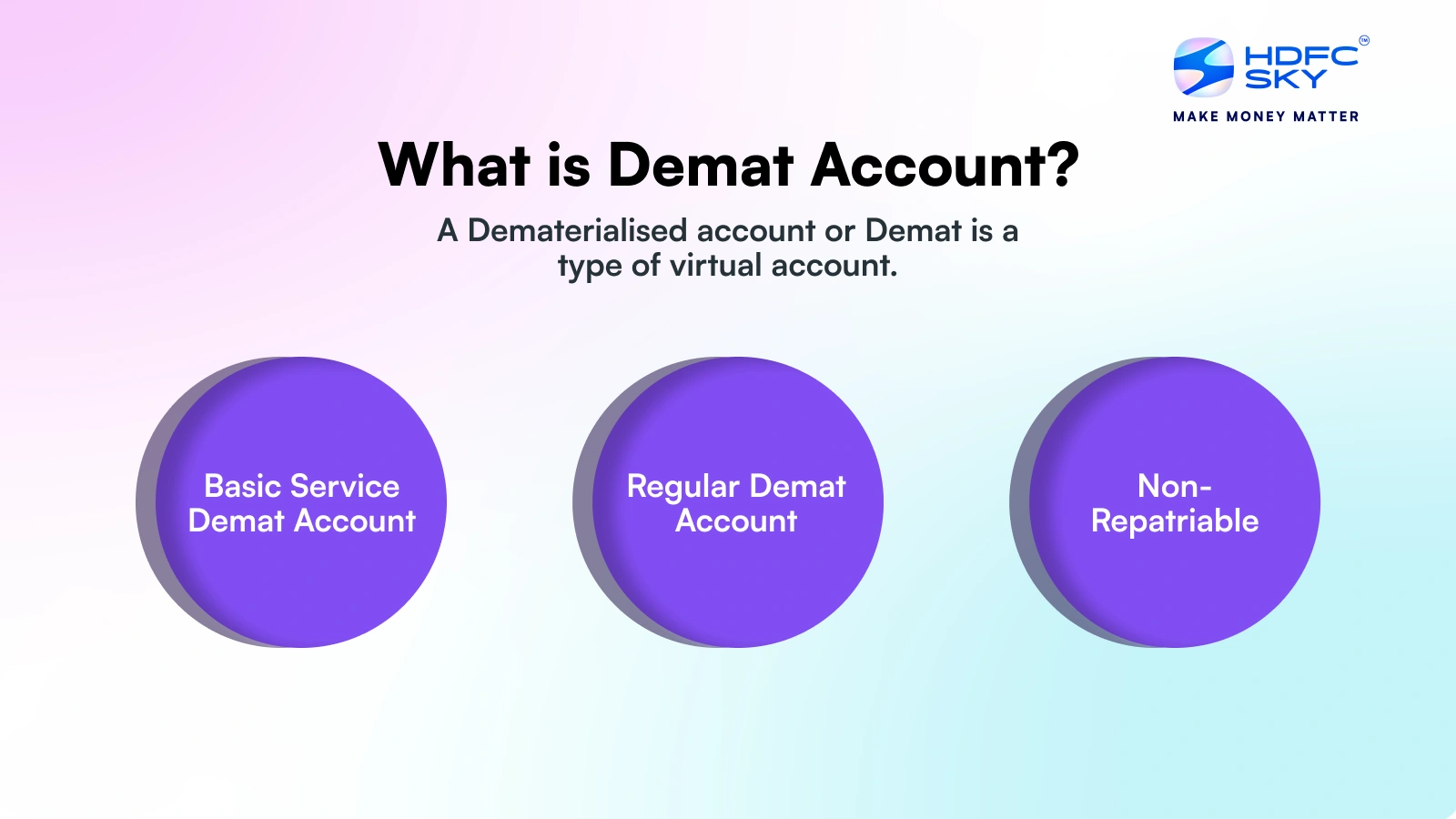
Demat account charges can differ based on the Demat account types and its benefits. Let’s look at some of the types below:
- Basic Service Demat Account: Introduced by The Securities And Exchange Board of India in 2012 for small investors. The difference between a Regular and Basic Service Demat account lies in the maintenance charges, there are no maintenance charges if the total value of the holdings remains less than Rs.50,000 in the investors account. The Basic Service Demat Account automatically converts to a Regular Demat Account if the total value of the holdings exceeds Rs.50,000.
- Regular Demat Account: This is the regular and default demat account offered by depositories. The charges on a Regular Demat Account are determined by the terms and conditions offered by your depository participant and depository. There is no limit on holdings in a Regular Demat Account.
- Repatriable: This account is specifically for the NRIs (Non-Resident Indians) called as NRI account. Repatriable Demat can help if they wish to transfer their securities abroad. This Demat type allows the transfer of funds and securities from India to a foreign country.
- Non-Repatriable: This Demat type is also for NRIs. However, it is meant for NRIs who don’t intend to transfer their securities abroad. The securities held in a non-repatriable Demat remain in India and the funds from their sale cannot be transferred outside the country.
Benefits of Demat Account
A Demat account offers secure, fast and paperless management of your investments. Here are its key benefits:
- Safe and Secure: Eliminates risks of theft, loss or damage of physical share certificates.
- Easy Access and Monitoring: Track and manage all your investments online anytime.
- Reduced Paperwork: Speeds up transactions with minimal documentation.
- Faster Settlements: Enables quicker buying and selling of shares.
- Cost-Effective: Cuts costs on stamp duty and handling charges.
- Loan Facility: Securities in a Demat account can be used as collateral for loans.
- Corporate Benefits: Automatically receives dividends, bonus issues and rights shares.
- Nomination Option: Lets you appoint a nominee for account ownership transfer.
Eligibility Criteria for Opening a Demat Account Online
Look at the table below to know if you are eligible to open a Demat account:
| Requirement | Description |
| Age | You must be at least 18 years old to open a Demat account independently. Minors can open an account with the assistance of a guardian. |
| Citizenship | Indian citizens residing in India are eligible to open a Demat account. Non-resident Indians (NRIs) can also open accounts. Still, they may need to fulfil additional requirements and provide specific documentation depending on whether they want a repatriable or non-repatriable account. |
| PAN Card | A Permanent Account Number (PAN) card issued by the Income Tax Department of India is mandatory for all individuals opening a Demat account, including NRIs. |
| Bank Account | You need a valid bank account in India to link to your Demat account. This facilitates the seamless transfer of funds for buying and selling securities. |
| Legal Capacity | The individual opening the Demat account must be legally competent to enter a financial agreement. This means they should not be of unsound mind. |
Documents Required to Open a Demat Account
To open a Demat account in India, you need to submit the following documents:
- Proof of Identity: PAN Card (mandatory)
- Proof of Address: Aadhaar Card, Passport, Voter ID, Driving License or Utility Bill
- Proof of Income (for derivatives trading): Salary slip, ITR or bank statement
- Bank Proof: Cancelled cheque or a recent bank statement
- Passport-size Photographs
- Signature on White Paper: For verification purposes
Make sure the documents are self-attested and match your KYC data
Demat Opening Charges
The charges for opening a Demat account can vary depending on the Depository Participant (DP). Demat Account opening charges can range from ₹100 to ₹1,000, with some DPs offering free account openings as part of promotions.
The Annual Maintenance Charges (AMC) typically range from ₹300 to ₹1,000 per year, depending on the account type. These charges can also be waived off for a certain period by your DP. Transaction charges for buying and selling securities can range from ₹10 to ₹50 per transaction or a percentage of the trade value.
Dematerialisation charges (converting physical securities to electronic form) usually cost around ₹10 to ₹25 per certificate, while rematerialisation (converting electronic securities back to physical form) may cost ₹25 to ₹50 per certificate.
Comparing these charges across DPs is essential to choosing the most cost-effective option based on your trading volume and investment needs.
Factors to Consider While Opening a Demat Account
Before opening a Demat account, it’s important to evaluate certain key aspects to ensure smooth trading and investing:
- Brokerage Charges: Compare account opening fees, annual maintenance charges (AMC) and transaction fees.
- Reputation of the Depository Participant (DP): Choose a SEBI-registered and trusted DP like banks or reputed brokers.
- User Interface & Platform: Ensure the broker provides an easy-to-use trading platform and mobile app.
- Customer Support: Good customer service can help resolve issues quickly and efficiently.
- Account Linking: Check if the DP allows easy linking of trading and bank accounts.
- Additional Services: Look for value-added services like research reports, stock tips or robo-advisory.
- Speed of Transactions: The platform should facilitate fast and smooth buying/selling of shares.
- Security: Ensure the platform uses secure encryption and login systems to protect your assets.
Conclusion
Opening a Demat account is crucial for investing in the stock market or other financial securities. By understanding what a Demat account is, its benefits and how it works, one can make an informed decision. Opening a Demat account online is straightforward and requires minimal documentation. It is essential to compare the charges including annual maintenance fees and transaction costs, before choosing the right broker or depository participant as per your need. Knowing the details about the documents required to open a demat account and facilitating the same properly decreases the chances of rejection in the demat account opening process. Ultimately, a Demat account simplifies the process of holding and trading securities, making it an essential tool for modern investors.
Related Articles
FAQs on What is Demat Account?
What are the types of Demat accounts?
There are four types, Regular, Basic Service Demat Account (BSDA), Repatriable (for NRIs), and Non-Repatriable accounts.
What documents are required to open a Demat account?
You need a PAN card, Aadhaar or passport for ID and address proof, bank details, a photograph, and income proof.
What is a Demat Account used for?
A Demat Account holds and manages securities like stocks and bonds in electronic format. This digital system eliminates the need for physical certificates, reducing risks associated with loss, theft, or damage and streamlining transactions.
Who can open a Demat Account?
Any Indian resident above the age of 18 years with a valid Permanent Account Number (PAN) card and a bank account can open a Demat Account. The process typically involves choosing a Depository Participant (DP), filling out an application form, and submitting required documents like identity proof, address proof, and bank details. The applicant must comply with the KYC norm.
There are special requirements for Demat Account for minors whereby the account needs to be operated by a guardian till the time the minor does not attain majority. The guardian would need to submit his documents like PAN number, bank account details and comply with all the KYC norms. All the investments and receipts are managed through the bank account of the guardian.
Can Demat Accounts be opened jointly?
Yes, Demat Accounts can be opened jointly, allowing multiple individuals to hold and manage securities together. This is useful for families, business partners, or any group looking to manage investments collectively. Joint accounts require all account holders to provide details and documentation during the account opening process.
Is a Demat Account compulsory to apply for an IPO?
Yes, a Demat Account is required to hold shares acquired through an IPO. When you apply for an IPO, your allotted shares are credited to your Demat Account. Without a Demat Account, you cannot receive or manage these shares electronically.
Is a Demat Account compulsory for availing a systematic investment plan?
No, a Demat Account is not compulsory for SIPs; they can be held in mutual fund folios. A Demat Account is primarily used for holding and trading securities, while SIPs are managed directly through mutual fund companies or brokers, which may not require a Demat Account.