- Offerings
- Tools & Platforms
Tools & Calculators
- Open API
- Calculators
- SIP Calculator
- CAGR Calculator
- Compound Interest Calculator
- FD Calculator
- RD Calculator
- EPF Calculator
- Retirement Calculator
- HDFC SIP Calculator
- Mutual Fund Return Calculator
- Lumpsum Calculator
- Step Up SIP Calculator
- ETF SIP Calculator
- Brokerage Calculator
- Equity Margin Calculator
- SWP Calculator
- EMI Calculator
- MTF Calculator
- Pricing
- SKY Learn
- Mutual Funds
- Margin Trading
- Financial Planning
- Personal Finance
- Share Trading
- IPO
- Derivatives
- Currencies
- Intraday Trading
- Trading Strategies
- Demat Account
- Commodity
- ETF
- Understanding Dividend Yield
- Why is Dividend Yield Important?
- How to Calculate Dividend Yield
- Example of Dividend Yield Calculation
- Key Factors Affecting Dividend Yield
- Pros and Cons of Dividend Yield for Investors
- Dividend Yield and Dividend Payout Ratio
- Dividend Yields and Inflation
- Conclusion
- FAQs on What is Dividend Yield?
- Understanding Dividend Yield
- Why is Dividend Yield Important?
- How to Calculate Dividend Yield
- Example of Dividend Yield Calculation
- Key Factors Affecting Dividend Yield
- Pros and Cons of Dividend Yield for Investors
- Dividend Yield and Dividend Payout Ratio
- Dividend Yields and Inflation
- Conclusion
- FAQs on What is Dividend Yield?
What is Dividend Yield and What are the Factors Affecting It?
By HDFC SKY | Published at: May 29, 2025 02:00 PM IST
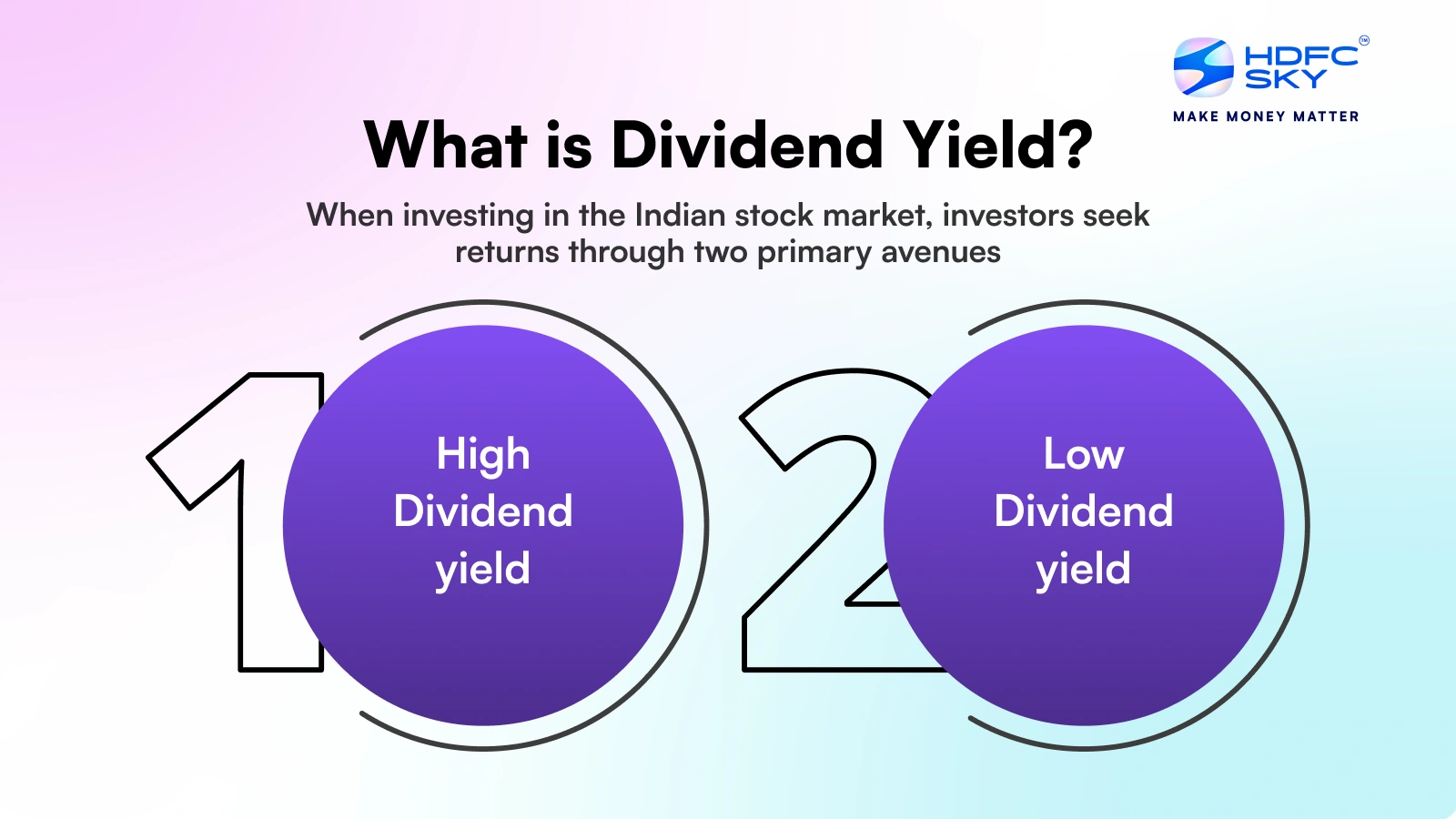
When investing in the Indian stock market, investors seek returns through two primary avenues: capital appreciation (the increase in share price) and dividends. Dividends represent a portion of a company’s profits distributed to its shareholders, providing a potential income stream. However, simply looking at the absolute dividend amount paid per share doesn’t provide a complete picture for comparison. To understand the income potential relative to the investment cost, investors use a crucial metric: Dividend Yield.
Understanding what is dividend yield is fundamental for anyone looking to invest in dividend stocks or build an income-generating portfolio in India. This article explains the dividend yield meaning, its calculation using the dividend yield formula, its importance, influencing factors, and key considerations.
Understanding Dividend Yield
When a company pays you a dividend, they are giving you a percentage of its profit. The dividend and yield are connected, but they are two different concepts. The dividend is the money you receive. The yield is the percentage of the share price you receive as a dividend. The dividend yield explained simply is: Annual Dividend per Share / Current Market Price per Share.
When you invest in dividend yielding shares, you are searching for companies that pay you good money back. Companies pay dividends depending upon the financial situation and reserves held with it, some are high and some are low dividend yielding shares.
High dividend shares are suitable for people who want money regularly. But high yield sometimes means the company is doing badly. The share price has dropped, and the yield appears high. So, always know why the yield is high. In India, oil, banking, and power companies have high yields. Tech companies and new enterprises pay less because they still have the scope to grow. If you want a regular income, you can also consider high yield dividend stocks and dividend yielding mutual funds.
There are mainly two types of yields.
-
High Dividend Yield
A stock with a high dividend yield suggests that the company returns a relatively large amount of its value back to shareholders as dividends compared to its current share price. These shares with high dividends (in percentage terms) often appeal to income-focused investors. This might occur because the company is mature with stable earnings and fewer growth reinvestment needs, or potentially because its share price has fallen significantly. Finding the highest dividend yield stocks requires careful screening.
-
Low Dividend Yield:
Low yield means the company retains more money to grow. You get less now, maybe more in the future if the company grows. This implies that a lot of the profit the company earns is ploughed back so that it can be used as retained earnings, which makes the dividend paid lower, as it is, after all, a charge against the profit.
Why is Dividend Yield Important?
Dividend yield is a significant metric for several reasons:
- Income Assessment: It provides a direct measure of the cash return an investor receives from dividends relative to the stock’s current price, crucial for those investing for regular income.
- Comparison Tool: It allows investors to compare the dividend-paying capacity of different companies on a like-for-like percentage basis, regardless of their absolute share prices. This helps compare potential dividend yielding shares.
- Valuation Indicator (with caution): Sometimes, an unusually highest paying dividend stocks yield might signal that a stock is potentially undervalued by the market (if the high yield is due to a price drop not justified by fundamentals). Conversely, very low yields might sometimes accompany high-growth, highly valued stocks.
- Component of Total Return: It quantifies one of the two main components of total return from equity investing (the other being capital appreciation). Understanding yield helps assess the source and stability of potential returns.
- Screening Factor: Investors often use dividend yield as a key screening criterion to find stocks or dividend yielding mutual funds (or dividend yield funds) that meet their income requirements.
How to Calculate Dividend Yield
Calculating dividend yield is easy if you use the dividend yield formula:
Dividend Yield = ((Annual Dividend per Share / Current Market Price per Share) × 100).
Where, Annual Dividend per Share is the total dividend declared by the company on a per-share basis over the course of a year (typically the last financial year). In India, this usually includes interim dividends plus the final dividend declared. You can find this data on financial portals, company announcements on exchange websites (NSE/BSE), or annual reports.
This provides you with a percentage. You can use this formula to compare companies. If you wish to invest in dividend stocks, always check the yield. It makes you understand how much you will receive every year.
Example of Dividend Yield Calculation
Let’s look at a simple dividend yield example to get a clear idea of the concept:
Consider ‘Infosys Ltd’, a well-known Indian IT company.
- Lets say its
- Current Market Price per Share = ₹1,500
- Total Dividend Declared in the last financial year = ₹35 per share
- So as per the dividend yield formula its yield can be calculated as:
- Dividend Yield = (₹35 / ₹1,500) * 100%
- Dividend Yield = 0.0233 * 100%
- Dividend Yield ≈ 2.33%
This means that based on the current market price and the last year’s dividend, investing in Infosys shares would provide an approximate dividend income return of 2.33% per annum.
Key Factors Affecting Dividend Yield
- Dividend yield shares vary with the share price. When the price goes up, the yield decreases unless the dividend increases too.
- As the price goes down, the yield goes up. Therefore, sometimes high yield is when the company is in serious trouble.
- The industry also counts. Certain industries, such as oil, energy, and banks, offer high yields. Technology firms and startups make lower payments, but that does not imply that they are not strong investments.
- The profits of the company are important. If a company earns more profit, it can pay more dividends. If profits decrease, dividends can also decrease.
- How often a company pays dividends matters. There are some who pay annually, some who pay semi-annually, and some who pay whenever they happen to have a surplus.
- Trends in the market may also affect the yield. If the overall market is falling, yields may seem to be high. But it could be risky.
- The health of the firm is extremely important. If a firm is heavily in debt, it may not continue to pay excessive dividends.
- Always look at the company’s history. If it has been paying consistent or increasing dividends over many years, it is more secure.
- The highest dividend yield is not always the best. In some cases, it is better to choose a company with steady and secure dividends.
Pros and Cons of Dividend Yield for Investors
Pros
- If you invest in dividend stocks, you get regular income even if the share price does not rise.
- Dividend yielding funds and dividend yielding mutual funds lower your risk by investing in many companies.
- You can compare dividend yield shares easily and pick the ones that suit your needs.
- Steady income is good for people who want cash flow, like retirees.
- Dividend growth stocks increase their dividends over time, so your income can grow.
Cons
- In India, dividends are taxed as per your income tax slab, so your real income may be less.
- Sometimes, companies with the highest dividend yield do not grow much, so your investment may not increase in value.
- A very high yield can mean the company is in trouble or the share price has dropped a lot.
- If the company cannot keep paying, you may lose money, and the share price can fall.
- Focusing only on highest paying dividend stocks can be risky if the company is not strong.
- If a company cuts its dividend, your income drops, and the share price often falls too.
Dividend Yield and Dividend Payout Ratio
Dividend yield is the percentage of the share price you receive as a dividend (How much dividend income do I get for the price I pay?).
The dividend payout ratio on the other hand is the proportion of a company’s profit distributed as dividends. (What percentage of profits is the company distributing as dividends?)
Both are useful but not identical. High yield is not always a high payout ratio. A company will sometimes distribute a good proportion of profit as dividends, but the share price is high, and hence the yield is low. You should always consider both when selecting shares.
Dividend Yields and Inflation
Inflation can erode the value of your dividend income. When inflation is high and your dividend yield is low, you are not earning. For instance, when inflation is 6% and your yield is 4%, your real return is negative. In India, always attempt to select shares or funds with yields more than inflation. Your money will be secure. Dividend yielding funds can assist you, but always check the real return after inflation.
Is High Dividend Yield Always Good?
An extremely high dividend yield is not always a good thing. Sometimes the share price has dropped because the company is in trouble financially. This can make the yield look high, but it is risky. The company may not be able to keep paying. Always find out why the yield is high. Look at the profits and record of the company. Better safe and steady than to aim for the highest yield.
Conclusion
Dividend yield is a quick and easy way to know how much money you receive from your stocks. It assists you in choosing good dividend yield stocks and dividend yielding mutual funds in India. Compare companies based on the dividend yield formula. But do not blindly believe in the highest dividend yield. Ensure that the company is healthy and can continue to pay. Look for consistent and increasing dividends. Use income as equal growth for maximum returns. If you need money often, invest in dividend stocks or mutual funds. But first, always check. In the Indian market, safe and steady is the best way to grow your money.
Related Articles
FAQs on What is Dividend Yield?
What is dividend yield, and why is it significant?
Dividend yield is the proportion of a company’s share price received by shareholders annually in the form of dividends. It assists investors in making decisions about the level of income they will receive from holding a stock. It is a significant indicator for individuals looking for a regular income and for comparing income potential between various shares.
How do you calculate the dividend yield of a stock?
Dividend yield is also obtained by dividing the dividend per share per annum by the price per share and multiplying by 100. For example if we assume the company pays ₹20 per share in a year and the price per share is ₹400, the dividend yield will be 5%.
What is a good PE ratio?
The Price-to-Earnings (P/E) ratio is a valuation metric, different from dividend yield. There is no single ‘good’ P/E ratio; it varies widely depending on the industry, company growth expectations, market conditions, and profitability. It needs to be compared against industry peers and historical averages.
Are dividends taxable?
Yes, dividends are taxed in India. They are included in your overall income and taxed based on your income tax slab. Tax at source (TDS) is deducted by companies only if your dividend income for the year is more than ₹5,000.
What is the good time to purchase high yield dividend stocks?
There isn’t one definitive ‘good time’. Some investors look for opportunities when prices of fundamentally strong dividend payers dip temporarily (boosting the yield). Others focus on consistency and buy regularly. The key is ensuring the dividend appears sustainable at the time of purchase and aligns with your goals.