- Offerings
- Tools & Platforms
Tools & Calculators
- Open API
- Calculators
- SIP Calculator
- CAGR Calculator
- Compound Interest Calculator
- FD Calculator
- RD Calculator
- EPF Calculator
- Retirement Calculator
- HDFC SIP Calculator
- Mutual Fund Return Calculator
- Lumpsum Calculator
- Step Up SIP Calculator
- ETF SIP Calculator
- Brokerage Calculator
- Equity Margin Calculator
- SWP Calculator
- EMI Calculator
- MTF Calculator
- Pricing
- SKY Learn
- Mutual Funds
- Margin Trading
- Financial Planning
- Personal Finance
- Share Trading
- IPO
- Derivatives
- Currencies
- Intraday Trading
- Trading Strategies
- Demat Account
- Commodity
- ETF
What is Equity Delivery? Ways to Invest in Equity Delivery
By HDFC SKY | Updated at: Sep 15, 2025 08:51 PM IST
Summary
- Equity Delivery Meaning: Equity delivery refers to buying shares and holding them in a demat account without selling on the same day, unlike intraday trading. It is suitable for long-term investment strategies.
- Ownership and Benefits: Investors gain full ownership of the shares, making them eligible for dividends, bonus shares, and voting rights.
- Holding Period: There is no time limit on how long shares can be held—days, months, or years—allowing investors to benefit from long-term price appreciation.
- Charges Involved: Unlike intraday, equity delivery incurs brokerage fees, Securities Transaction Tax (STT), stamp duty, SEBI turnover fees, and GST.
- Risk Profile: Delivery trading carries lower short-term risk than intraday, but is subject to market volatility over the holding period.
- Strategy Insight: Best suited for investors looking to build wealth steadily over time, without the need for constant market monitoring.
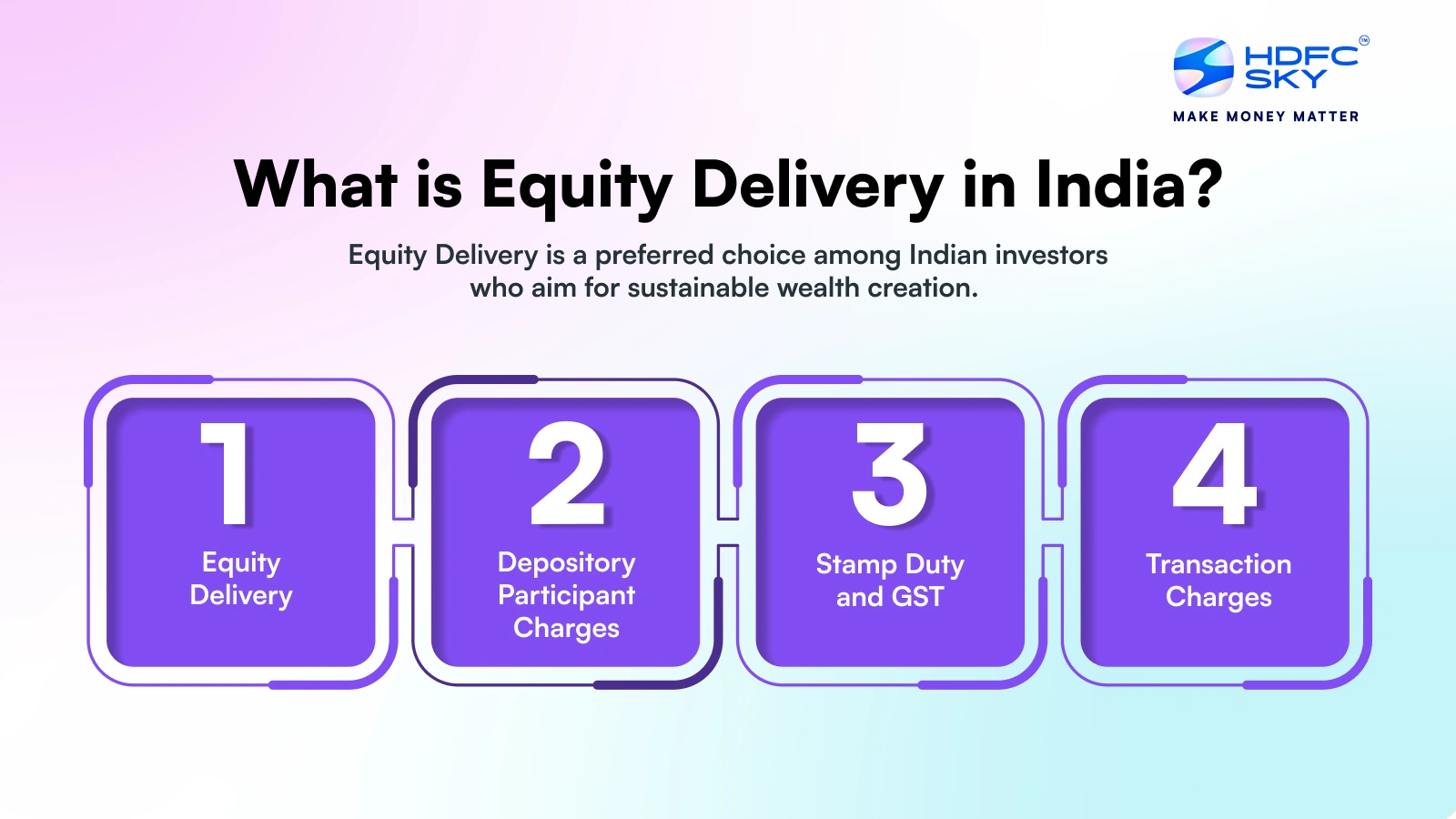
What is Equity Delivery in India?
Equity delivery is a preferred choice among Indian investors who aim for sustainable wealth creation. Let me explain the Equity Delivery concept with a simple example that everyone can relate to. Imagine you have ₹10,000 and you believe a particular company may grow well in the future. Through NSE equity delivery trading, you can buy shares of this company and keep them in your demat account – think of this account as your digital locker where you safely store your shares.
Equity Delivery Meaning
Equity delivery means the process by which an investor buys shares and holds them in a Demat account for a period of time. Unlike intraday trading, where shares are bought and sold within the same day, equity delivery allows you to keep your stocks as long as you want.
Here are some essential aspects of equity delivery:
- Ownership: You own the stocks outright once they are credited to your Demat account.
- No Time Constraints: Hold the stocks for days, months, or even years.
- Long-Term Wealth Creation: Ideal for investors focusing on capital growth over time.
Ways to Invest in Equity Delivery
Investing in equity delivery involves a systematic approach to maximise returns while managing risks. Here are the primary ways to invest:
- Direct Stock Investment
- Buy shares of individual companies directly from stock exchanges like NSE or BSE.
- Conduct thorough research on company performance, industry trends, and future growth prospects.
- Investing via Mutual Funds
- Opt for equity-oriented mutual funds where fund managers invest in a diversified portfolio of stocks.
- Suitable for investors who prefer professional management.
- Systematic Investment Plan (SIP)
- Invest a fixed amount regularly in stocks or equity mutual funds.
- Helps in averaging out market volatility and building a disciplined investment habit.
- Portfolio Management Services (PMS)
- Avail services of professional portfolio managers to manage your investments.
- Ideal for high-net-worth individuals (HNIs) seeking personalised strategies.
- Thematic and Sectoral Investment
- Focus on specific themes or sectors like IT, renewable energy, or FMCG.
- Aligns investments with emerging market trends.
By combining these methods, investors can create a well-rounded equity delivery strategy to achieve financial goals.
What is Equity Delivery Charges?
Understanding equity delivery charges is crucial for financial planning. These charges typically include:
- Equity Delivery Brokerage Fees: A percentage of the transaction value.
- Depository Participant Charges: Fees for maintaining shares in the Demat account.
- Stamp Duty and GST: Levied as per government regulations.
- Transaction Charges: Imposed by stock exchanges like NSE.
| Type of Charge | Example Amount |
| Brokerage Fee | 0.1% of trade value (varies by broker) |
| Depository Charges | ₹20 per transaction |
| Stamp Duty | 0.015% of trade value |
| GST on Brokerage | 18% of brokerage |
*Note: Opting for a broker offering free for equity delivery or discounted plans can significantly reduce costs.
How Do I Purchase Delivery Stock?
Buying delivery stocks involves the following steps:
- Open Demat Account and Trading : Choose a reputed broker.
- Login to Your Trading Platform: Access your broker’s online or mobile platform.
- Select Your Stock: Search for the company’s shares you want to buy.
- Place Your Order: Opt for the “Delivery” option and specify the quantity.
- Funds Allocation: Ensure sufficient balance in your account, as no margin is allowed.
- Monitor Settlement: Wait for the shares to reflect in your Demat account after the T+2 settlement period.
Benefits of Equity Delivery
Why should you choose equity delivery over other forms of trading? Here are the advantages:
- Long-Term Wealth Creation : Equity delivery allows you to benefit from the long-term growth potential of companies. For example, investors who held Infosys shares since its IPO in 1993 have witnessed a remarkable wealth increase.
- Dividends and Bonuses : As a shareholder, you receive dividends and are eligible for bonus shares.
- Loan Against Shares : Many banks provide loans against shares held in your Demat account, offering financial flexibility.
- Reduced Risk : Unlike intraday trading, equity delivery minimises the impact of short-term market volatility.
Conclusion
Understanding equity delivery is important for anyone looking to create long-term wealth through the stock market. Unlike the fast-paced world of intraday trading, delivery investing is about patience and believing in a company’s growth potential.
Related Articles
FAQs on What is Equity Delivery?
What is Free Equity Delivery?
Free equity delivery refers to a trading service where brokers don’t charge any brokerage fees for delivery-based trades. However, other regulatory charges still apply, like Securities Transaction Tax (STT), stamp duty, and GST.
Which is Better: Intraday or Delivery?
The choice between intraday and equity delivery trading depends on your investment goals, time availability, and risk appetite. Delivery trading is better for building long-term wealth, offering additional benefits like dividends, and voting rights, while intraday offers quick profits but higher stress and risk.
What is the Equity Delivery Charge?
Equity delivery charges include various components beyond just brokerage. The main charges are brokerage fees (ranging from 0% to 0.5%), Securities Transaction Tax (0.1%), stamp duty (state-specific), and GST (18% on brokerage). Some brokers also charge account maintenance fees.
What is Equity Delivery Brokerage?
Equity delivery brokerage is the fee charged by brokers for executing your delivery trades. Traditional brokers typically charge 0.3-0.5% of the trade value, while discount brokers might offer significantly lower rates or even free delivery trading. For instance, on a trade of ₹10,000, traditional brokerage might be ₹30-50, while discount brokers might charge nothing. However, remember that even with zero*brokerage, you’ll still need to pay other regulatory charges.
What is Equity Delivery and Equity Intraday?
Equity delivery involves buying shares to own long-term, offering stability and benefits like dividends. Intraday trading involves buying and selling shares within a day, suited for active traders seeking quick returns with lower capital requirements.