- Offerings
- Tools & Platforms
Tools & Calculators
- Open API
- Calculators
- SIP Calculator
- CAGR Calculator
- Compound Interest Calculator
- FD Calculator
- RD Calculator
- EPF Calculator
- Retirement Calculator
- HDFC SIP Calculator
- Mutual Fund Return Calculator
- Lumpsum Calculator
- Step Up SIP Calculator
- ETF SIP Calculator
- Brokerage Calculator
- Equity Margin Calculator
- SWP Calculator
- EMI Calculator
- MTF Calculator
- Pricing
- SKY Learn
- Mutual Funds
- Margin Trading
- Financial Planning
- Personal Finance
- Share Trading
- IPO
- Derivatives
- Currencies
- Intraday Trading
- Trading Strategies
- Demat Account
- Commodity
- ETF
What is Expiry Day Trading? How to Trade, Importance & Benefits
By HDFC SKY | Published at: May 28, 2025 12:12 AM IST
As traders tend to look for more techniques and thrills while trading in the stock markets, more unique strategies are incorporated into daily transactions.
Expiry day trading involves trading derivative contracts like options and futures on their expiration date. In India, these dates vary by contract: weekly and monthly index options for Nifty 50 and Bank Nifty expire on Thursdays, Nifty Financial Services (Finnifty) options expire on Tuesdays, and Nifty Midcap Select options expire on Mondays. Monthly stock options and futures expire on the last Thursday of the month. This technique is also applied to futures and other derivative contracts.
What Is Expiry Day Trading?
Expiry day trading is trading or dealing done by buying and selling futures and options contracts on their last valid day. The objective is to leverage market volatility in their favour and gain from quick price fluctuations.
Traders need to speculate and preempt the prices of the contracts when they want to sell on the expiry day. Many buy at low premiums, expecting a greater percentage of profit on the expiry day trade.
Timing is of the essence, as contracts lose value near expiry dates, and even a slight deflection in price can significantly affect the gain or loss. It is also crucial to closely monitor trade and market movements to manage risks and make the right move at the right time.
Importance of Expiry Dates in Trading
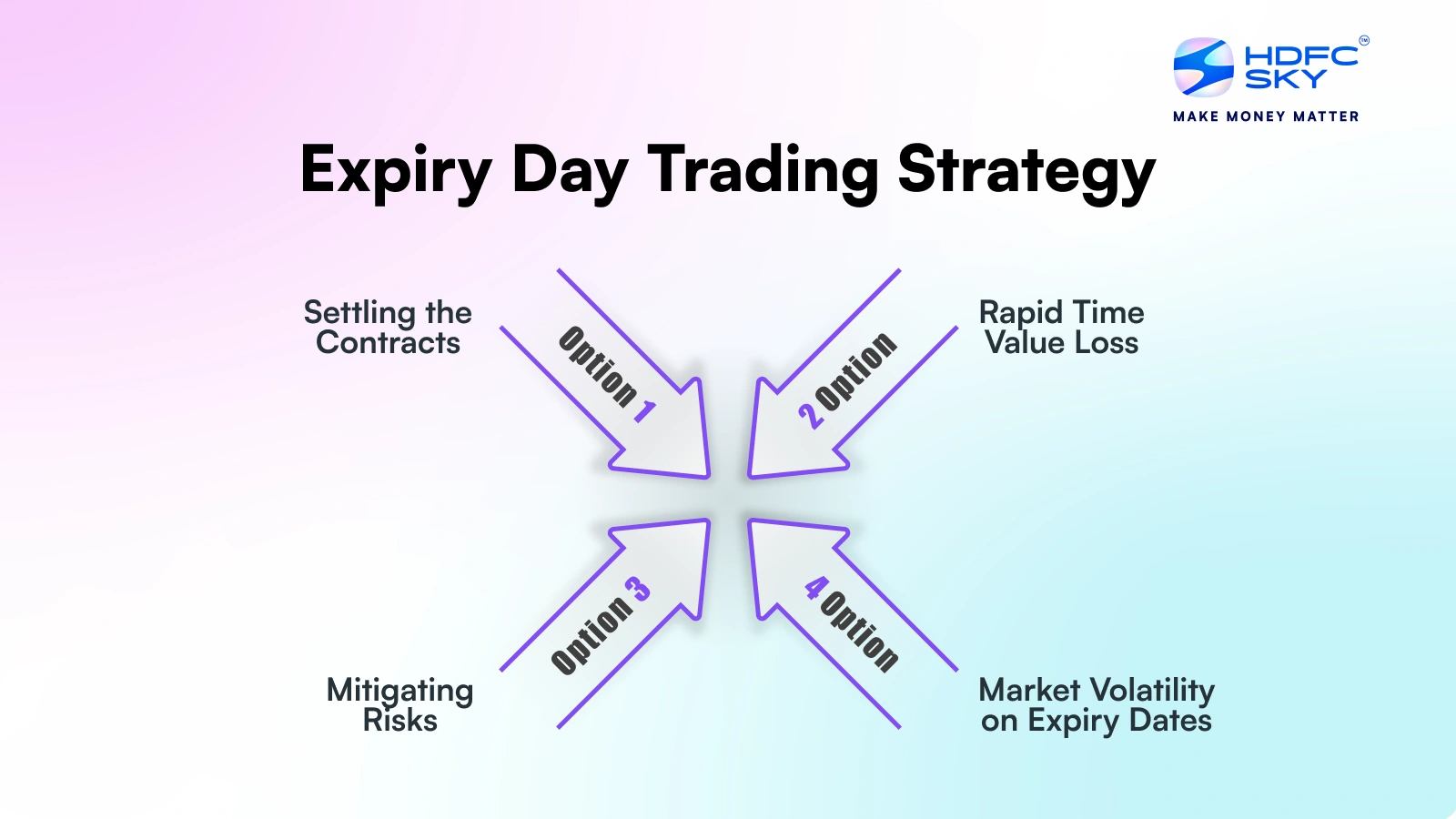
The expiry day strategy in options trading is vital as the validity date influences settlement management risk and can help control market influence. The significance of expiry dates further includes:
- Settling the Contracts: Expiry day trading strategies include buyers closing the trade by either using the options or letting it expire. The sellers are obligated to act if options are used.
- Rapid Time Value Loss: Time decay is the loss of the time value of options that happens as the expiry date approaches. This tends to reduce the option price even further.
- Market Volatility on Expiry Dates: Since expiration days are usually fixed, the volume of trades increases exponentially each day. This may lead to higher market movements and sudden price fluctuations.
- Mitigating Risks: Close monitoring of market conditions and tracking expiry days helps counter risks in such trades. Extending the same and not closing often leads to significant losses.
How To Make Trades On Option Expiry Day?
To make your expiry day option trading success, the strategy you need to adopt involves:
- Initiate by studying various market trends, news, and research to anticipate price movements.
- Concentrate on options that may look unviable currently but may turn profitable with favourable market moves.
- Set a stop loss price to keep a check on your profit targets and follow them to manage risks.
- Keep a close watch on the market throughout and stay updated with news and information related to your trades.
- Place limit orders in your trade to ensure entry and exit at your desired price.
- Focus on spreads as they can limit risk and have the potential to gain. You can also opt for a bull call spread, where you can sell a call option at a higher strike price than an option you buy.
How to Do Expiry Day Trading?
Expiry day option buying & selling require you to have some tricks up your sleeve. For an option trading strategy on expiry day, you need to focus on both to understand the spread.
| Expiry Day Option Buying Strategy | Expiry Day Option Selling Strategy |
| Look for options that seem undervalued compared to the underlying asset’s potential movements. | Get rid of those out-of-the-money options, which will soon turn worthless as they expire. |
| Try to purchase options that are more sensitive to price changes. | Use both buying and selling options simultaneously to benefit from the spread and minimise the risk of value loss. |
| Consider buying options moving in the direction of strong price trends, and would continue to do the same. | Sell your options when market volatility is high, as premiums are inflated, and you tend to gain more. |
| For instance, you may buy a call option of a stock with a strike price of Rs. 202 when the stock is actually trading at Rs. 200. | In this case, you may sell a put option on a stock trading at Rs. 300, with a strike price of Rs. 290, anticipating that the price will stay above Rs. 290 by expiry. |
Expiry Day Trading Strategies – Mistakes to Avoid
To most experienced traders, expiry day trading means lucrative and significant returns. However, to optimise risk and return, like any other market trade, certain errors are to be avoided at any cost:
- Do not wait too long to purchase your options during expiry day trading. The value of options diminishes as the expiration date approaches.
- Ensure you research market trends, past data, and other relevant information before initiating a trading transaction. You need to monitor the market regularly.
- Factoring in market volatility is important as it is usually high on expiry dates.
- Make prudent choices to diversify your trades across different options and varied underlying assets.
- Plan all the details before you enter expiry day trading. Determine your entry and exit prices, risk mitigation plans, stop loss, and profit targets to create a clear trading plan, especially if you’re considering how to plan your options trading around expiry dates.
Advantages of Expiry Day Option Buying Strategy
Traders attuned to the latest market information and who can effectively manage risk can benefit significantly from expiry day trading.
- The price of options decreases as expiry dates near, enabling traders to lower the cost of purchase.
- The leverage is relatively higher in expiry day trading, as small price fluctuations can trigger higher returns, leading to quicker profits.
- The maximum loss is limited to the premium paid for buying the options, making it easier to manage risks.
- Trading positions can be adjusted throughout the day, making it convenient to keep track and manage risks.
- High market volatility can create lucrative opportunities and healthy returns if you time your deal well.
Conclusion
Expiry day trading requires an understanding of complex market assets and processes, such as derivatives, commodities, options, and futures. It also requires a strong appetite for taking high risks and enduring significant losses.
If you want to begin this journey with investible mutual funds, your decisions need to be backed by solid strategies, up-to-date research, extensive market knowledge, and strong monitoring techniques.
Related Articles
FAQs on Expiry Day Trading
Are there specific market hours for expiry day trading?
The market hours for expiry day trading are the same as normal market trading times in India, which are from 9:15 am to 3:30 pm IST. However, the last hours are quite active as the traders choose to finalise their positions by then.
Is it risky to trade on expiry day?
It is risky to trade on expiry dates as transaction volumes are high, making price movements rapid and volatility quite high. Usually, seasoned traders are equipped to handle such fast-paced trading requirements. However, one should always be prepared for losses and ensure the usage of strict risk management rules.
What is an effective strategy for buying Bank Nifty options?
Bank Nifty expiry day strategy involving selling and buying bank Nifty options essentially depends on factors like strike price, option premiums and market sentiments towards the banking sector. For example, if you can forecast increased volatility in the banking sector, you may choose to trade in BankNifty options expiring on Thursdays.
What indicators are useful for expiry day trading?
Here are some useful indicators that help traders evaluate market trends, movements and directions:
- “Open Interest” shows a number of active contracts and market sentiments.
- The “Relative Strength Index” is used to map the momentum to identify overbought conditions.
- “Moving Averages” indicate trends by calculating the average price over a period of time.
- “Volume Oscillators” track trading activities, showing the number of transactions.