- Offerings
- Tools & Platforms
Tools & Calculators
- Open API
- Calculators
- SIP Calculator
- CAGR Calculator
- Compound Interest Calculator
- FD Calculator
- RD Calculator
- EPF Calculator
- Retirement Calculator
- HDFC SIP Calculator
- Mutual Fund Return Calculator
- Lumpsum Calculator
- Step Up SIP Calculator
- ETF SIP Calculator
- Brokerage Calculator
- Equity Margin Calculator
- SWP Calculator
- EMI Calculator
- MTF Calculator
- Pricing
- SKY Learn
- Mutual Funds
- Margin Trading
- Financial Planning
- Personal Finance
- Share Trading
- IPO
- Derivatives
- Currencies
- Intraday Trading
- Trading Strategies
- Demat Account
- Commodity
- ETF
What is Intraday Margin? Check SEBI Rules, and Eligibility
By HDFC SKY | Updated at: Apr 24, 2025 03:34 PM IST
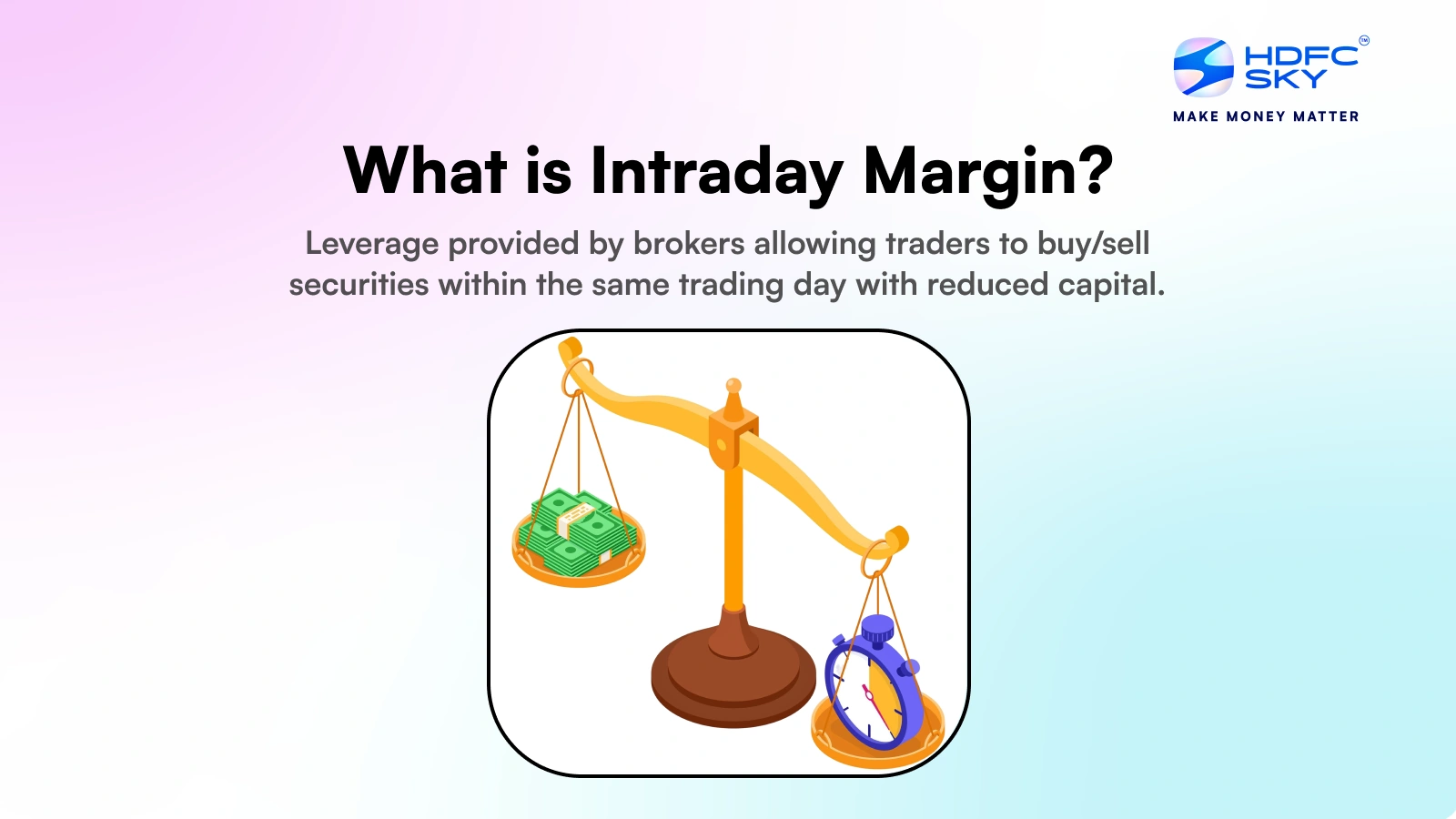
Trading in the stock market requires capital, strategy, and risk management. For traders looking to maximise short-term opportunities, intraday margin trading offers a way to amplify exposure with borrowed funds. This article explores its meaning, the latest day trading margin rules, advantages, risks, and eligibility for participation in this high-stakes domain.
In 2020, SEBI revised margin requirements for cash market trading, requiring intraday traders to deposit at least 20% of their total transaction value with brokers to access margin facilities. However, you can trade without margin through cash intraday trading, using only available funds, limiting trading capacity but reducing risk exposure.
What is Intraday Margin?
Intraday margin refers to the borrowed funds or loans that brokers provide to traders for executing trades within a single trading day. This facility allows traders to buy more shares than their available capital would typically permit. The meaning of intraday margin essentially boils down to potentially leveraging your existing funds to increase your profits.
Let’s understand how margin is calculated in intraday trading. So, when you trade on margin in intraday trading, your broker gives you a multiple of your funds available. For example, if you have ₹50,000 in your trading account and a broker offering 5x margin, you could trade with ₹2,50,000. This increases your purchasing power and, thus, your potential profits or losses as well.
Here is an intraday margin example. Let’s consider that you wish to purchase 100 shares of a company which is trading at ₹500 per share. In typical cases, you would require ₹50,000. However, with a 5x margin, you would only require ₹10,000 as margin money to execute this trade.
SEBI New Rules for Intraday Margin
Since September 2021, the Securities and Exchange Board of India (SEBI) has introduced new intraday margin rules. These rules aim to ensure responsible trading and mitigate risks. They have had a significant impact on how margin works in intraday trading.
Here are the key points you need to consider :
- Peak Margin Reporting: Brokers now have to report the peak margin that traders use four times a day. For instance, if a trader starts the day with ₹50,000 in their account and at one point during the day uses margin to take positions worth ₹2,50,000 (a 5x leverage), the peak margin utilised would be ₹2,00,000 (the borrowed amount). This peak margin figure needs to be reported.
- Initial Margin: The trader must deposit collateral in the form of a margin before entering the trade.
- Penalty for Shortfall: In case of margin shortfall, the penalty is passed on to the trader as well as the broker. For example, if the required margin for your trades was ₹20,000, but you only had ₹18,000, resulting in a shortfall of ₹2,000, a penalty will be levied. The penalty can range from 0.5% to 1% per day of the shortfall amount and may increase with repeated instances of shortfall within a month.
- Reduced Leverage: Before SEBI’s regulatory changes, brokers could offer intraday leverage up to 40-50 times the trader’s margin. After the implementation of new rules in September 2021, this maximum leverage was reduced to 5 times.
These rules aim to promote responsible trading and reduce the chances of defaults in the system.
Who is Eligible for Intraday Margin?
Here are the factors related to the eligibility for intraday margin trading:
- Account Type: You need to have a trading account that supports margin trading.
- Minimum Balance: Most brokers want a minimum balance to be eligible for margin trading.
- Trading Experience: Some brokers may consider your trading history and experience.
- Risk Assessment: They will usually assess your risk profile and ability to meet your financial obligations.
- Regulatory Compliance: You are required to follow all SEBI guidelines and your broker’s policies.
- Income proof: If trading in futures and options, you must have proof of income.
Note that margin trading can increase profits but also raises the risk of significant losses. Before engaging in margin trading, it is vital to understand these risks.
Advantages and Disadvantages of Intraday Margin
Intraday margin presents the following benefits and challenges:
Advantages of Intraday Margin:
- Better Buying Power: Leveraged positions help you take larger positions, which could lead to bigger profits.
- Diversification: With more funds, you can make diversified intraday trades on various stocks.
- Opportunity to Potentially Profit from Short-Term Market Movements: Margin trading can amplify your exposure to short-term market movements, potentially increasing your Return on Investment (ROI).
Disadvantages of Intraday Margin:
- Amplified Losses: Gains are magnified, and so are losses. You can lose more than your principal.
- Margin Calls: If your trades don’t go your way, you may receive a margin call, which means you will have to deposit more money quickly.
- Higher Costs: Margin trading generally involves higher costs, including brokerage fees and interest on borrowed funds.
- Psychological Pressure: The increased stakes involved in margin trading may push traders to make emotional decisions, a common pitfall in this game.
You must be able to fulfill the minimum balance requirement. If you fail to do so, the broker will exit the trade.
Conclusion
Intraday margin trading can be a powerful tool in a trader’s arsenal, offering the potential for higher profits. However, it comes with significant risks and requires a deep understanding of the market, strict discipline, and robust risk management strategies. As with any form of trading, it is crucial to educate yourself thoroughly, start small, and never risk more than you can afford to lose.
Related Articles
FAQs on What is Intraday Margin?
Can I do intraday without margin?
In 2020, SEBI revised margin requirements for cash market trading, requiring intraday traders to deposit at least 20% of their total transaction value with brokers to access margin facilities. However, you can trade without margin through cash intraday trading, using only available funds, limiting trading capacity but reducing risk exposure.
Is the intraday margin free?
No, intraday marginis not free. Brokers typically charge interest on the borrowed amount. Additionally, there may be higher brokerage fees for margin trades. It is essential to factor in these costs when calculating potential profits.
What is an example of a day trade margin?
An example of day trading margin could be: If you have ₹1,00,000 in your account and your broker offers 5x leverage, you could potentially trade with ₹5,00,000 for intraday trades. This allows you to buy more shares or take larger positions.
How is intraday margin calculated?
It depends on the broker and the specific stock. Generally, it is a percentage of the total trade value. For example, if the margin requirement is 20% and you want to buy shares worth ₹1,00,000, you would need ₹20,000 as margin.
What is the intraday peak margin?
Intraday peak margin refers to the highest margin utilised by a trader during a trading day. SEBI now requires brokers to report this four times daily to ensure traders are not over-leveraging and maintain the market’s integrity.
What is a Day Trading Margin Call?
A Day Trading Margin Call occurs when your account value falls below the minimum margin requirements set by your broker. This can happen due to losses in your open positions. You will need to either deposit more funds or close some positions to meet the margin requirements.