- Offerings
- Tools & Platforms
Tools & Calculators
- Open API
- Calculators
- SIP Calculator
- CAGR Calculator
- Compound Interest Calculator
- FD Calculator
- RD Calculator
- EPF Calculator
- Retirement Calculator
- HDFC SIP Calculator
- Mutual Fund Return Calculator
- Lumpsum Calculator
- Step Up SIP Calculator
- ETF SIP Calculator
- Brokerage Calculator
- Equity Margin Calculator
- SWP Calculator
- EMI Calculator
- MTF Calculator
- Pricing
- SKY Learn
- Mutual Funds
- Margin Trading
- Financial Planning
- Personal Finance
- Share Trading
- IPO
- Derivatives
- Currencies
- Intraday Trading
- Trading Strategies
- Demat Account
- Commodity
- ETF
- What is Intraday Trading?
- How Intraday Trading Works
- Features of Intraday Trading
- Benefits of Intraday Trading
- How to Do Intraday Trading
- How to Invest in Intraday Trading
- How to Choose Stocks for Intraday Trading?
- Some Intraday Trading Indicators
- Things to Consider for Intraday Trading
- How Does Intraday Trading Differ From Regular Trading?
- Intraday Trading vs Delivery Trading
- Advantages of Intraday Trading
- Disadvantages of Intraday Trading
- Intraday Trading Strategies
- Conclusion
- FAQs on What is Intraday Trading in Stock Market?
- What is Intraday Trading?
- How Intraday Trading Works
- Features of Intraday Trading
- Benefits of Intraday Trading
- How to Do Intraday Trading
- How to Invest in Intraday Trading
- How to Choose Stocks for Intraday Trading?
- Some Intraday Trading Indicators
- Things to Consider for Intraday Trading
- How Does Intraday Trading Differ From Regular Trading?
- Intraday Trading vs Delivery Trading
- Advantages of Intraday Trading
- Disadvantages of Intraday Trading
- Intraday Trading Strategies
- Conclusion
- FAQs on What is Intraday Trading in Stock Market?
What is Intraday Trading & How to Invest in Intraday Trading?
By Ankur Chandra | Updated at: Oct 17, 2025 06:18 PM IST
Summary
- Definition: Intraday trading refers to buying and selling stocks within the same trading day to capitalize on small price movements.
- Objective: The goal is to earn profits from stock price fluctuations during the day rather than holding positions overnight.
- Timeframe: Trades are squared off before the market closes, avoiding overnight risk exposure.
- Ideal for: Traders who can monitor markets closely, have risk tolerance, and are adept at reading charts and indicators.
- Key Features:
- High volatility is preferred to maximize profit potential.
- Leverages margin trading, increasing both risk and reward.
- Requires technical analysis, real-time decision-making, and discipline.
- Tools & Indicators Used:
- Candlestick charts, moving averages, RSI (Relative Strength Index), and volume trends.
- Risks:
- Rapid price changes can lead to losses.
- Overtrading and lack of strategy can reduce capital.
- Strategy Importance: A well-defined entry/exit plan, stop-loss, and target-setting are crucial for successful intraday trading.
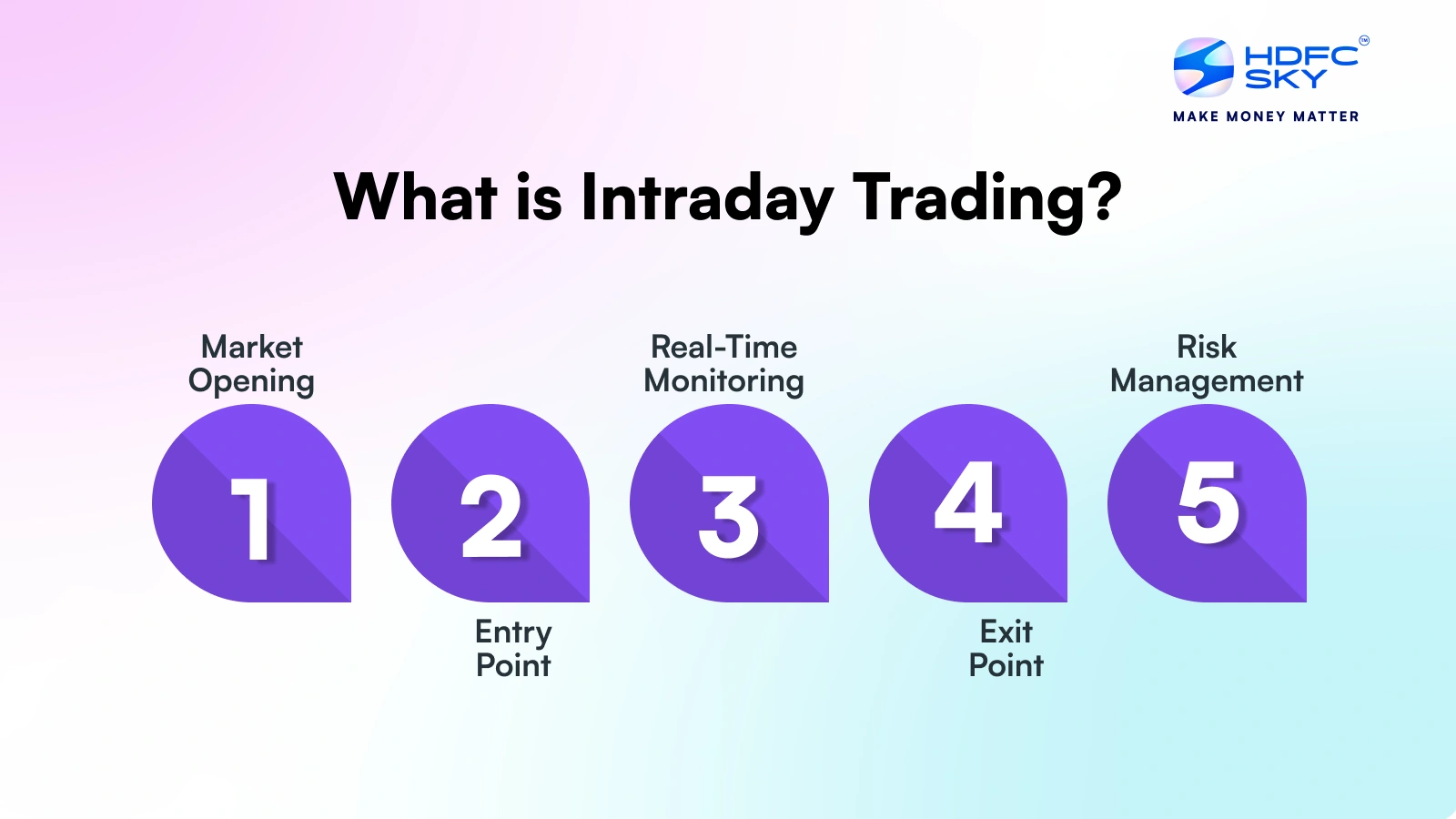
Intraday trading refers to the practice of buying and selling stocks within the same trading day. Traders aim to capitalise on small price movements by closely monitoring market trends and making quick decisions. This type of trading requires strong market knowledge, technical analysis skills and risk management strategies to succeed
What is Intraday Trading?
Intraday trading meaning lies in capitalising on short-term price fluctuations in the financial markets. When engaging in intraday, traders analyse market movements and price patterns throughout the day to identify potential trading opportunities. The primary goal is to generate profits from these small price movements, requiring traders to maintain a careful balance between quick decision-making and risk management.
How Intraday Trading Works
Intraday trading involves buying and selling financial instruments like stocks or derivatives within the same trading day. Here’s how it works:
- Trade Execution: Traders buy shares when they expect the price to rise and sell them the same day before the market closes.
- Use of Leverage: Brokers often offer margin or leverage, allowing traders to take larger positions with less capital.
- Target Small Price Movements: Traders aim for small price changes using charts, technical indicators and real-time market data.
- Square Off Before Close: All open positions must be closed before the trading session ends to avoid conversion into delivery trades.
- Tools Used: Stop-loss orders and target prices are essential to manage risk and lock profits.
Success in intraday trading relies on quick decision-making, understanding of market trends and strict risk control.
Features of Intraday Trading
Intraday trading involves buying and selling financial instruments within the same trading day. It demands quick decisions, precision and a clear strategy.
- Same-Day Settlement: All trades are squared off before market close.
- High Liquidity: Focuses on stocks or assets with high trading volume.
- Margin Trading: Traders can use leverage to increase position size.
- Quick Turnaround: Aims to profit from short-term price fluctuations.
- Use of Technical Tools: Relies on charts, patterns and indicators.
- Tight Stop Losses: Risk management is essential due to market volatility.
- Short Holding Period: No overnight positions are held.
Benefits of Intraday Trading
Intraday trading for beginners offers several significant advantages for active market participants:
- Capital Efficiency: Traders can utilise margin funding to take larger positions than their available capital would normally allow. This leverage can significantly enhance returns when used judiciously with proper risk management strategies.
- Quick Profit Opportunities: Capitalising on small price movements throughout the day enables traders to generate returns more frequently than traditional investing. Even small percentage moves can translate into meaningful profits when trading with adequate volume.
- Risk Management Flexibility: Positions closed within the same day eliminate overnight risks from global market movements or unexpected news events. Traders can start each day fresh without carrying forward previous positions’ baggage.
- Market Knowledge Enhancement: Regular participation in intraday trading develops a deeper understanding of market mechanics, price action and trading psychology. This knowledge proves valuable across all forms of market participation.
How to Do Intraday Trading
Intraday trading involves buying and selling stocks within the same trading day to capitalize on price movements. Here’s how to do it effectively:
- Choose a Reliable Broker: Open a trading and Demat account with intraday trading features.
- Pick Liquid Stocks: Focus on stocks with high trading volume and volatility.
- Use Technical Analysis: Apply charts, indicators (like RSI, MACD) and patterns to spot opportunities.
- Set Entry & Exit Points: Plan your trade with target prices and stop-loss levels.
- Trade with Discipline: Stick to your strategy and avoid emotional decisions.
- Monitor the Market: Stay active during market hours to catch price movements.
- Avoid Holding Positions Overnight: Square off all positions before market close.
- Review Your Trades: Analyse profits and losses to improve your strategy.
How to Invest in Intraday Trading
Intraday trading requires discipline, strategy and real-time market analysis. Here’s how you can start:
1. Open a Trading and Demat Account
To begin, you need an active trading account and Demat account with a trusted stockbroker. Most online platforms provide a simple sign-up process where you can complete your KYC and start trading within a few hours.
2. Learn the Basics of Intraday Trading
Understand how intraday trading works. You must buy and sell the same stock on the same day. If you do not close the position before the market closes (by 3:15 PM), it is usually squared off automatically.
3. Choose the Best Intraday Stocks
Pick stocks that have high liquidity and volatility. The best intraday stocks are usually large-cap or actively traded mid-cap stocks that move enough to give decent profit opportunities. Avoid penny stocks as they are low in volume and can be risky.
4. Use Technical Indicators
Intraday traders rely heavily on technical analysis. Use indicators such as Moving Averages, RSI (Relative Strength Index) and Bollinger Bands to decide your entry and exit points. These tools help you predict short-term price trends.
5.Set Entry, Target and Stop Loss
Before you place a trade, set a clear entry price, a target price for profit and a stop loss to control risk. This avoids emotional decision-making and protects your capital from big losses.
6. Monitor the Trade
Once your trade is live, keep an eye on price movement. If the stock hits your target or stop loss, exit the trade immediately. Do not wait in hope, as intraday moves can reverse quickly.
How to Choose Stocks for Intraday Trading?
The selection of intraday trading stocks requires careful consideration of multiple factors. Here is how to select stock for intraday trading:
- Liquidity: Opt for highly liquid stocks for smooth entry and exit.
- Volatility: Choose stocks with moderate volatility for profit opportunities without excessive risk.
- Correlation with Indices: Focus on stocks that align with market indices like NIFTY.
- Trading Volume: High trading volume indicates active buying/selling, signalling potential price movements.
Some Intraday Trading Indicators
Understanding and effectively utilising technical indicators is important for successful intraday trading. These indicators help traders create the best intraday trading strategy based on price and volume data. Here’s a detailed examination of the most significant indicators:
1. Moving Average
The Moving Average serves as a fundamental indicator that smooths out price data to create a constantly updated average price. This indicator helps traders identify the overall trend direction and potential support and resistance levels. For example, when a stock’s price crosses above its 20-day moving average, it might signal a bullish trend, while crossing below could indicate a bearish movement.
2. Bollinger Bands
Bollinger Bands function as a more sophisticated version of moving averages, consisting of three lines: a middle band (typically a 20-day moving average) and upper and lower bands that represent standard deviations from the middle band. When prices move closer to the upper band, it might indicate overbought conditions, while proximity to the lower band could suggest oversold conditions.
3. Momentum Oscillators
The Momentum Oscillators provide insights into the speed of price changes, helping traders identify potential trend reversals. These indicators measure the rate of price changes over time, allowing traders to spot when a trend might be losing strength or gaining momentum. This information proves particularly valuable for timing entry and exit points in intraday trading.
4. Relative Strength Index (RSI)
The Relative Strength Index (RSI) operates on a scale from 0 to 100, measuring the speed and magnitude of recent price changes to evaluate overbought or oversold conditions. Traditional interpretation suggests that RSI readings above 70 indicate overbought conditions, while readings below 30 suggest oversold conditions, though these levels should be considered in conjunction with other market factors.
Things to Consider for Intraday Trading
Successful intraday trading requires adherence to several fundamental principles that can significantly impact trading outcomes. These principles serve as guidelines for maintaining discipline and managing risk effectively:
1. Enter and Exit At The Right Time
Entering and exiting positions at the right intraday trading time remains paramount in intraday trading. This requires careful analysis of market trends and price patterns to identify optimal entry points while having predetermined exit levels based on both profit targets and risk management parameters. The timing of trades often determines their profitability more than the selection of the stocks themselves.
2. Have A Stop Loss Always
Implementing stop-loss orders represents a non-negotiable aspect of risk management in intraday trading. These orders automatically close positions when losses reach predetermined levels, protecting traders from catastrophic losses. Each trade should have a clearly defined stop-loss level before execution, typically based on technical analysis and risk tolerance.
3. Factor In Historical Returns
Historical price patterns and returns provide valuable insights for future trading decisions. While past performance doesn’t guarantee future results, understanding how a stock has behaved historically during similar market conditions can help traders make more informed decisions. This includes analysing factors such as average daily price ranges and typical reactions to market events.
4. Don’t Get Impulsive
Maintaining emotional control and avoiding impulsive decisions stand as a critical factor in intraday trading success. The fast-paced nature of the market can trigger emotional responses but successful traders develop the discipline to stick to their predetermined strategies regardless of market fluctuations. This includes resisting the urge to chase losses or deviate from established trading plans based on temporary market movements.
5. Start Small
Starting with smaller position sizes allows new traders to gain experience while minimising potential losses. This approach enables traders to learn from real market conditions without risking significant capital. As traders develop consistency and prove their strategies effective, they can gradually increase their position sizes. This methodical progression helps build confidence while developing risk management skills.
6. Avoid Penny Scrips
Penny stocks, despite their apparent attraction due to lower prices, often pose significant risks for intraday trading. These stocks typically demonstrate high volatility and low liquidity, making them challenging to trade effectively. Additionally, they’re more susceptible to manipulation and often lack the fundamental backing that provides stability in larger, more established companies.
7. Remaining Calm
Emotional control represents perhaps the most crucial aspect of successful intraday trading. The fast-paced nature of intraday trading can trigger intense emotions. Successful traders develop mechanisms to maintain emotional equilibrium regardless of profit or loss situations. This might involve setting strict trading rules, maintaining a trading journal and regularly reviewing performance objectively.
How Does Intraday Trading Differ From Regular Trading?
Let’s examine the key differences between intraday trading and regular trading through a detailed comparison:
| Aspect | Intraday Trading | Regular Trading |
| Time Horizon | Positions opened and closed within the same day | Can hold positions for days, months, or years |
| Settlement | Same-day settlement required | Standard T+2 settlement cycle |
| Ownership | No actual transfer of shares occurs | Complete transfer of ownership |
| Capital Required | Lower due to leverage availability | Full payment required for purchases |
| Risk Level | Higher due to short time frames | Generally lower with longer holding periods |
| Analysis Type | Primarily technical analysis | Both fundamental and technical analysis |
| Cost Structure | Lower margin requirements but higher frequency | Higher margin requirements but lower frequency |
| Strategy Focus | Price movements and market momentum | Company fundamentals and long-term growth |
Intraday Trading vs Delivery Trading
The distinction between intraday trading and delivery trading represents a fundamental difference in the approach to market participation. Here’s a comprehensive comparison:
| Parameter | Intraday Trading | Delivery Trading |
| Investment Horizon | Single trading day | Multiple days to years |
| Price Sensitivity | Extremely high due to short timeframe | Relatively lower due to longer holding period |
| Risk Management | Requires constant monitoring | More flexible monitoring requirements |
| Capital Efficiency | Higher due to leverage availability | Lower, as full payment is required |
| Transaction Costs | Higher due to frequent trading | Lower due to fewer transactions |
| Analysis Required | Primarily technical analysis | Both fundamental and technical analysis |
| Market Knowledge | Demands in-depth market understanding | Can work with basic market knowledge |
| Time Commitment | Full-time attention during market hours | Can be managed part-time |
Advantages of Intraday Trading
Intraday trading allows traders to capitalise on short-term price movements and exit positions within the same day, reducing overnight risks.
- No Overnight Risk: Positions are closed the same day, avoiding market volatility after hours.
- High Liquidity: Intraday stocks are generally highly traded, allowing easy entry and exit.
- Leverage Benefit: Brokers offer higher leverage, enabling bigger trades with less capital.
- Quick Returns: Potential to earn profits within a single trading session.
- Low Capital Requirement: Intraday trading can be started with relatively small investment.
- More Trading Opportunities: Multiple trades can be done in one day across various stocks.
Disadvantages of Intraday Trading
Intraday trading carries high risks due to market volatility and requires quick decision-making, which can lead to significant losses.
- High Risk: Rapid price changes can result in quick losses.
- Requires Constant Monitoring: Traders must stay glued to screens throughout the session.
- Emotional Stress: Fast-paced trading can cause anxiety and impulsive decisions.
- Transaction Costs: Frequent trades lead to higher brokerage and taxes.
- Leverage Risks: While leverage increases profits, it can also amplify losses.
- Limited Time to React: Market moves quickly, leaving little room for error or analysis.
Intraday Trading Strategies
Intraday trading requires effective strategies to capitalize on short-term price movements and minimize risks.
- Scalping: Making quick trades to earn small profits repeatedly throughout the day.
- Momentum Trading: Buying stocks showing strong trends and high volume to ride the momentum.
- Breakout Trading: Entering trades when price breaks key support or resistance levels.
- Reversal Trading: Identifying points where the price trend is likely to reverse for profit.
- Gap and Go: Trading stocks that gap up or down at market open and continue in that direction.
- Moving Average Strategy: Using moving averages to spot entry and exit points based on trend direction.
- Use of Technical Indicators: RSI, MACD, Bollinger Bands help confirm trade signals.
These strategies, combined with disciplined risk management, can help traders maximize intraday profits.
Conclusion
Intraday trading represents a sophisticated approach to market participation that demands dedication, discipline and continuous learning. While it offers the potential for significant returns, success requires a thorough understanding of market mechanics, robust risk management strategies and emotional control. Traders must carefully consider their financial goals, risk tolerance and time commitment before engaging in this intensive form of trading.
The key to successful intraday trading lies not just in understanding technical indicators or choosing the right stocks but in developing a comprehensive approach that combines market knowledge, risk management and psychological preparation.
Related Articles
FAQs on What is Intraday Trading in Stock Market?
Who should participate in intraday trading?
Intraday trading is most suitable for individuals who can dedicate 6-8 hours daily to market monitoring, possess strong analytical skills, and maintain emotional discipline. Participants should have adequate market knowledge, a risk-management strategy, and sufficient capital to absorb potential losses while understanding that consistent profitability requires experience and dedication.
Is there any limit for intraday trading?
Intraday trading operates within specific regulatory limits set by exchanges and brokers. The key limitations include margin requirements, typically ranging from 5x to 20x leverage depending on the broker, and circuit breaker limits that temporarily halt trading when market movements exceed predetermined thresholds. Position limits vary based on market capitalisation and exchange regulations.
What is timing for intraday trading?
The optimal timing for intraday trading typically focuses on market opening hours (9:15 AM to 3:30 PM IST for Indian markets). The first hour often presents volatile opportunities, while the pre-closing period (2:30 PM to 3:30 PM) can offer significant price movements.
Can I sell intraday shares the next day?
Intraday positions must be closed within the same trading day. If positions remain open at market close, brokers typically automatically square them off or convert them to delivery trades, potentially requiring additional margin. Converting intraday positions to delivery requires sufficient funds to cover the full position value.
How to start intraday trading?
Beginning intraday trading requires opening a trading account with a reliable broker, understanding market mechanics, and learning technical analysis. Start with paper trading or small positions, develop a clear intraday strategy, set strict risk management rules, and gradually increase exposure as you gain experience and consistency.
How to select stocks for intraday trading?
Stock selection for intraday trading should focus on highly liquid securities with significant daily trading volumes, reasonable price volatility, and clear technical patterns. Choose stocks from major indices, avoid penny stocks, and consider correlation with market trends. Regular monitoring of stock-specific news and sector performance enhances selection accuracy.