- Offerings
- Tools & Platforms
Tools & Calculators
- Open API
- Calculators
- SIP Calculator
- CAGR Calculator
- Compound Interest Calculator
- FD Calculator
- RD Calculator
- EPF Calculator
- Retirement Calculator
- HDFC SIP Calculator
- Mutual Fund Return Calculator
- Lumpsum Calculator
- Step Up SIP Calculator
- ETF SIP Calculator
- Brokerage Calculator
- Equity Margin Calculator
- SWP Calculator
- EMI Calculator
- MTF Calculator
- Pricing
- SKY Learn
- Mutual Funds
- Margin Trading
- Financial Planning
- Personal Finance
- Share Trading
- IPO
- Derivatives
- Currencies
- Intraday Trading
- Trading Strategies
- Demat Account
- Commodity
- ETF
The Need for Financial Planning and Its Key Benefits
By HDFC SKY | Updated at: May 19, 2025 12:07 AM IST

The best way to see money grow is by executing a proper financial plan. Financial planning should be holistic in approach. The process should start off by evaluating the financial situation, and go on to identify the goals, and finally to implement the financial plan to achieve the goals. An ideal financial plan would consider all areas of finance related to your work and life, including investing, savings, insurance, and taxation,among others.
While this may seem easy, a financial plan requires a very comprehensive approach. So, before taking the plunge there are certain golden tips that you could consider and follow.
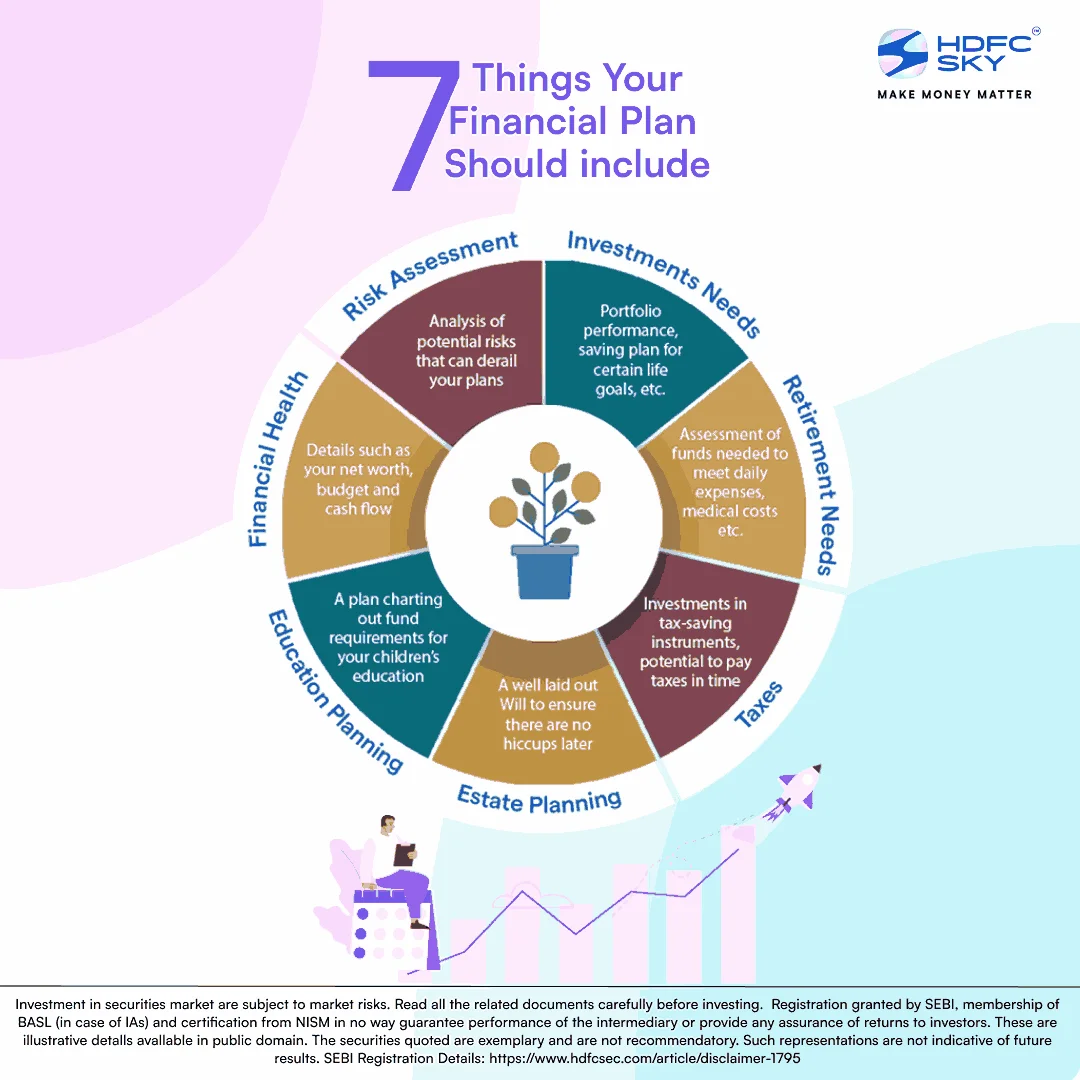
Things to do before planning finances
Consider needs and obligations
When you begin considering a financial plan, the first area to consider is your individual (in case of married individuals, it would be the family’s too) needs and requirements, and how these are likely to evolve and change through your and your family’s lifetime. A lifetime would be dotted with a number of events, such as job switch or starting a business, marriage of self, birth of children, buying a house, illness/deaths in the family, marriage of children, and so on. Financial planning should take into consideration the financial angles to all these events, and more.
Manage money
Managing money— and doing a good job of it—is among the most important factors in living a wholesome life. Systematic saving on a regular basis can help reap significant benefits in future. This can be done by distributing your salary/income under various heads, such as expenses, equated monthly instalments (EMIs), investments, and savings.
An important aspect about saving is that done properly, it will make sure that you never get into a debt trap.
Prepare a budget
Budgeting is vital for managing cash flows. Budget lays out in detail the amount of money an individual has in hand or will get/earn over the lifetime of the Budget, how these funds will be spent,and how much would be saved. It’s better to categorize expenses into i) fixed – expense items that cannot be avoided, and ii) variable – expense items that could be avoided or delayed.
Start living within your means
While credit options allow you to live a certain quality of life instantly, these can adversely impact your financial stability in the near and long term. Hence, it’s best to learn to live within your means and not spend big, wherever avoidable.
Review financial situation regularly
Cultivate a habit of reviewing your financial situation regularly. This involves looking at your savings and managing the budget, among others. This will help keep your affairs under control and allow you to make changes in certain spending habits.
Become financially educated
As you learn more about financial planning, you will be able to explore more avenues for wealth-creation and make better decisions regarding various aspects of your portfolio.
Wind up debt
Hasty spending can lead you to a debt trap, derailing your financial goals. If you already have debt, it makes sense to wind it up, and establish a robust spending plan. For this, you need to have a proper financial strategy in place.
Set financial goals
You should have a clear idea of why you are saving money. The goals may be for the short term or long term.
Start creating an emergency fund
You should have an emergency fund that can allow you and family to survive without income for at least six months. In thecurrent post-COVID times, some financial experts say this kitty should be enough to see you through for two years. This will protect your other savings and shield you from taking on unwanted debt.
Start planning taxes
Ensure that tax planning is aligned with your long-term financial goals. Avenues that serve the dual purpose of wealth-creation and tax-saving are perfect bets.
Buy sufficient insurance cover
Make sure you and family are adequately insured. As you age, premiums get pricier. So, it is important to buy insurance as early as possible in life.
Start investing early
Start small but start early! Investing is an imperative aspect of your financial journey. The power of compounding does the magic here. You can start small and increase the contribution to your investment kitty as your income grows over the years.
Prioritize saving and investing
Usually, people tend to spend first and invest whatever amount is left at the end of the month. That’s not a great idea. Do the reverse. Based on the average expenses, it’s better to determine a fixed amount that can be saved and invested every month.
Plan your retirement early
It is said that if one starts to sow seeds of sound financial status in early adulthood, the greater are the chances of being able to enjoy a stress-free life in the sunset years. This means one needs to focus on building a healthy retirement corpus right from your young age. By doing this, you can look forward to living a carefree old age.
Seek professional help
Whilst some of these considerations are basic and can be self-managed, it is important to seek professional help to avoid any kind of confusion and problems in future.
Importance of financial planning
Financial planning is important as it helps get a detailed insight into your income and expenses, tracking and cutting down costs consciously, and automatically increasing savings in the long run. A good financial plan also helps you reach your goals even as you enjoy a good standard of living. It helps map out a tangible solution to achieving said goal.
Related Articles