- Offerings
- Tools & Platforms
Tools & Calculators
- Open API
- Calculators
- SIP Calculator
- CAGR Calculator
- Compound Interest Calculator
- FD Calculator
- RD Calculator
- EPF Calculator
- Retirement Calculator
- HDFC SIP Calculator
- Mutual Fund Return Calculator
- Lumpsum Calculator
- Step Up SIP Calculator
- ETF SIP Calculator
- Brokerage Calculator
- Equity Margin Calculator
- SWP Calculator
- EMI Calculator
- MTF Calculator
- Pricing
- SKY Learn
- Mutual Funds
- Margin Trading
- Financial Planning
- Personal Finance
- Share Trading
- IPO
- Derivatives
- Currencies
- Intraday Trading
- Trading Strategies
- Demat Account
- Commodity
- ETF
What is PSU ETF? and How Does It Work?
By HDFC SKY | Published at: May 19, 2025 02:33 PM IST
An Exchange Traded Fund (ETF) is a marketable security that tracks an index, sector, or group of assets and trades like a stock on exchanges. It offers flexibility, diversification, and transparency. One popular category is the PSU bank ETF.
In the next sections, we’ll explore what a PSU ETF is and how it works.
What is PSU Bank ETF?
A PSU Bank ETF is an exchange-traded fund that tracks a specific index of public sector banks, such as the Nifty PSU Bank ETF. This ETF PSU bank strategy allows investors to gain exposure to a basket of government-owned banks through a single investment.
It offers diversification, lower costs, and trades like any normal stock. Since it mirrors the Nifty PSU Bank Index, its value reflects the performance of major PSU banks. It’s ideal for those targeting the financial sector.
How Does PSU Bank ETF Work?
A PSU ETF pools money from investors to buy shares of public sector banks listed in a specific index, such as the Nifty PSU Bank Index. Regulated by SEBI and traded on stock exchanges like NSE and BSE, the fund follows a passive PSU bank ETF strategy, aiming to replicate the index’s performance.
Since ETFs trade like regular shares, investors can buy or sell units during market timing at live prices. The PSU bank ETF offers an instant spread of investments, as one unit includes multiple PSU bank stocks. It’s professionally managed, making it suitable for hands-off investors in the financial sector.
Factors to Consider Before Investing in PSU Bank ETFs
Before investing in a PSU bank ETF, evaluating certain factors that can impact your returns and overall experience is essential. PSU ETFs may seem simple, but like all investments, they carry their own risks and conditions.
Here’s what you should know:
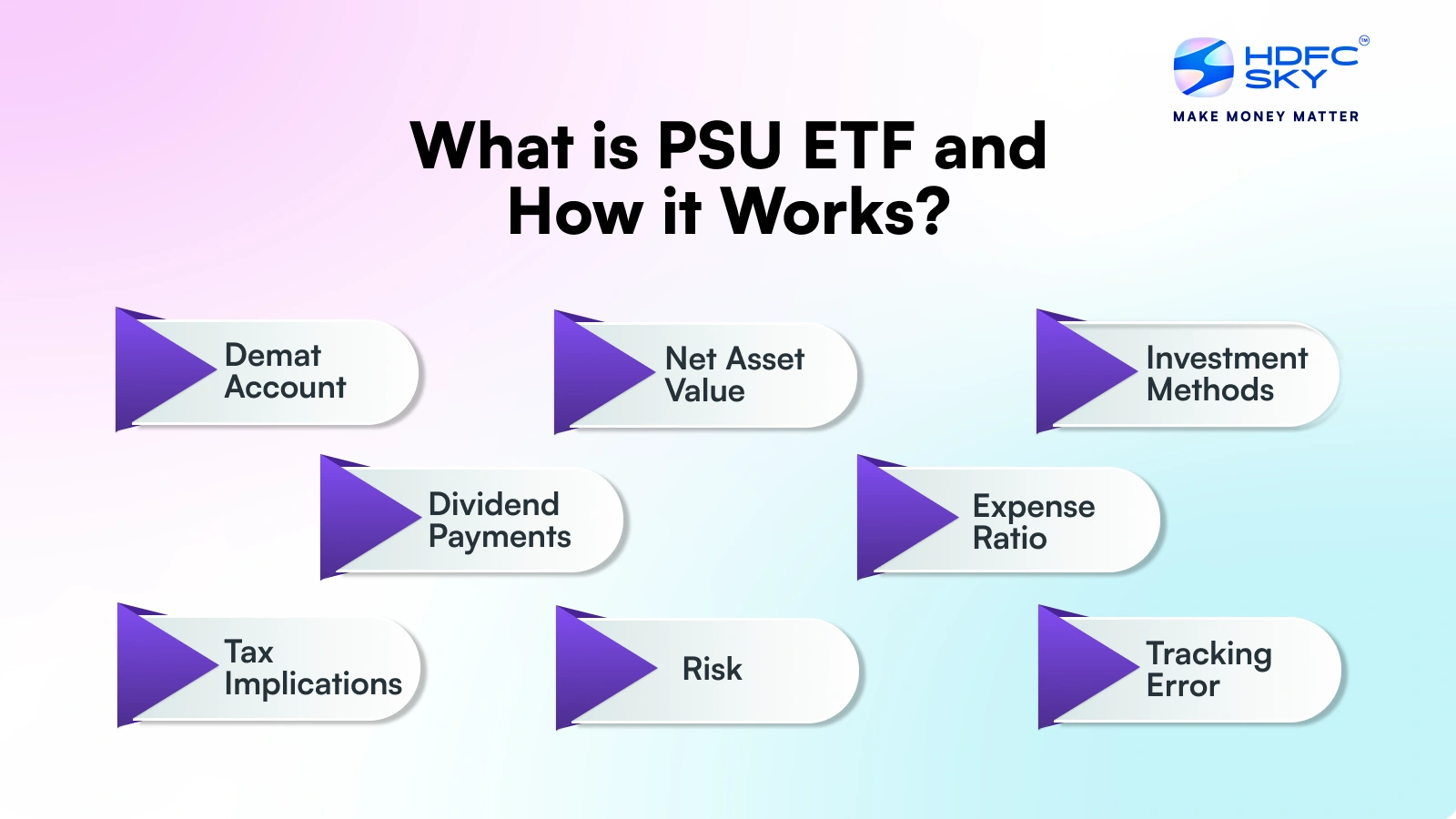
- Demat Account: To invest in a PSU bank ETF, you need an active demat and trading account. Since ETFs are listed and traded on exchanges like NSE and BSE, a demat account helps you hold ETF units electronically and trade them like stocks.
- Dividend Payments: PSU ETFs may offer dividend income if the underlying companies distribute profits. However, dividend payout policies vary between funds. Some reinvest the dividends (growth option), while others distribute them to investors (dividend payout). Check the fund details before investing.
- Tax Implications: ETFs are subject to capital gains tax. If you sell your PSU ETF units within one year, gains are taxed as short-term capital gains at 15%. Long-term capital gains over ₹1 lakh are taxed at 10% for units held longer than a year. Also, dividends may be taxed based on your income tax slab.
- Net Asset Value (NAV): NAV reflects the per-unit value of the ETF’s underlying assets. Due to demand-supply differences, the market price of the PSU bank ETF may differ slightly from the NAV while trading. Monitor both values to make informed decisions.
- Risk: PSU ETFs are exposed to market risks, particularly those linked to public sector banks. Government policies, economic conditions, and regulatory changes can influence these banks. Prices fluctuate widely, so risk tolerance is key, especially for new investors.
- Expense Ratio: The expense ratio is a small annual fee charged by the fund house for managing the ETF. Though PSU ETFs typically have lower expense ratios compared to mutual funds, even a small difference can impact long-term returns. Look for ETFs with low and competitive fees.
- Investment Methods: During trading hours, you can invest in a PSU ETF via the stock exchange. It works just like buying any listed stock. Some fund houses also allow lump-sum investments through their platforms. SIP (Systematic Investment Plan) isn’t available for ETFs in the traditional sense.
- Tracking Error: PSU bank ETFs aim to replicate an index like the Nifty PSU Bank Index. However, there may be slight differences in performance. This difference is called a tracking error. Lower tracking errors indicate better index replication.
- Liquidity and Trading Volume: Choose ETFs with higher daily trading volumes. This ensures better liquidity, making it easier to buy or sell units at fair prices without major slippage.
Conclusion
PSU bank ETFs offer a simple way to invest in government-backed banks through a single, varied instrument. With features of both stocks and mutual funds, they suit investors seeking sector exposure with liquidity and lower costs. Reviewing your goals and financial plan helps you select the right ETF PSU bank investment.
Related Articles
FAQs on What is PSU ETF?
Are there any risks associated with investing in a PSU bank ETF?
Yes, PSU bank ETFs carry market risks. Since they track government-owned banks, their performance depends on their financial health and economic policies. The ETF’s PSU bank value can fluctuate due to sector volatility, interest rate changes, or political and regulatory developments.
Can I trade in a PSU bank ETF?
Yes, you can trade PSU bank ETFs just like regular stocks on the stock exchange. These ETFs are listed on platforms like NSE and BSE, allowing you to buy and sell units throughout the trading day at real-time market prices.
Do PSU bank ETFs pay dividends?
Some PSU bank ETFs may offer dividend payouts, depending on the earnings of the underlying bank stocks. However, dividend payments are not guaranteed. Investors should check the specific PSU ETF scheme’s dividend policy before investing.
Why should you invest in any of the PSU bank ETFs?
The main reason to invest in a PSU bank ETF is diversification within the banking sector at a low cost. It provides exposure to multiple public sector banks through a single instrument, following a passive investment strategy with the potential for long-term returns.
Which is the benchmark index that PSU bank ETFs in India usually track?
In India, the Nifty PSU Bank Index is one of the most common benchmarks for PSU bank ETFs. This index tracks the performance of major government-owned banks, and the ETF PSU bank funds aim to replicate its returns as closely as possible.