- Offerings
- Tools & Platforms
Tools & Calculators
- Open API
- Calculators
- SIP Calculator
- CAGR Calculator
- Compound Interest Calculator
- FD Calculator
- RD Calculator
- EPF Calculator
- Retirement Calculator
- HDFC SIP Calculator
- Mutual Fund Return Calculator
- Lumpsum Calculator
- Step Up SIP Calculator
- ETF SIP Calculator
- Brokerage Calculator
- Equity Margin Calculator
- SWP Calculator
- EMI Calculator
- MTF Calculator
- Pricing
- SKY Learn
- Mutual Funds
- Margin Trading
- Financial Planning
- Personal Finance
- Share Trading
- IPO
- Derivatives
- Currencies
- Intraday Trading
- Trading Strategies
- Demat Account
- Commodity
- ETF
What is Stock Trading? Types of Trading in the Stock Market
By HDFC SKY | Updated at: Oct 24, 2025 06:38 PM IST
Stock trading is the process of buying and selling shares of publicly listed companies through a stock exchange. It allows investors to participate in a company’s growth while aiming to earn profits from price fluctuations. With the rise of digital platforms, stock trading has become more accessible offering a range of strategies from long-term investing to short-term trades.
What is Stock Trading?
Stock trading is the act of buying and selling shares of publicly traded companies with the goal of making a profit. It involves analysing market trends, company performance and price movements to decide when to enter or exit a trade. Stock trading can be done on exchanges like the NSE or BSE in India and ranges from intraday trading to long-term investing.
How Does Online Share Trading Work?
Online share trading allows investors to buy and sell stocks through digital platforms provided by brokers. Here’s how it works:
- Open a Demat & Trading Account: Register with a SEBI-registered broker to get access to the trading platform.
- Fund Your Account: Transfer money from your bank account to your trading account.
- Place Orders: Use the platform to place buy or sell orders for shares listed on stock exchanges.
- Execution & Settlement: Orders are matched in real-time; shares are credited/debited to your Demat account and funds are settled as per T+1 or T+2 cycle.
- Track & Manage: You can monitor prices, news, charts and manage your investments online anytime.
It offers speed, transparency and convenience for retail investors.
Types of Trading in the Stock Market
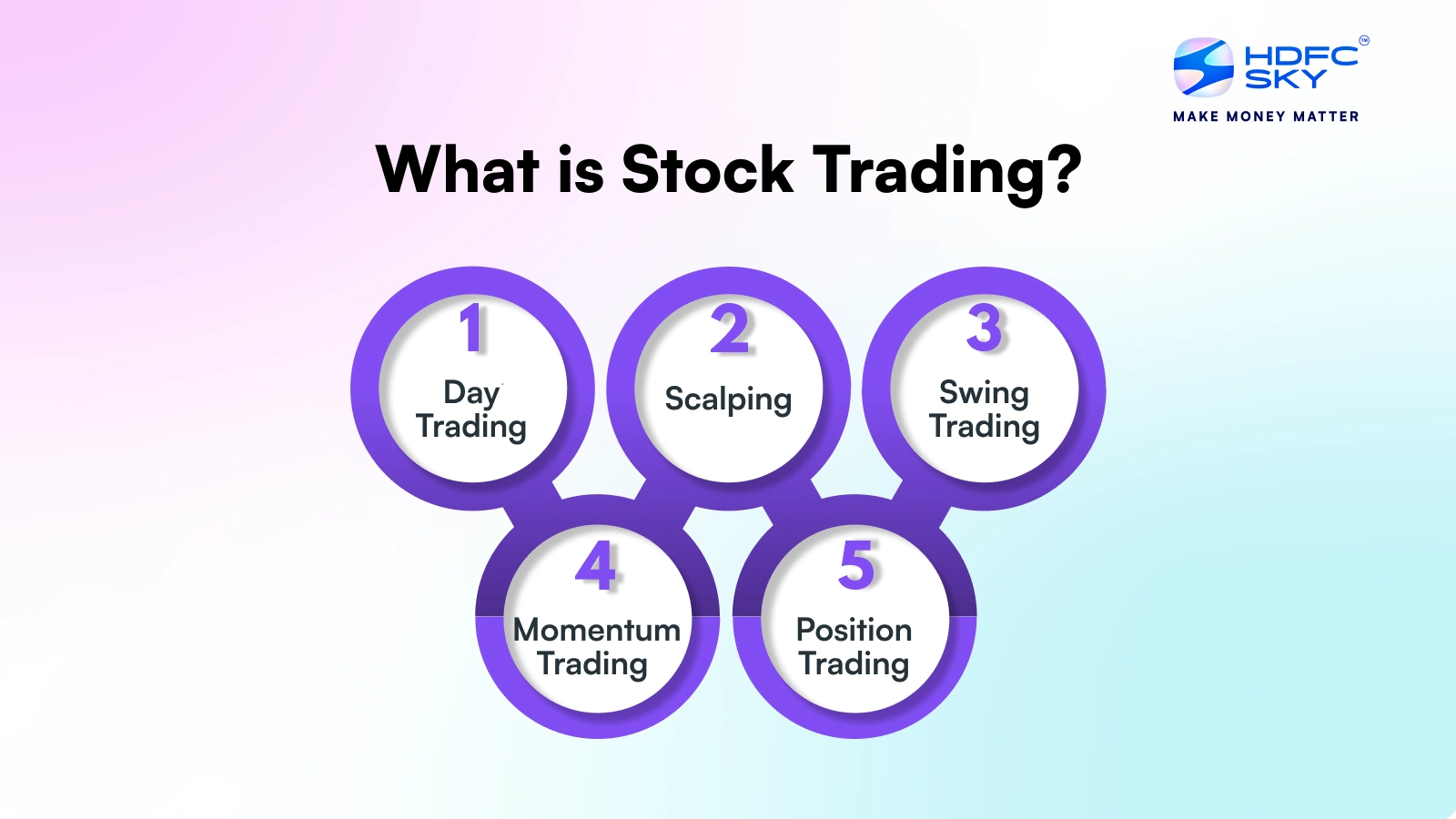
Different stock market trades will use varying combinations of time frames, levels of risk and market conditions to achieve their objectives. Here are the different types of trading in the stock market that are utilised by investors and traders:
1. Day Trading
Day Trading is the method of purchasing and selling shares within a single trading session. Traders buy stocks at a low price and sell them at a higher price. As the name suggests, a trader closes position daily. Day traders capitalise on brief profit margins that result from minor price movements. To effectively carry out this type of share trading, a person must have a good grasp of the current market situation, the ability to conduct market and technical analysis and a good understanding of rapid decision-making.
2. Scalping
In this strategy, traders earn small profits by making multiple ultra-short-term trades in a single day. It can be seen as one of the most time-intensive strategies where trades are made during the day and minuscule profits from tiny price movements are captured. Scalpers primarily focus on price action movement and are able to take advantage of liquidity and order volume at market openings and closings.
3. Swing Trading
In swing trading, stocks are bought and held for a few days to a few weeks to achieve short-term price changes. This technique combines both fundamental and technical analysis and is usually chosen by people who appreciate the depth of financial markets moderately above casual trading and investing.
4. Momentum Trading
Momentum traders make trades in stocks with strong upward or downward movements. They tend to buy or sell stocks when the price is predicted to change drastically. In this trading style, the profit potential is much higher, but so are the risks. This strategy is more suitable in active market conditions.
5. Position Trading
As a strategy, this method of trading needs a favourable change to occur in at least several months, but it does lower the level of management required to achieve a satisfactory profit level. Position trading is easy to implement, especially in markets with slower-changing price levels. It usually takes more than minimal effort to understand trades in order to see the payoff.
Learning about all the different types of trading in the stock market allows traders to develop strategies that suit their risk appetite and financial goals.
Share Trading Brokerage Charges
When an investor buys or sells shares, they pay stockbrokers a fee known as a brokerage charge for carrying out the buy and sell orders. These charges differ with different types of brokers and how the trading is done.
- Full-Service Brokers: These brokers do research, give advice and manage portfolios. They charge a commission of 0.3% to 0.5% per trade.
- Discount Brokers: They charge minimal amounts for trading and do not provide any advisory services, just charging ₹10 –₹20 a trade.
- Intraday Trading Brokerage: For intraday share trading in India, the commission is between 0.01% and 0.05%, which is more profitable than delivery trading.
- Delivery Trading Brokerage: For keeping stocks for more than 1 day, the broker commission is 0.1%- 0.5% per trade.
- Hidden Costs: Traders may incur additional expenses apart from commissions, such as Securities Transaction Tax (STT): A tax levied by the government on transactions executed on stock exchanges (different rates for intraday vs delivery).
- Exchange Transaction Charges: Fees charged by NSE/BSE for using their platform.
- SEBI Turnover Fees: Charges levied by the regulator, SEBI.
- GST: Applicable @ 18% on Brokerage and Transaction Charges.
- Stamp Duty: Levied by state governments on share transfers (buying).
- Depository Participant (DP) Charges:Fees for debiting shares from your Demat account when selling.
Difference Between Trading and Investing
Trading and investing are two distinct approaches to making money in financial markets. While both involve buying assets, their strategies and goals differ.
| Aspect | Trading | Investing |
| Objective | Quick profits | Long-term wealth creation |
| Time Horizon | Short-term (minutes to weeks) | Long-term (years to decades) |
| Approach | Technical analysis & market timing | Fundamental analysis & value focus |
| Risk Level | High due to volatility | Comparatively lower |
| Frequency of Trades | Frequent | Infrequent |
| Returns | Potentially higher in short-term | Steady, compounding over time |
| Instruments Used | Stocks, derivatives, forex, etc. | Stocks, mutual funds, bonds, etc. |
Current Impact of Online Trading
Online trading has transformed the financial landscape by making market participation faster, more accessible and cost-effective for individual investors.
- Wider Access: Anyone with internet access can trade from anywhere.
- Lower Costs: Brokers offer low or zero commission models.
- Real-Time Data: Instant market updates improve decision-making.
- Faster Execution: Orders are placed and completed within seconds.
- Increased Participation: More retail investors are entering the market.
- Rise of Mobile Trading: Apps have made trading more user-friendly.
- Algorithmic & AI Trading: Automated strategies now dominate volumes.
- Education & Awareness: Online content and tools improve investor knowledge.
Online trading has democratised investing but also demands financial literacy and discipline due to easy access and fast-paced decision-making.
Conclusion
Share trading meaning essentially boils down to participating in the stock market with the objective of generating profits from short-term price movements. Online share trading is different from long-term investing.
In all cases, the basics of the market should be known beforehand. The choice between spending years investing in shares or short-term trading assets depends on your goals, willingness to take risks and time, resulting in an organised form of participating in the stock market.
Related Articles
FAQs on What is Stock Trading?
Why do companies need shares, and why do they have to list them?
Companies issue shares to raise capital for business purposes like expansion, R&D, or debt repayment. Listing shares on a stock exchange allows them to raise funds from the public via an IPO and provides a regulated marketplace for existing and new shareholders to easily buy and sell those shares, ensuring liquidity and price discovery.
How are shares priced in the market, and who determines the price?
The stock prices change according to the demand and supply. Their price is affected by several things, such as the company profits, other market trends, and feelings of investors towards the market. Initially the price is set by the company that issues the IPO, and later, during online share trading in India, the users set the value of the shares.
Can you make money from share trading?
Share trading provides a wide range of profit options with increases in stock values and dividends. Share trading in India allows traders to earn money via purchasing low and selling high.
How do I start share trading?
To start share trading india: 1) Obtain a PAN card. 2) Open a Demat and Trading account with a SEBI-registered stockbroker. 3) Link your bank account. 4) Educate yourself thoroughly on market basics, trading strategies, and risk management. 5) Deposit funds into your trading account and begin cautiously, preferably with small amounts.
How to make profits in share trading?
Consistent profits in trading are challenging and require a robust strategy, typically involving technical or fundamental analysis, disciplined entry and exit rules, strict risk management (like using stop-losses), controlling emotions, continuous learning, and adapting to changing market conditions. There is no guaranteed method for How to Make Profits in Share Trading.
What is the importance of share trading in financial growth?
Share trading helps in creating wealth, provides liquidity to the market and helps in growing the economy. Investors in share trading in India enjoy the benefits of long-term growth, appreciation of capital, and security.