
- Offerings
- Tools & Platforms
Tools & Calculators
- Open API
- Calculators
- SIP Calculator
- CAGR Calculator
- Compound Interest Calculator
- FD Calculator
- RD Calculator
- EPF Calculator
- Retirement Calculator
- HDFC SIP Calculator
- Mutual Fund Return Calculator
- Lumpsum Calculator
- Step Up SIP Calculator
- ETF SIP Calculator
- Brokerage Calculator
- Equity Margin Calculator
- SWP Calculator
- EMI Calculator
- MTF Calculator
- Pricing
- SKY Learn
- Mutual Funds
- Margin Trading
- Financial Planning
- Personal Finance
- Share Trading
- IPO
- Derivatives
- Currencies
- Intraday Trading
- Trading Strategies
- Demat Account
- Commodity
- ETF
Understanding Why Companies Go Public: Benefits, Process & Terms
By Shishta Dutta | Updated at: Jun 5, 2025 04:55 PM IST
When a company “goes public,” it means it is offering its shares to the general public for the first time through an Initial Public Offering (IPO). This process involves listing the company’s shares on a stock exchange, allowing investors to buy and sell them. Going public provides the company with access to capital from a broader pool of investors, which can be used for growth, debt repayment, or other corporate needs. It also increases the company’s visibility and can enhance its credibility. However, going public also subjects the company to regulatory scrutiny, reporting requirements, and market fluctuations.
Why Does a Company Decide to Go Public?
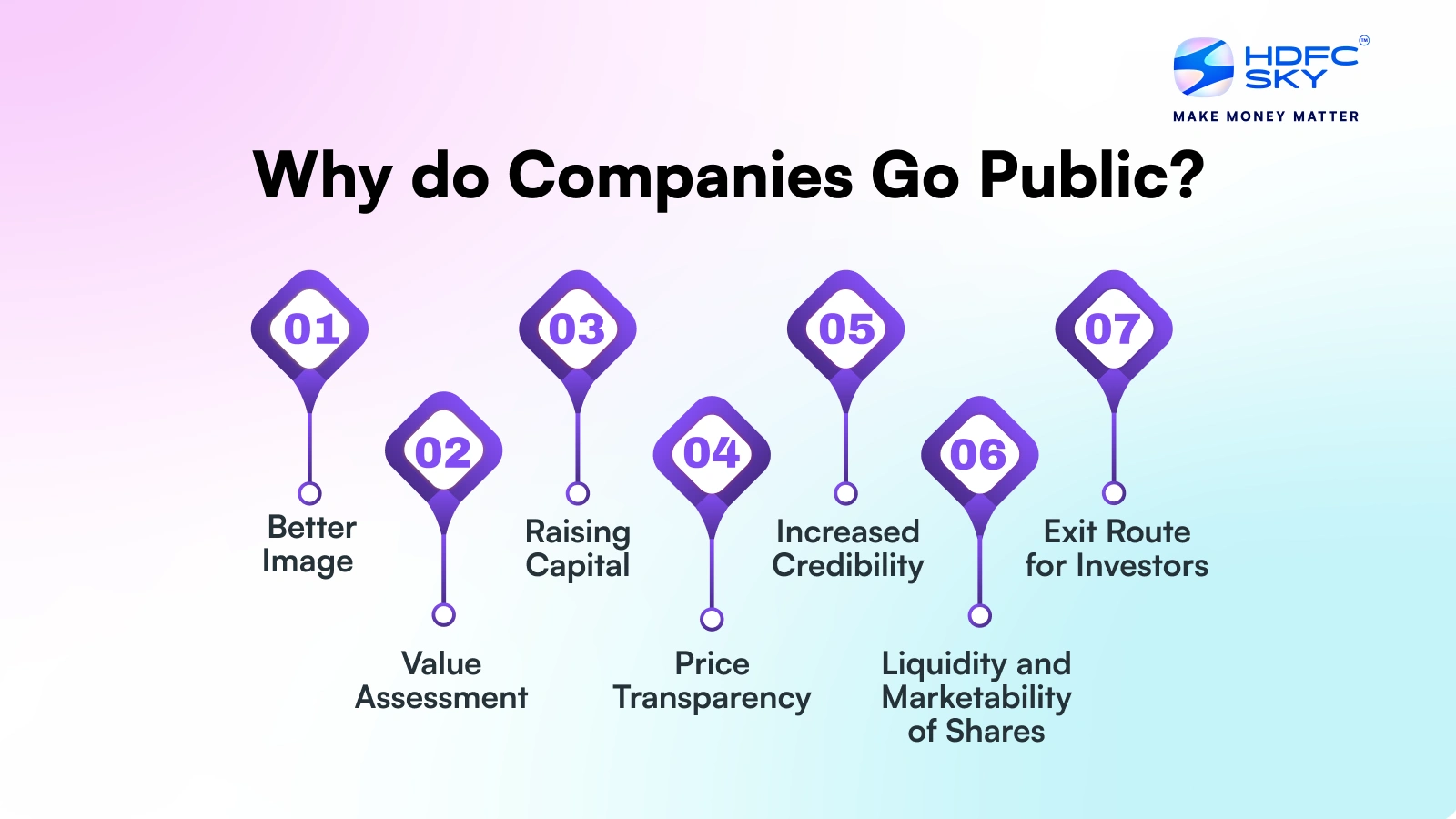
Usually, a company decides to go public keeping in mind the following causes –
- Better Image: Going public boosts a company’s visibility and enhances its reputation, signalling stability and success. This improved image can attract customers, business partners, and top talent, positively impacting the company’s growth and market presence.
- Raising Capital: An IPO allows a company to raise significant funds from public investors. This capital can be used for expansion, new projects, or reducing debt, supporting long-term growth and financial health.
- Price Transparency: Public companies list their shares on stock exchanges, providing transparent, real-time information about their market value. This transparency helps investors make informed decisions based on current share prices.
- Value Assessment: Being publicly traded helps establish a company’s market value through its share price. This valuation reflects investor confidence and market conditions, providing a clear measure of the company’s worth.
- Increased Credibility: Public companies undergo regulatory scrutiny and regular reporting, enhancing their credibility. This increased transparency can build trust with customers, investors, and partners, strengthening the company’s market position.
- Exit Route for Investors: An IPO offers early investors, like venture capitalists, a way to sell their shares and realize returns. This exit strategy provides liquidity and allows investors to profit from their initial investments.
- Liquidity and Marketability of Shares: Shares of public companies are easily traded on stock exchanges, providing liquidity and making it straightforward for shareholders to buy or sell their investments, enhancing marketability and flexibility.
How Do Companies List in the Stock Market?
- Preparation: Companies prepare for an IPO by conducting internal audits, financial reviews, and legal assessments. They also assemble a team of financial advisors, legal experts, and underwriters.
- Regulatory Compliance: The company must comply with SEBI regulations and prepare an IPO prospectus detailing financials, business models, and risks. The prospectus is submitted for approval.
- Approval: SEBI reviews the IPO application and prospectus. Once approved, the company receives the green light to proceed with the IPO.
- Pricing and Timing: The company and underwriters set the IPO price and determine the timing for the public offering.
- Marketing: The company conducts a roadshow to market the IPO to potential investors, including institutional and retail investors.
- Subscription: Investors submit their applications to buy shares during the IPO period. This phase involves collecting bids and ensuring regulatory compliance.
- Allotment: Shares are allotted to investors through a random or proportional process, depending on demand and allocation rules.
- Listing: After allotment, the company’s shares are officially listed on the stock exchange and begin trading, allowing the public to buy and sell shares.
- Post-Listing: The company continues to adhere to regulatory requirements, including regular financial reporting and disclosure of material events.
Advantages of Going Public
- Access to Increased Funds: Going public allows a company to raise substantial capital by selling shares to the public. This funding can be used for expansion, research and development, debt repayment, or other strategic initiatives.
- Exit Route for Existing Investors: An IPO provides a way for early investors, such as venture capitalists and private equity holders, to sell their shares and realise their returns on investment. This liquidity event allows them to exit their investments while potentially earning significant profits.
- Shares Become More Liquid: Once listed on a stock exchange, a company’s shares become more liquid, meaning they can be bought and sold more easily. This increased liquidity makes it easier for shareholders to trade their investments and helps attract more investors.
- Shares Are More Marketable: Publicly traded shares are more easily bought and sold on stock exchanges, enhancing their marketability. This increased liquidity attracts more investors and facilitates smoother trading.
- Increased Stakeholder Trust: Being publicly listed requires rigorous regulatory compliance and transparency, which builds trust among stakeholders, including customers, investors, and business partners. This increased trust can strengthen the company’s reputation.
- Opportunity for Takeovers: A public listing provides a structured platform for potential mergers and acquisitions. The company’s market value is readily available, making evaluating and executing takeover opportunities easier.
- Better Visibility: Going public boosts a company’s profile and visibility. Increased media coverage and public interest can enhance brand recognition, attract new customers, and open up additional business opportunities.
Disadvantages of Going Public
- Complex and Lengthy Process: The process of going public involves extensive preparation, regulatory approvals, and legal complexities, which can be time-consuming and challenging for the company.
- High Upfront Costs: Companies face significant costs related to underwriting fees, legal expenses, and compliance costs during the IPO process. These expenses can be substantial and may impact the company’s finances.
- Loss of Control: Publicly traded companies may face dilution of control as they have to answer to a broader group of shareholders. This can limit the founder’s or management’s influence over company decisions.
- Increased Compliance Requirements: Public companies must adhere to stringent regulatory requirements, including regular financial disclosures and audits. This increased scrutiny can add to operational burdens and administrative costs.
- Need to File Financial Papers Every Year: Public companies are required to file detailed financial reports annually and quarterly with regulatory bodies. This ongoing reporting requirement ensures transparency but involves significant time and effort.
Key IPO Terms
Given below are some of the key terms related to IPO –
- Venture: In the context of IPOs, a venture usually refers to a business or startup seeking to raise funds for growth. Venture capitalists often invest in these early-stage companies before they go public, hoping for high returns as the company grows and eventually offers shares to the public.
- Market: The market refers to the financial environment where stocks, including IPO shares, are bought and sold. It includes stock exchanges like the NSE and BSE where public companies list their shares, allowing investors to trade them.
- Market Capitalisation: Market capitalisation (market cap) is the total value of a company’s outstanding shares of stock, calculated by multiplying the share price by the total number of shares. It provides an indication of a company’s size and overall value in the market.
- Fresh Issue: A fresh issue refers to the new shares a company offers to the public during an IPO. Unlike existing shares sold by current shareholders, fresh issues are newly created shares that increase the company’s total number of shares.
- Price Band: The price band is the range of prices within which investors can bid for shares in an IPO. It sets a minimum and maximum price for the shares, helping to determine the final issue price based on investor demand.
- Book Value: Book value represents a company’s net worth, calculated by subtracting total liabilities from total assets. It gives a snapshot of the company’s value according to its financial statements and can be used to assess if shares are fairly priced.
- Underwriter: An underwriter is a financial institution or investment bank that helps a company with the IPO process. They manage the issue, set the share price, and often buy shares to sell to the public, taking on the risk of selling the shares.
Conclusion
Launching the company for public issues is a great way to raise capital, improve market position, strengthen the brand name and allow expansion of the company. For investors, it is a great opportunity to be part of the IPO issuing company’s growth journey right from the onset. In the article above, we have discussed the why, how, advantages, and disadvantages of a company going public, along with key IPO terms for your better understanding.
Related Articles
FAQs on Why Do Companies Go Public?
Why would a company want to go public?
A company may choose to go public to raise funds, improve visibility, improve share liquidity and marketability, among other reasons
Why do some companies choose not to public?
Going public comes with its own set of challenges like high upfront cost, complex process of approval, time-consuming process and leads to loss of autonomous control in the company.
Is it better to be acquired or go public?
Both come with their pros and cons. Depending upon the objective, a company goes for either an acquisition or an IPO.




