- Offerings
- Tools & Platforms
Tools & Calculators
- Open API
- Calculators
- SIP Calculator
- CAGR Calculator
- Compound Interest Calculator
- FD Calculator
- RD Calculator
- EPF Calculator
- Retirement Calculator
- HDFC SIP Calculator
- Mutual Fund Return Calculator
- Lumpsum Calculator
- Step Up SIP Calculator
- ETF SIP Calculator
- Brokerage Calculator
- Equity Margin Calculator
- SWP Calculator
- EMI Calculator
- MTF Calculator
- Pricing
- SKY Learn
- Mutual Funds
- Margin Trading
- Financial Planning
- Personal Finance
- Share Trading
- IPO
- Derivatives
- Currencies
- Intraday Trading
- Trading Strategies
- Demat Account
- Commodity
- ETF
Delivery Trading Online: Start Investing With HDFC Sky
With Our Research Backed Stock Recommendations

What is Delivery Trading?
Delivery trading meaning refers to the process of buying shares and holding them in a Demat account for more than one day. In delivery trading, you take actual ownership of the shares, unlike intraday trading where positions are squared off the same day. It is ideal for long-term investors aiming for wealth creation.
- Long-term growth
- Dividend Income
- Protection against volatility
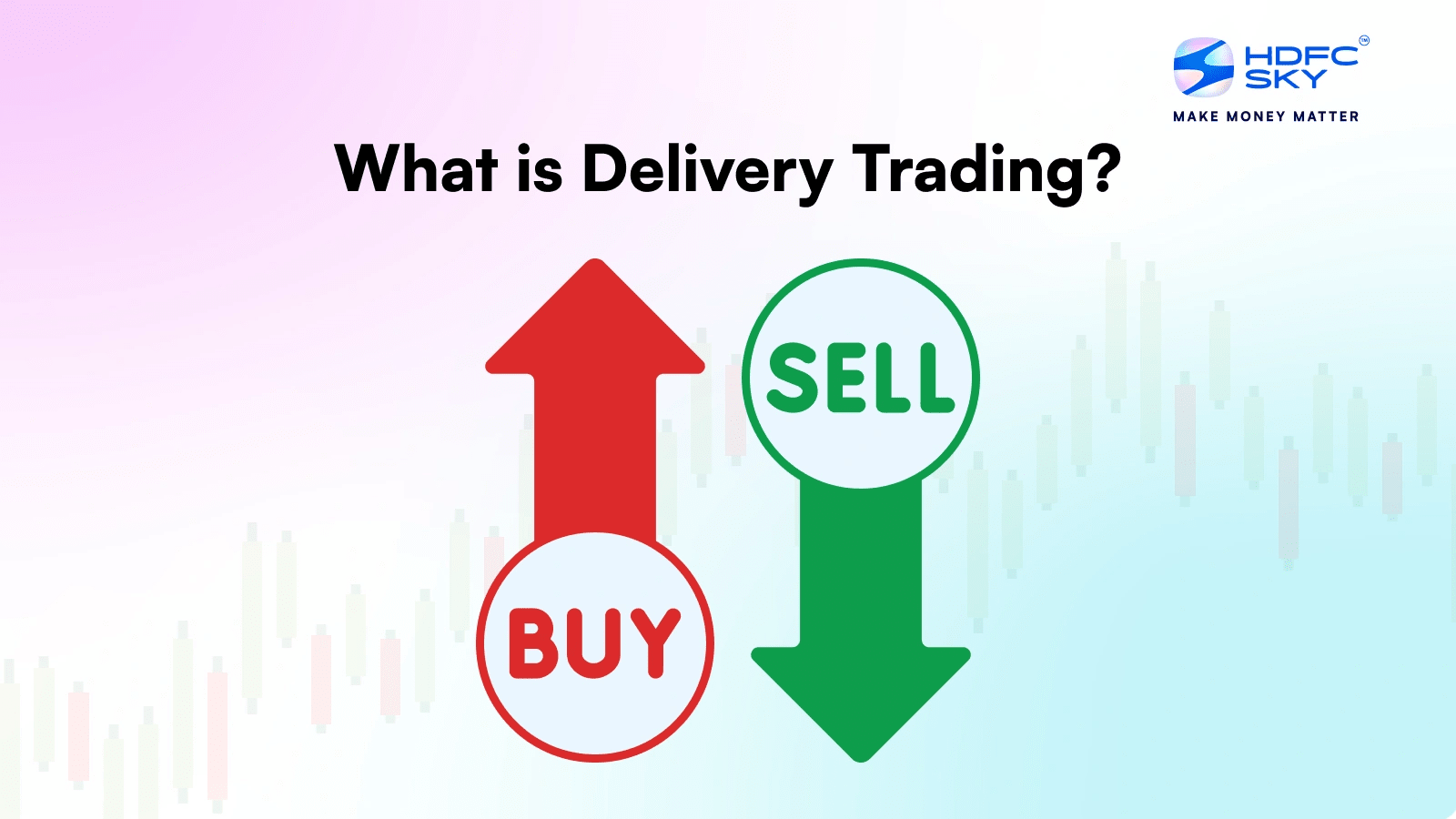
Key points about delivery-based trading: Asset ownership – You own the stock for more than 1 day, Settlement period – T+1 settlement period. Delivery Trading offers the opportunity to gain from the appreciation of the investment and attracts lower capital gains tax if investment is held for more than one year before selling.
Delivery Trading with HDFC Sky
HDFC SKY charges the same brokerage of Rs 20/ order or 2.5% of the order value (whichever is lower) on delivery orders, as on intra-day orders.
HDFC SKY offers research-based stock recommendations.
You can add a stock on the Watch-list feature of HDFC SKY app to track it.

Secure Transactions
Research and Analysis
Realtime Market Data
Watchlist
How Delivery Trading Works at HDFC Sky?
Open Your Demat & Trading Account with HDFC Sky
Add you are ready to do delivery trading & investing
Select Stock from Research Recommendation
Place Your Buy/Sell Order on Web or App
Order Executed
Open Your Demat & Trading Account with HDFC Sky
Add you are ready to do delivery trading & investing
Select Stock from Research Recommendation
Place Your Buy/Sell Order on Web or App
Order Executed
 Pricing
Delivery Trading Charges in Trading with HDFC Sky
Benefit from low delivery trading charges with no hidden fees
Delivery Order
₹20 or 2.5% of order value (Whichever is Lower)
Intraday Order
₹20 or 2.5% (Whichever is Lower)
Benefits of more long term investing in stocks

More long-Term Growth Potential
More long-term investing allows for potential growth over time.

Stronger Ownership Rights with longer term investment
Ownership rights give investors a say in company operations and decisions

Dividends may be realized
Dividends provide a steady stream of income for long term investors

May Align better with long term financial goals
May allow you to build wealth over time and potentially achieve financial goals

Longer term investments may carry lower risks
Ride out market fluctuations and potentially recover from short-term losses

Capital Appreciation Potential
Higher Potential to get steady and consistent returns over time
More long-Term Growth Potential
More long-term investing allows for potential growth over time.
Stronger Ownership Rights with longer term investment
Ownership rights give investors a say in company operations and decisions
Dividends may be realized
Dividends provide a steady stream of income for long term investors
May Align better with long term financial goals
May allow you to build wealth over time and potentially achieve financial goals
Longer term investments may carry lower risks
Ride out market fluctuations and potentially recover from short-term losses
Capital Appreciation Potential
Higher Potential to get steady and consistent returns over time
Learn Delivery Trading By Watching Videos
Learn delivery trading by watching videos to master long-term investing. Our easy-to-follow tutorials cover analyzing stocks, making smart buy-and-hold decisions, placing orders, checking order status and reviewing portfolio. Perfect for beginners and those looking to improve, our videos offer expert tips, market analysis, and practical examples.

How Does Delivery Trading Work?
1. Buying and holding of stocks
Unlike intraday trading where the trades are squared off on the same day, in delivery trading you buy the share and hold them in your demat account for a day or more based on your investment strategy.
2. Gaining ownership
Once you have bought the shares of a particular company and held them in your demat account, you become the shareholder (partial owner) of that company and are entitled to receive dividends and other shareholder benefits.
3. Settlement
Once the buying order is placed, the broker notifies the exchange about the trade, and the exchange facilitates the transfer of shares from the seller’s account to the buyer’s demat account. This settlement typically occurs on the T+1 day, which is two business days after the transaction date.
4. Capital and brokerage charges
In order to buy the shares you must ensure there is sufficient capital in your trading account to cover the cost of the shares. Brokerage, mandatory fees like STT and other transaction costs may also apply.
Example of Delivery Trading
Let’s understand more clearly with an example.
Rajeev, an aspiring investor interested in delivery trading, conducts thorough fundamental analysis to identify promising companies in the stock market. After evaluating various options, he concludes that Company X, an automobile firm, is set for significant growth in the coming years based on its strong financial health and market potential.
Initial Purchase:
1. Company : Company X
2. Current Market Price : Rs.250 per Share
3. Shares Purchased : 100 Shares
Rajeev decides to invest in Company X and places a buy order for 100 shares at the current market price of ₹250 each. The exchange processes his order, and the 100 shares are transferred to his demat account. The settlement is completed, and Rajeev now holds 100 shares of Company X in his portfolio.
Holding Period:
Over the next year, Company X experiences substantial growth due to a surge in sales and improved financial performance. As a result, the market price of Company X’s shares increases to ₹400 each.
Dividend income:
During this holding period, Rajeev, as a shareholder of company X, receives a dividend of ₹25 per share paid out by the company. These dividends amounting to ₹2500 are credited to his trading account, providing some passive income from his investment.
Selling the shares:
1. Selling Price : ₹400 per share
2. Shares Sold: 100 shares
3. Profit per Share: ₹150
With the market price of Company X’s shares now at ₹400, Rajeev decides to take advantage of the opportunity to realise a profit. He places a sell order for the 100 shares he owns. The order is executed, and the shares are debited from his demat account. The settlement for the sale is completed the next day.
Profit Calculation:
1. Purchase Price: ₹250 per share
2. Selling Price: ₹400 per share
3. Profit per Share: ₹400 – ₹250 = ₹150
• Total Profit from selling: ₹150 per share x 100 shares = ₹15,000
Rajeev receives the funds from the sale of the shares, including the total profit of ₹15,000, into his trading account. His returns also include the dividend of Rs 2500 that he earned.
What Did We Learn?
Through this delivery trading strategy, Rajeev successfully capitalizes on the appreciation in the share price of Company X. His profit of ₹15,000, combined with the dividend of ₹2,500 received, demonstrates how delivery trading can be a profitable investment approach when executed with careful research and timing.
By holding onto shares for the long term, Rajeev not only benefits from potential price increases but also gains from regular dividend payouts. This strategy helps investors focus on the overall growth and stability of the company, rather than short-term market fluctuations. To maximize success, it’s crucial to stay informed about market trends and company performance, ensuring well-timed and researched investment decisions.
How To Start Delivery Trading ?
A. Create a trading and demat account
The first and foremost step to start trading is to choose a broker of your choice and open a trading and demat account.
Steps to open a demat account
Opening a demat account is essential for trading and holding securities in electronic form. This account simplifies the process of buying, selling, and managing your investments, providing a secure and efficient way to keep track of your holdings. By converting physical shares into electronic form, a demat account helps reduce paperwork and minimizes the risk of theft or loss.
1. Choose a broker
Research and compare different brokers based on their brokerage, transaction charges, user experience and good customer support.
2. Visit the broker’s website
Navigate and find the section ‘create an account’. Select the option to create demat and trading account.
3. Fill out the application form
Fill out your personal details, and link your bank account, aadhar and pan.
4. Upload documents
Upload your identity proof, bank proof and income proof.
5. Complete e-KYC and verification
Complete your e-kyc process which may include your biometric verification.
6. Submit your application
Review all the information and documents uploaded and submit after confirming that all the information is correct.
7. Account activation
Once your application is verified and processed, you will receive an email that contains your account details.
8. Access your account
Login to your account with your account credentials and familiarise yourself with the platform.
B. Transfer of funds
In order to buy shares, you need funds. And for delivery trades, you need to ensure you have enough funds to place a buy order. You can directly transfer funds from your bank account to your trading account.
After transferring funds to your trading account, make sure to keep an eye on your balance. This way, you’ll always be ready to place buy orders without any issues. Regularly checking your account helps you stay on top of your trading and avoid any surprises.
C. Selecting stocks
It is important to invest your capital in a good stock that has the potential to grow over the years. For that purpose, a thorough research of the company is necessary to avoid the risk of losing your capital.
There are two ways to select a potential stock
Fundamental Analysis
In fundamental analysis, you study the company’s financial statements and broader economic indicators in order to come to a conclusion. You also assess the overall state of the company and the demand for its products and services.
Where can you find the fundamentals of a company?
1. Company filings: Companies are required to file regular reports with the SEBI and stock exchanges. There, you will find the company’s financial statements, management discussions and any other important information regarding the company.
2. Company website: Publicly listed companies have an investor relations section on their website where investors can access financial statements, earnings releases, investor presentations and many other important documents that may come in handy to the investor.
3. Financial platforms: Many platforms such as Moneycontrol, Google finance, Marketwatch and other platforms contain fundamental data regarding the companies and also finance-related news.
Technical Analysis
In technical analysis, you analyze the price and volume data represented graphically in charts. The below indicators are used to determine the movement of prices and thus help to decide further investment plans:
- Market trends
- Chart patterns
- Price movements
- Volume analysis
- Practical applications through backtesting
D. Placing buy order
After selecting the company you want to invest in, you proceed to place the buy order for the amount of shares you want to buy. You can either place a limit order where you can decide the price you want to buy or a market order where the order is placed on the market value.
E. Settlement
After T+1 days the shares are transferred to your demat account and you can view them on your portfolio.
F. Reviewing your portfolio
It is important to periodically assess the performance of your portfolio and make necessary adjustments to align with your investment goals. A diverse portfolio helps in reducing potential risks.
Advantages of delivery trading to investors
- More Long-term wealth creation
You can take advantage of the potential growth of companies by holding stocks and thus grow your capital. As companies grow and expand, their stock prices often increase, providing capital appreciation over time. - Periodic dividend income
Many stocks pay periodic dividends. Periodic dividend income provides a steady cash flow from your investments, enhancing your overall returns. - Flexibility and control
Gain complete control over the stocks you purchase and decide when to sell them. You can take your own time to analyse market trends and make necessary adjustments to your portfolios without any risk of losing your capital. - Lower risk compared to intraday trading
Intraday trading involves trading based on the current price movements which happens on that particular day often involving the risk of exposure to volatility and abrupt price movements. But since delivery trading involves holding stocks for a longer period it reduces the risk of exposure to volatility and reduces the pressure to make quick decisions. Even if a stock goes down on one day, it may recover in the coming few days. - Diverse portfolio
Over time, investors can invest in stocks belonging to different sectors and asset classes, reducing potential risks and look forward to greater returns. By holding a diversified portfolio, investors can balance risk and reward, mitigating the impact of poor performance in any single investment.
Benefits of a diverse portfolio
- Reduced risks: By investing in a variety of assets, you minimize the risk of loss due to the poor performance of any one asset or sector.
- Smooth returns: With an increase in time, the losses in one sector can be overcome by gains in another sector thus maintaining a balanced portfolio.
- Exposure to opportunities: A diverse portfolio allows you to take advantage of growth opportunities across different sectors, instead of being restricted to one.
- Psychological benefits
Delivery trading reduces the pressure of taking decisions based on momentary price fluctuations and volatility, allowing investors to focus on long-term goals without the pressure of daily market movements. Investors can practice patience and discipline, thus enabling them to take proper decisions based on their research and analysis.
Disadvantages of delivery trading & investing
- Company performance
The success of a delivery trade or investment depends on the stocks’ long-term performance. If the company is not doing well in terms of its sales or finances, then the stock prices will lower, creating a capital loss. Even well-performing companies can experience stock price fluctuations due to broader market volatility. Economic downturns, political instability, or industry-specific issues can affect stock prices, making it challenging to predict long-term performance accurately. - High brokerage
Some brokers levy higher brokerage charges on delivery transaction. Besides brokerage, there may be other hidden costs like account maintenance fees, demat charges, and taxes. But you can take advantage of brokers that have zero*/low brokerage on transactions. HDFC SKY charges the same brokerage for both delivery & intra-day orders. - Capital requirement
To buy stocks, you need to pay the full value of the shares plus brokerage and transaction charges. - Brokerage
Your stockbroker may levy a definite percentage of the order value as brokerage charge for delivery orders. It can be either a fixed amount per order or a variable brokerage based on the transaction value of the order. HDFC SKY usually charges a flat Rs 20/order for delivery orders. - Securities Transaction Tax (STT)
This is a government tax of 0.1% levied on the purchase and sale of securities . It is applicable to all the trades executed through the stock exchange. - Goods and Service Tax (GST)
A GST of 18% is levied on the brokerage charged on equity orders. - Stamp Duty
Stamp duty is charged by the state government as the transaction involves the transfer of securities from one party to another. The stamp duty is collected by the broker when you do an equity transaction.
4. Exchange Transaction ChargesExchange transaction charges are .00325%.
5. SEBI Turnover FeesThe Securities and Exchange Board of India levies a turnover charge of 0.0001% on all delivery trades.
6. Depository Participant ChargesThese charges are levied by the depository participant (authorized partner of NSDL/CDSL) for the safekeeping of your securities.
7. Account Maintenance ChargesBrokers may charge a fixed annual fee (ranging from ₹100 to ₹1000) and GST for maintaining your trading and demat accounts.
Difference between Intraday Trading and Delivery Trading
Intraday trading and delivery trading are two different types of trading in the stock market that differ in the time frame.
| Feature | Intraday Trading | Delivery Trading |
|---|---|---|
| Timeframe | The positions are squared off on the same day of buying (bought securities are sold and sold securities are repurchased) | There is no limited timeframe. The stocks can be held for days, months or years |
| Leverage | Brokers provide a high leverage to buy intraday positions | Emerging facility can be availed by paying interest to the broker |
| Ownership | There is no actual transfer of ownership | The stocks are delivered to the buyer’s demat account and are owned by the investor – making them a shareholder of the company |
| Analysis | The stocks are bought based on price, volume actions and some short term technical analysis tools, which has limitation due to very shorter time frame. | The stocks are bought based on fundamental or technical analysis with better and reliable tools with more sustainability and reliability. |
| Risk | High risk due to leverage and volatility in prices | Long-term market and company-specific risks |
| Transaction costs | High (due to the frequency of trades) | Low |
| Profits | Gained from short-term price changes | Gained from long-term capital appreciations and dividends |
| Tax Liability | Gets treated as your salary or business income | Short-Term Capital gain tax 20%, if held for less than 1 year. Long Term Capital gain tax at 12.5% without indexation benefit, if held for more than 1 year. |
The Key to a Successful Trade: Using Strategies
Behind consistent successful trades, there is a pre-planned strategy that factors various conditions. Investors use various types of strategies according to their time horizon to reduce risks and optimise their investments.
Growth Investing
Growth investing involves buying and holding stocks of companies that are intended to grow at a rapid pace in the coming years. Investors study those companies that are expected to expand based on their financial and operational metrics in a short period of time. Investors who follow this strategy tend to invest in smaller or mid-ranged companies with high growth potential. This strategy aims to generate profits based on capital appreciation rather than immediate dividends.
Investors should thoroughly check and keep in mind the following before investing –
- Whether the company has a future scope to grow
- Research the company’s financial and operational statements
- Company’s performance history
- Return on assets
Value Investing
This is another delivery trading strategy where investors buy and hold stocks of potential companies when their share value is the lowest. Investors make informed decisions by analysing the company revenues and other factors to determine whether this company can jump back on track and the stock prices may trade closer to its intrinsic value thus achieving greater returns. Investors see this as an opportunity to make good returns as they are able to buy stocks at a discounted price.
Buy and Hold
This is nothing but buying and holding stocks for several years or in simple words long-term investment. This strategy is for those investors who want to have a diverse portfolio of investments focusing on long-term returns rather than short-term profits. Investors following this strategy usually invest in stocks of well-established companies that have strong fundamentals and there is limited risk.
Swing trading and positional trading
Swing and positional trading are two different trading strategies used by investors depending upon the market trends and their investment capacity. But both align with the concept of delivery trading as these strategies involve buying and holding stocks for a specific period of time.
What is Swing Trading?
Swing trading involves buying and holding stocks for a short period of time. It may vary from a few days to few weeks. Investors use this trading strategy by analyzing the company’s chart patterns. As the name suggests, investors aim to capture short-term swings formed during price movements. Unlike day trading, which focuses on intraday price movements, swing trading seeks to benefit from trends and fluctuations over a slightly longer period.
When the stock prices move upwards and form the swing head, investors sell off their shares to make profits.
Advantages
- Capital can be freed and used for other opportunities
Disadvantages
- Investors need to remain vigilant regarding price fluctuations
What is Positional Trading?
Positional trading involves holding stocks for longer or extended period of time from months to years solely focusing on long term returns. Investors usually use this strategy to generate profit by investing or creating positions during price fluctuations in the long run. This strategy is meant for those who want to reap benefits without any potential risks.
Advantages
- One can invest accordingly with respect to the company growth trends in the long term
- You need not be constantly worried about market volatility
Common mistakes to avoid before doing delivery trading
1. Not doing proper research before investing
Research the company thoroughly to avoid risks. Always read and follow credible sources to understand their finances, management, past performance, future plans and competition before selecting stocks. Without practicing proper discipline and analysis, one should not invest in the stock market.
2. Neglecting risk management
By not following proper risk management techniques, traders tend to lose a portion of their capital or even wipe out their accounts completely. Investors often don’t place stop losses or follow position sizing, incurring huge losses.The first rule of the stock market is to not lose capital. Always set strict stop losses to avoid huge losses if the market is not moving in your favour.
3. Not creating a diverse portfolio
Investing highly in only one sector or a single stock increases the chances of incurring losses if that particular stock goes down. Therefore, it is important to spread your capital in stocks of various profitable sectors so as to balance the profits or losses. It is also important to regularly review your portfolio to ensure it aligns with your investment goals and risk tolerance.
4. Emotional trading
Much of the investment journey is emotional management. Fear of losing or missing out can cloud a trader’s judgment. They might panic and sell during a short-term price drop or hold on, hoping for a rebound. Stay patient and avoid making trades based on emotions. Always stick to your plan.
5. Lack of patience
Traders abandon their long-term investment goals when they spot profit-booking opportunities in the short run. Similarly, investors often get frustrated when there are no signs of quick profits. Delivery trading may require significant time to generate returns. Therefore, it is necessary to remain patient while your investment reaps a good value.
6. Overtrading
After making significant amount of losses, traders often tend to take more positions in the hope of converting their losses to profit- without prior analysis. Beginners often succumb to their temptation and take more trades in order to chase momentums in the market. This often leads to higher transaction costs and ultimately poor performance. Not being greedy is the key
Learn More About Delivery Trading
Personal Finance 6m
Why invest in the stock market? Know the Benefits of stock market investment
 HDFC SKY

FAQ's on Delivery Trading
What is delivery trading?
Delivery trading involves buying shares and holding them in your Demat account for a longer period, rather than selling them within the same trading day. You own the shares outright, and there’s no borrowing or margin involved.
How is delivery trading different from intraday trading?
In delivery trading, you own the shares, while in intraday, trades are squared off the same day with no ownership.
Is there a time limit for holding shares in delivery trading?
No, you can hold delivery shares for as long as you want days, months, or even years.
Are there any extra charges for delivery trading?
Delivery trades may include brokerage, STT, and Demat charges depending on your broker.
Do I need a Demat account for delivery trading?
Yes, a Demat account is necessary to store and manage shares bought through delivery trading.
What is the brokerage charge for delivery in HDFC Sky?
The brokerage charge for delivery orders is Rs 20 or 2.5% whichever is lower.
For how many days can we hold delivery shares?
Delivery shares can be held for any amount of days, months or years based on your analysis of the price movement of the script. There is no specific time limit in holding delivery shares as they will be stored in your demat account.
Can delivery trades be sold on the same day?
Delivery trade means that investors can buy and sell their holdings based on relatively long-term investment plans. While delivery trades can be sold on the same day, such transactions would no longer be a delivery trade but instead classified as an intraday trade.
How do I choose the right broker for delivery trading?
Research various broking platforms for their ease of use, brokerage rate, modern features, research reports, security and support.
How do delivery traders make money?
Delivery trading means buying and holding stocks for a long period and selling them at the right price. Through fundamental analysis, investors research companies that have growth potential for the upcoming days or years and hold their stocks to sell them at a suitable time. Other than capital appreciation, they also receive company dividends and other shareholder benefits.
Can delivery be converted to intraday?
Yes, an investor can convert his delivery stocks into intraday based on his broker’s policy. This feature by the broker enables the investor to follow their investment strategies based on the current market movements to create short-term profits if feasible.
Is delivery better than intraday?
Delivery trading enables the investor to analyse the market trends without the risk of short-term volatility and price fluctuations and also benefits from dividends along with capital gains. Intraday trading enables the trader to make short-term profits with less capital. However, the risk involved is relatively higher.
Can we short-sell in delivery?
No, you cannot short sell in delivery trading as delivery trading involves storing the shares that you own in a Demat account.