- Offerings
- Tools & Platforms
Tools & Calculators
- Open API
- Calculators
- SIP Calculator
- CAGR Calculator
- Compound Interest Calculator
- FD Calculator
- RD Calculator
- EPF Calculator
- Retirement Calculator
- HDFC SIP Calculator
- Mutual Fund Return Calculator
- Lumpsum Calculator
- Step Up SIP Calculator
- ETF SIP Calculator
- Brokerage Calculator
- Equity Margin Calculator
- SWP Calculator
- EMI Calculator
- MTF Calculator
- Pricing
- SKY Learn
- Mutual Funds
- Margin Trading
- Financial Planning
- Personal Finance
- Share Trading
- IPO
- Derivatives
- Currencies
- Intraday Trading
- Trading Strategies
- Demat Account
- Commodity
- ETF
- What is the Commodity Market Timing in India?
- Commodity Trading Timings in India
- Different Commodity Exchanges in India
- Major Commodity Exchanges (MCX) Trading Hours in India
- Why is Market Timing Important for Commodity Trading?
- Best Time to Trade in the Commodity Market
- Factors Influencing Commodity Market Pricing
- Risk Management Strategies for Commodity Trading
- Factors Affecting Commodity Market Timings
- Commodity Market Trading Holidays in India
- Conclusion
- FAQs on Commodity Market Timings in India
- What is the Commodity Market Timing in India?
- Commodity Trading Timings in India
- Different Commodity Exchanges in India
- Major Commodity Exchanges (MCX) Trading Hours in India
- Why is Market Timing Important for Commodity Trading?
- Best Time to Trade in the Commodity Market
- Factors Influencing Commodity Market Pricing
- Risk Management Strategies for Commodity Trading
- Factors Affecting Commodity Market Timings
- Commodity Market Trading Holidays in India
- Conclusion
- FAQs on Commodity Market Timings in India
What is the Commodity Market Timing in India? Know Best Time to Trade in the Commodity Market
By Shishta Dutta | Updated at: Oct 30, 2025 09:04 PM IST
Understanding Commodity Market Timing in India is essential for traders and investors who wish to participate in commodity trading effectively. These timings help align Indian markets with global exchanges, offering extended hours for trading metals, energy, and agricultural products. Knowing the right timing ensures better planning, improved liquidity, and the ability to respond to market-moving events across time zones.
What is the Commodity Market Timing in India?
Commodity market timing in India refers to the specific hours during which commodity trading takes place on exchanges like MCX and NCDEX. Typically, the commodity market opens at 9:00 AM and closes at 11:30 PM (IST) on all trading days, allowing investors to buy and sell various commodities within this timeframe. These timings help traders plan their activities and ensure smooth market operations.
Commodity Trading Timings in India
In India, the commodity market timings are customised to suit both domestic and international traders. The trade timings are divided into two sessions: morning session and evening session. These sessions align with global stock exchanges allowing traders to also transact in international market trends and price points.
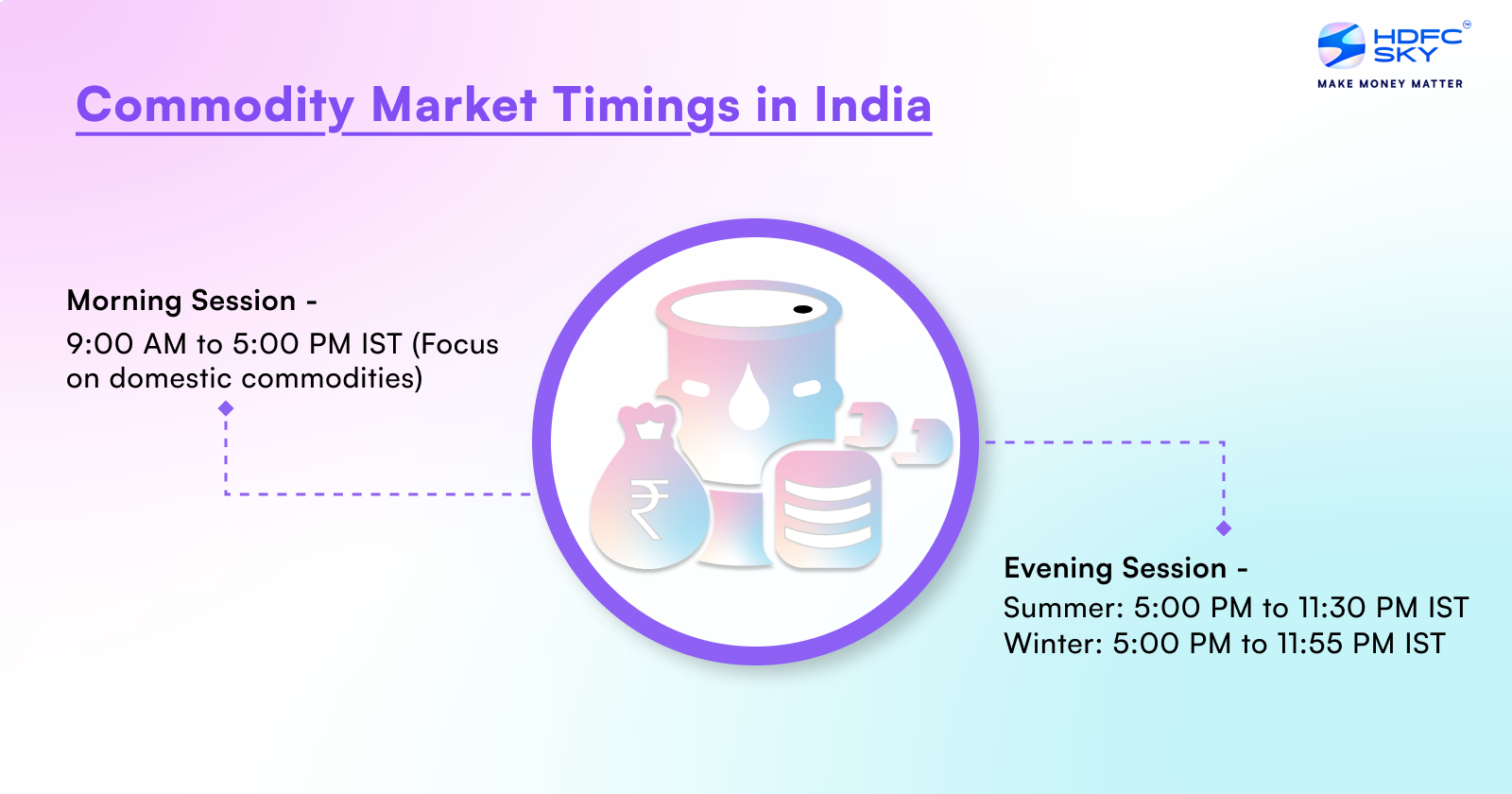
- Morning Session: The morning session typically starts at 9:00 AM IST and conclude at 5:00 PM IST. This session is focused on traders that trade in domestic commodities.
- Evening Session: The evening session begins at 5:00 PM IST and ends at 11:30 PM IST in summer and 11:55 PM IST in winter.
Knowing these commodity market hours allows traders to make informed decisions when to enter or exit trades.
Different Commodity Exchanges in India
Commodity trading in India is facilitated through several regulated exchanges. Here are the key ones:
- Multi Commodity Exchange of India (MCX): The largest commodity exchange in India dealing in metals, energy, and agri-commodities.
- National Commodity and Derivatives Exchange (NCDEX): Primarily focuses on agricultural commodities like wheat, soybean, and guar.
- Indian Commodity Exchange (ICEX): Known for diamond futures and other niche commodities.
- National Multi Commodity Exchange (NMCE): Merged with ICEX; earlier it was the first demutualised electronic commodity exchange.
- ACE Derivatives and Commodity Exchange: A smaller exchange that also offers trading in various commodities.
These exchanges operate under the regulation of SEBI (Securities and Exchange Board of India).
Major Commodity Exchanges (MCX) Trading Hours in India
In India, the Multi Commodity Exchange (MCX) is one of the fundamental platforms for commodity trading. The commodity market trading time on the MCX are:
| Exchange | Trading Session | Timing |
| MCX | Morning Session | 9:00 AM – 5:00 PM IST |
| MCX | Evening Session | 5:00 PM – 11:30 PM IST |
| MCX | Winter Evening Session | 5:00 PM – 11:55 PM IST |
Why is Market Timing Important for Commodity Trading?
Market timing is crucial in commodity trading because prices are highly sensitive to global events, supply-demand changes, and economic data releases. Proper timing allows traders to:
- React quickly to international market movements
- Maximise profit opportunities during high-volume trading hours
- Avoid unnecessary risks during volatile or low-liquidity periods Plan strategies around key announcements or inventory data
- Match their trades with global commodity exchange timings for better execution
Best Time to Trade in the Commodity Market
The ideal commodity trading time depends on each trader’s strategy, goals, and market focus.
- Morning Session for Domestic Focus: Any trader with their primary focus on the domestic commodity market may log in to the morning session from 9 am to 5 pm IST.
- Evening Session for International Impact: Traders focused on global commodity market movements may capitalise on the evening session from 5 pm-11:30/11:55 pm IST. This session is more reactive to international stock market cues and trade developments across the globe.
- Overlap with Global Markets: The overlap of Indian and global trading hours provides a larger window of opportunity. These extended trading hours facilitate traders to take advantage of domestic and international cues.
Factors Influencing Commodity Market Pricing
Commodity prices are driven by multiple dynamic factors. Understanding these helps traders make informed decisions. Key influences include:
- Supply and Demand: Core driver; scarcity increases prices, oversupply reduces them.
- Weather Conditions: Impacts agricultural and energy commodities.
- Geopolitical Events: Conflicts or tensions can disrupt supply chains.
- Currency Fluctuations: A weaker domestic currency can make imports expensive.
- Government Policies: Export/import duties, subsidies, and regulations affect pricing.
- Global Economic Indicators: Inflation, interest rates, and GDP influence investor sentiment.
- Speculation and Market Sentiment: Traders’ expectations and trends also move prices.
Risk Management Strategies for Commodity Trading
Any trader, equity, future and options and commodity must have a risk management plan. It is critical for any trader participating in the market. Awareness of commodity market timings may help you in better risk management.
- Diversify Your Portfolio: Diversifying across commodities like precious metals, crude oil, natural gas, and others is a good way to mitigate and manage risk.
- Use Stop-Loss Orders: To protect capital in a trade it is ideal to set a stop loss order. This helps in exiting a trade without incurring heavy losses, especially during market volatility.
- Stay Informed: Market movements can be anticipated by keeping abreast with global news related to commodities and adapting them to your trading management systems. This ensures the mitigation of risks.
- Limit Your Exposure: Having a trade management system that aligns with your risk appetite is an ideal way to manage risks during commodity trading hours.
Factors Affecting Commodity Market Timings
Commodity market timings are influenced by several domestic and international elements. These factors determine when and how long markets remain open:
- Global Market Hours: Indian commodity markets align with global exchanges to ensure seamless trading.
- Type of Commodity: Agricultural commodities may have different trading windows than metals or energy.
- Regulatory Guidelines: SEBI and exchanges like MCX set specific timings for various commodities.
- Seasonal and Harvest Cycles: For agri-commodities, local harvest seasons can influence active trading hours.
- Daylight Saving Time (DST): Timings may shift slightly to match international trading hours when DST changes.
Commodity Market Trading Holidays in India
Mentioned below is a table outlining the commodity market timings during prominent Indian holidays:
MCX Holiday List 2025
| Date | Day | Holiday | Morning Session | Evening Session |
| January 1 | Wednesday | New Year’s Day | Open | Closed |
| February 26 | Wednesday | Mahashivratri | Closed | Open |
| March 14 | Friday | Holi | Closed | Open |
| March 31 | Monday | Id-Ul-Fitr | Closed | Open |
| April 10 | Thursday | Mahavir Jayanti | Closed | Open |
| April 14 | Monday | Ambedkar Jayanti | Closed | Open |
| April 18 | Friday | Good Friday | Closed | Closed |
| May 1 | Thursday | Maharashtra Day | Closed | Open |
| August 15 | Friday | Independence Day | Closed | Closed |
| August 27 | Wednesday | Ganesh Chaturthi | Closed | Open |
| October 2 | Thursday | Gandhi Jayanti / Dussehra | Closed | Closed |
| October 21 | Tuesday | Diwali (Laxmi Pujan) | Closed | Closed |
| October 22 | Wednesday | Balipratipada | Closed | Open |
| November 5 | Wednesday | Guru Nanak Jayanti | Closed | Open |
| December 25 | Thursday | Christmas | Closed | Closed |
*Note: Special timings for the Muhurat Trading on 21st October will be announced separately by the exchange.
A list of trading holidays can be found on the website of the National Stock Exchange. The Multi Commodity Exchange of India (MCX) website provides a complete list of holidays and active sessions on special days for staying updated with commodity market trading holidays to ensure no disruptions in your trading.
Conclusion
Understanding commodity market timings in India is important for traders to plan their strategies effectively. By knowing when the market opens and closes, along with holidays, traders can better align their trades with market movements. Participating in the morning session for domestic trades or the evening session for international trades, awareness of trading hours helps in taking timely decisions. Staying informed about factors influencing commodity prices and market timings ensures a more disciplined to commodity trading.
Related Articles
FAQs on Commodity Market Timings in India
Is the commodity market open on weekends?
No, commodity markets in India remain closed on Saturdays and Sundays. Trading happens only from Monday to Friday.
How Can I Find Out About Any Changes in The Commodity Market Trading Hours?
Any updates pertaining to commodity market trading hours are always announced by SEBI, the National Stock Exchange (NSE), the Bombay Stock Exchange (BSE) and the Multi Commodity Exchange of India (MCX) on their respective websites.
What Time Zone Is Considered for The Commodity Market Trading Hours in India?
Commodity market trading hours in India follow the Indian Standard Time (IST).
How Can I Find Out About Any Changes in The Commodity Market Trading Hours?
Any updates pertaining to commodity market trading hours are always announced by SEBI, the National Stock Exchange (NSE), the Bombay Stock Exchange (BSE) and the Multi Commodity Exchange of India (MCX) on their respective websites.
Are There Pre-Opening and Post-Closing Sessions in The Commodity Market?
Yes, pre-opening and post-closing sessions are a part of commodity trading. These sessions do not allow active trading and are used only for order matching and squaring off positions.