- Offerings
- Tools & Platforms
Tools & Calculators
- Open API
- Calculators
- SIP Calculator
- CAGR Calculator
- Compound Interest Calculator
- FD Calculator
- RD Calculator
- EPF Calculator
- Retirement Calculator
- HDFC SIP Calculator
- Mutual Fund Return Calculator
- Lumpsum Calculator
- Step Up SIP Calculator
- ETF SIP Calculator
- Brokerage Calculator
- Equity Margin Calculator
- SWP Calculator
- EMI Calculator
- MTF Calculator
- Pricing
- SKY Learn
- Mutual Funds
- Margin Trading
- Financial Planning
- Personal Finance
- Share Trading
- IPO
- Derivatives
- Currencies
- Intraday Trading
- Trading Strategies
- Demat Account
- Commodity
- ETF
All you Need to Know About Intraday Trading
By HDFC SKY | Updated at: May 13, 2025 01:38 PM IST
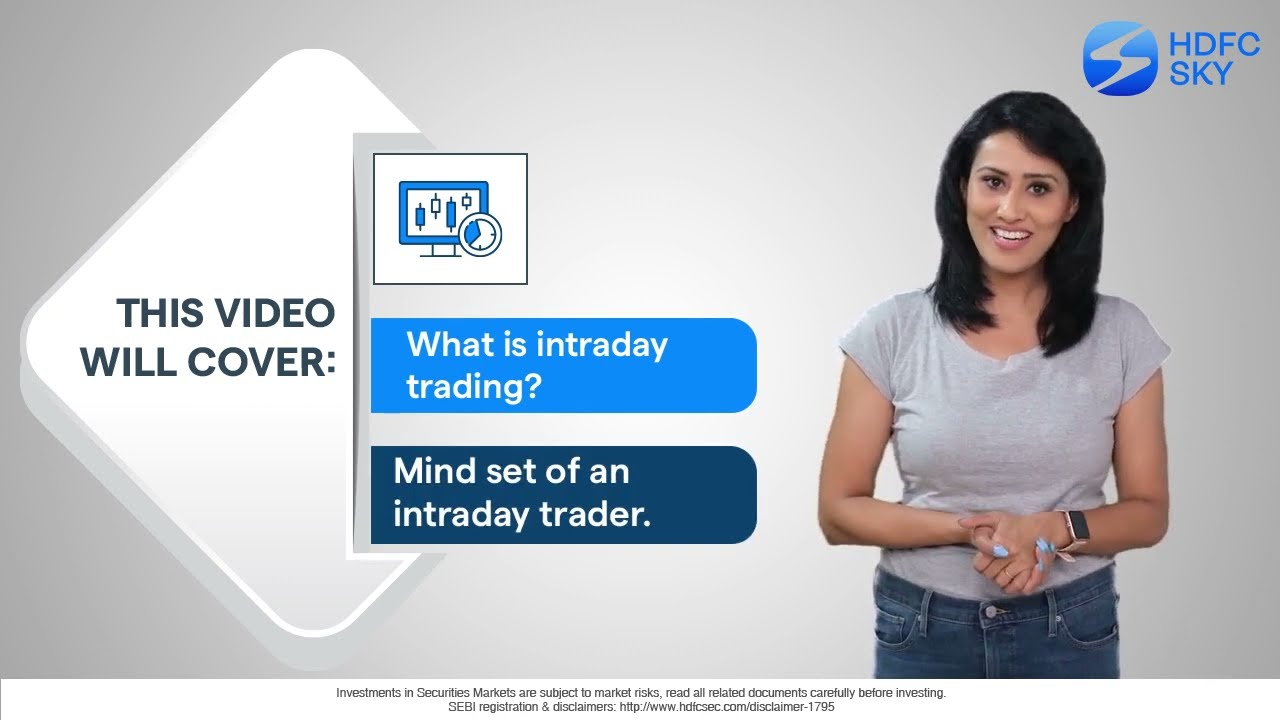
Intraday trading, also called day trading, is the practice of buying and selling stocks on the same day. Similarly, if you think the prices will go down, you can also short the stock, i.e., sell it first by borrowing the stock and return the borrowed shares by buying it later.
The idea is to make the most of short-term price movements occurring on a trading day. One of the key features of intraday trading is that it does not involve taking possession or delivery of the stock. Hence, shares never enter or leave your Demat account.
Remember, the position must be squared off the same day when you trade intraday. If you forget to close it by the end of the day, the trading system automatically closes all open positions by 3.15 pm. It will place a market order in the direction opposite of your trade at 3.15 pm. Hence, the order will be executed at the prevailing market price.
For example, assume you bought 500 shares of ABC Ltd. in the morning at Rs 100 and sold them in the afternoon when the price went up to Rs 102. In this case, you will make a profit of Rs 1,000 (500 shares x Rs 2 per share). If you do not sell the shares by 3.15 pm, the trading terminal will place a market sell order, and the shares will be sold at the prevailing market price. Here’s a more detailed explanation about what is Intraday Trading?
Availability of Margin in Intraday Trading
When you trade intraday you can also opt for the margin trading facility. Brokers typically provide you with a facility called margin trading that lets you buy more stocks than your money could otherwise buy. Under this facility, you pay a marginal amount for shares called margin money, and the broker lends you the rest. The margin varies from stock to stock and broker to broker.
For instance, if stocks of ABC Ltd. are available at a 25% margin, you will be required to provide only Rs 12,500 (25% of Rs 50,000) of your money. The rest will be paid for by the broker. Margin trading not only allows you to buy more shares than you could otherwise afford to but can also boost your profitability.
However, it may not always be as rosy. Remember that if the trade goes wrong, it can also magnify your losses. In margin trading, you are required to maintain a certain percentage of the total value of shares bought with the broker to cover any losses you may incur on trades. So, remember, intraday margin trading can result not only in substantial profits but also big losses. We will cover margin trading in detail with examples in chapter 14.1.
Note that the margin facility is not exclusive to intraday trades. Certain full-service brokers also offer margins in regular trades as well. However, there is a caveat. These trades must be settled within a specified duration, usually T+90 and attract a high-interest fee on the remaining amount (18%-24% annum).
The Mindset of an Intraday Trader
An intraday trader does not look at the fundamentals of the stock. This is because the difference between the market price and the intrinsic value (if any) can take multiple days, months or even years to converge. And as we know, intraday trades must be settled within the same session.
The premise of intraday trading is to take advantage of short-term price movements and make multiple small trades to make a sizeable profit. They can do this in both trending and consolidating movement in stocks. Let’s see how.
Trending stocks
Let’s assume it’s a bullish day for the market, and the prices of most stocks are rising. You determine that the shares of ABC Ltd are positively correlated with the market, i.e., they tend to rise when the market is rising and fall when the market is falling. Based on this belief, you buy the stock in the morning and sell it later during the day at a higher price to make a profit. If you are able to spot other stocks that follow a similar pattern as ABC, you can follow the same strategy and benefit from the general rise in prices.
Consolidating stocks
Let’s suppose you have been following the price action of stock ABC for some time. You have identified certain support and resistance levels within which the stock has been consolidating over some time. So, you could go short on ABC at its resistance level and square of the position when it hits support level. Doing this multiple times through the day could make you a neat profit even though the price of ABC has not seen much change over the course of the day.
Intraday trading indicators
In one of our earlier chapters, we discussed various indicators that come in handy while trading. While there are several indicators you can consider for intraday trading as well, here are some common ones.
Bollinger Bands:
Bollinger Bands are used to determine overbought and oversold conditions. Traders use them to identify entry and exit points in a range bound (consolidating) market. The idea is to go long when the price hits the lower band and go short when the price hits the upper band. You can read more about them in chapter 8.6 – Bollinger Bands: What are they and how to use them.
MACD:
Moving Average Convergence Divergence (MACD) is a trend-following momentum indicator. They track the relationship between two moving averages (a long-term and a short-term) to identify entry and exit points in a trending market. You can read more about them in chapter 8.7 – Use of Moving average convergence Divergence (MACD) in technical analysis.
RSI:
The Relative Strength Index (RSI) is a momentum indicator which is used to identify overbought and oversold zones. When the RSI is above 70, the stock is considered overvalued. A reading below 30 suggests the stock is undervalued. The RSI indicator works in both trending and consolidating markets. You can read more about them in chapter 8.5 – Relative Strength Index (RSI): What is it and how to use it in technical analysis.
Advantages of intraday trading
- Availability of margin lets you invest more than you could otherwise
- Short trades allow you to sell security first and buy it back later.
- No overnight risk as your position is squared off in a single session
Disadvantages of intraday trading
- High risk as the positions needs to be squared off within the same session
- Technical analysis mastery is a must to be consistently profitable
- Overnight gap ups and downs: If there is any major news overnight, orders placed overnight to buy or sell will reflect it in prices when the market opens.
Related Articles