- Offerings
- Tools & Platforms
Tools & Calculators
- Open API
- Calculators
- SIP Calculator
- CAGR Calculator
- Compound Interest Calculator
- FD Calculator
- RD Calculator
- EPF Calculator
- Retirement Calculator
- HDFC SIP Calculator
- Mutual Fund Return Calculator
- Lumpsum Calculator
- Step Up SIP Calculator
- ETF SIP Calculator
- Brokerage Calculator
- Equity Margin Calculator
- SWP Calculator
- EMI Calculator
- MTF Calculator
- Pricing
- SKY Learn
- Mutual Funds
- Margin Trading
- Financial Planning
- Personal Finance
- Share Trading
- IPO
- Derivatives
- Currencies
- Intraday Trading
- Trading Strategies
- Demat Account
- Commodity
- ETF
How to Find Stocks For Intraday Trading
By HDFC SKY | Updated at: Jun 2, 2025 03:27 PM IST
Intraday trading is a risky game. As a trader, you will have to try and make profits from the daily stock price movements. For this, you must have the ability to pick the right stocks at the right time and buy/sell them at an opportune moment.
And how do you pick the right stocks to trade? Seasoned traders follow certain rules for intraday stock picking that include considering factors such as volatility, liquidity, market trend, volumes, and so on.
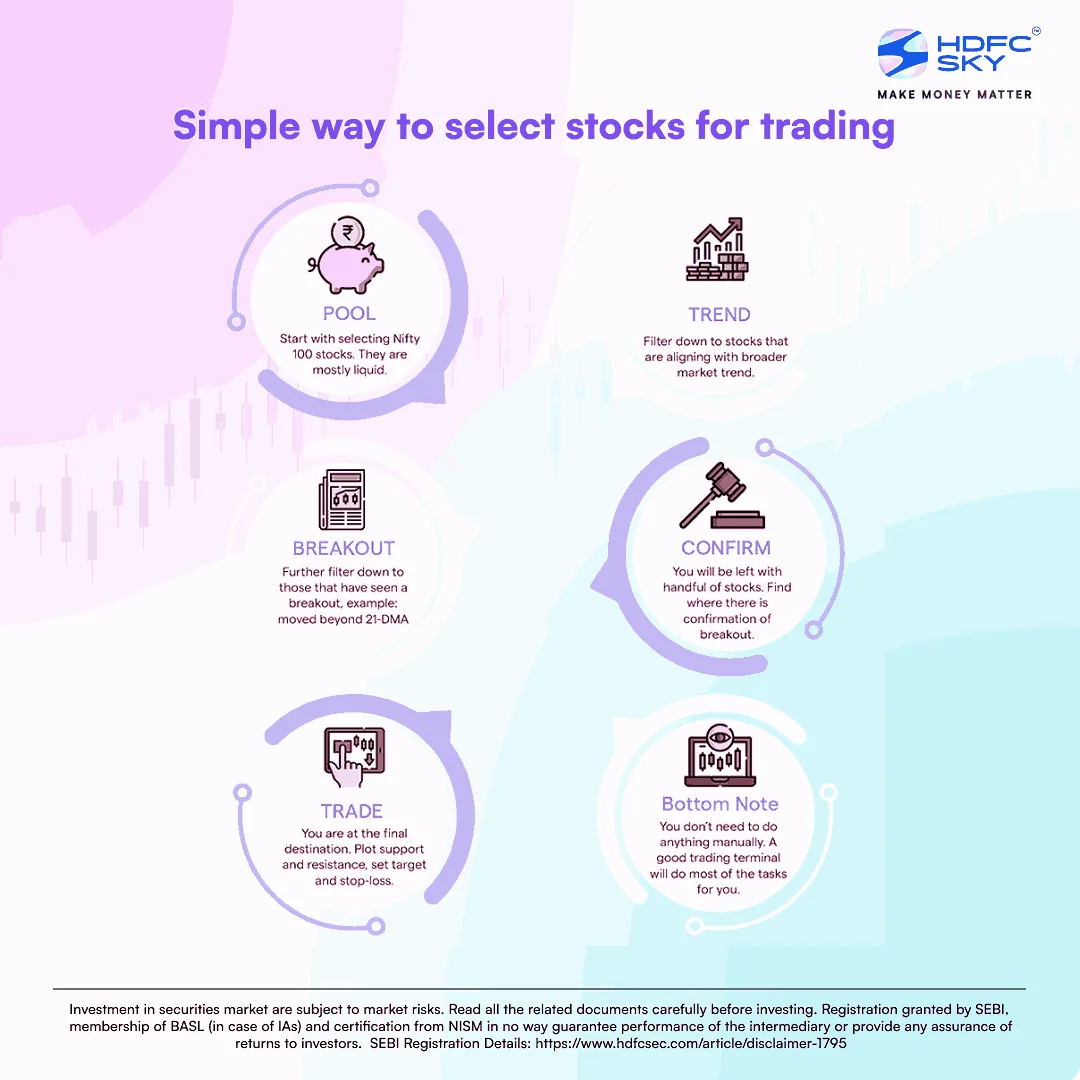
Let’s look at some of these factors to consider while picking up stocks for intraday trading:
Liquidity
You need to ensure there is liquidity in the stock before entering the trade. Liquidity means the stock is heavily and easily traded on the exchanges and there are a huge number of buyers and sellers available for that stock at a particular point in time.
You may find it difficult to find buyers or sellers for some stocks. They are termed illiquid stocks. As an intraday trader, you need to act at a lightning speed. So, it is important that the stocks you want to trade are easily tradable.
Volatility
The more the stock is volatile, the more you get trading opportunities. You can utilize the intraday swings in the stock price to trade and try to generate profit. Hence, picking stocks with high (but not too high) volatility can be beneficial.
Uncertainty in the market also plays an important role in volatility. It is advisable to set appropriate stop-loss levels to prevent fluctuations from undermining your potential gains.
Volumes
Along with volatility, volume is also an important factor that you will need to take into consideration while trading in the stock. Volumes mean the number of times the stock is traded or bought and sold during a trading session. It is advisable to look for stocks with high volumes. It is because high volumes indicate more interest in the stock. Trade Volume Index (TVI) helps day traders to make buy or sell decisions.
Trend
As we have learned earlier, stock prices move in a trend. They may keep rising until a peak level is reached and then may start falling. A successful trader can ride on these price waves and makes profits.
During an upward trend, you can go long on expectations that price will rise further. On the other hand, during a downward trend, you sell short in the hope that prices will continue to fall. Thus, the stocks which move in a trend are ideal for good trade.
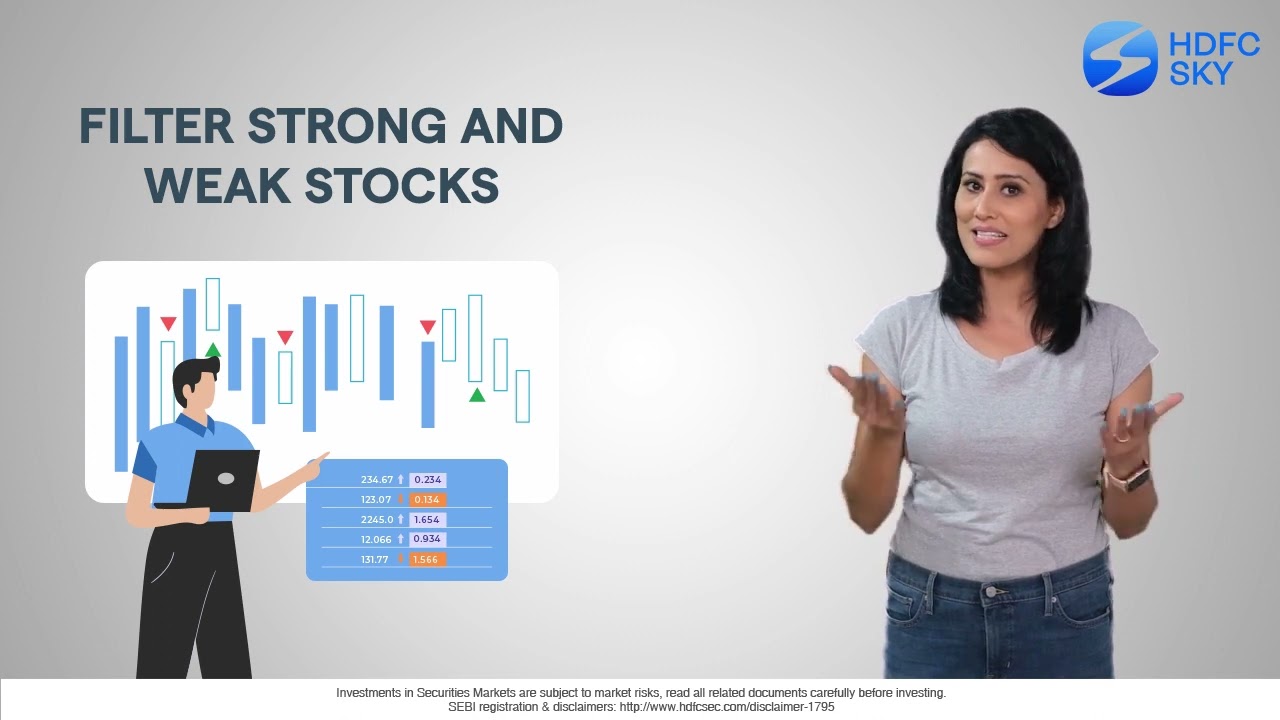
Check for strong stocks and weak stocks
After identifying volatile, highly liquid stocks that move with a trend, it is essential to choose strong stocks among them. We briefly discussed this point in our previous chapter as well. Strong stocks are those that move along with the trend, but more aggressively and intensively. This means if the general market trend is upward, these stocks will rise with more intensity. Weak stocks can be those which rise or fall along with the trend with lesser intensity or slower pace than the overall market.
You can use the relative strength (RS) indicator – not to be confused with relative strength index (RSI) indicator – is a good metric that you can use to track the stock’s performance versus a benchmark index.
However, the market is not always trending. There are times of indecisiveness when the market or stocks remain sideways. There is hardly any major movement seen in the stocks. At such times, it is advisable that you remain patient and wait for stocks to trend again.
Ride with the tide; never challenge the market
As an intraday trader, you must trade in line with the broader trend in the market. If the market trend does not support your strategy or analysis for a stock, it is better to leave that stock. It’s safer to ride along with the tide and not against it. Holding on to stock on just mere hopes should be avoided.
In fact, taking a contrarian approach or going against market trends may also sometimes prove beneficial. So, you buy when everyone else is selling and sell when everyone is buying. This could have potential. But it’s safer to just go with the trend.
Timing
As we have learned earlier, timing is crucial to rope in profits. Your decisions to buy or sell stocks must be quick. The strategy is to buy stocks that are rising and sell them when the price is slightly higher than the previous high of the prevailing trend. In a downtrend, you may book profit when the stock price slides below the previous low.
Square off your open positions
It is important for day traders to square off or close all the positions before the market closes for the day. This is because taking delivery of shares if the price target has not been achieved may not yield the desired results. As a day trader you take positions, or buy or sell stocks, with the intent of intraday trade based on market trends and technical analysis movements. Hence, holding positions for more than a day may not prove beneficial unless the stock fundamentals are strong.
Related Articles