- Offerings
- Tools & Platforms
Tools & Calculators
- Open API
- Calculators
- SIP Calculator
- CAGR Calculator
- Compound Interest Calculator
- FD Calculator
- RD Calculator
- EPF Calculator
- Retirement Calculator
- HDFC SIP Calculator
- Mutual Fund Return Calculator
- Lumpsum Calculator
- Step Up SIP Calculator
- ETF SIP Calculator
- Brokerage Calculator
- Equity Margin Calculator
- SWP Calculator
- EMI Calculator
- MTF Calculator
- Pricing
- SKY Learn
- Mutual Funds
- Margin Trading
- Financial Planning
- Personal Finance
- Share Trading
- IPO
- Derivatives
- Currencies
- Intraday Trading
- Trading Strategies
- Demat Account
- Commodity
- ETF
- What is GMP in IPO?
- Features of Trading in the Grey Market
- IPO Grey Market Dealers
- How Does GMP in IPO Work?
- How are IPO Shares Traded in the Grey Market?
- Steps to Trade IPO Shares in the Grey Market
- Types of Trading in Grey Market
- IPO Grey Market Rate Types
- Grey Market Premium vs Listing Price
- Advantages of Grey Market Premium (GMP)
- Disadvantages of Grey Market Premium (GMP)
- Risk and Challenges
- Conclusion
- FAQs on What is GMP in IPO?
- What is GMP in IPO?
- Features of Trading in the Grey Market
- IPO Grey Market Dealers
- How Does GMP in IPO Work?
- How are IPO Shares Traded in the Grey Market?
- Steps to Trade IPO Shares in the Grey Market
- Types of Trading in Grey Market
- IPO Grey Market Rate Types
- Grey Market Premium vs Listing Price
- Advantages of Grey Market Premium (GMP)
- Disadvantages of Grey Market Premium (GMP)
- Risk and Challenges
- Conclusion
- FAQs on What is GMP in IPO?
What is GMP (Grey Market Premium) in IPO? Features of Trading in the Grey Market
By HDFC SKY | Updated at: Oct 24, 2025 06:07 PM IST
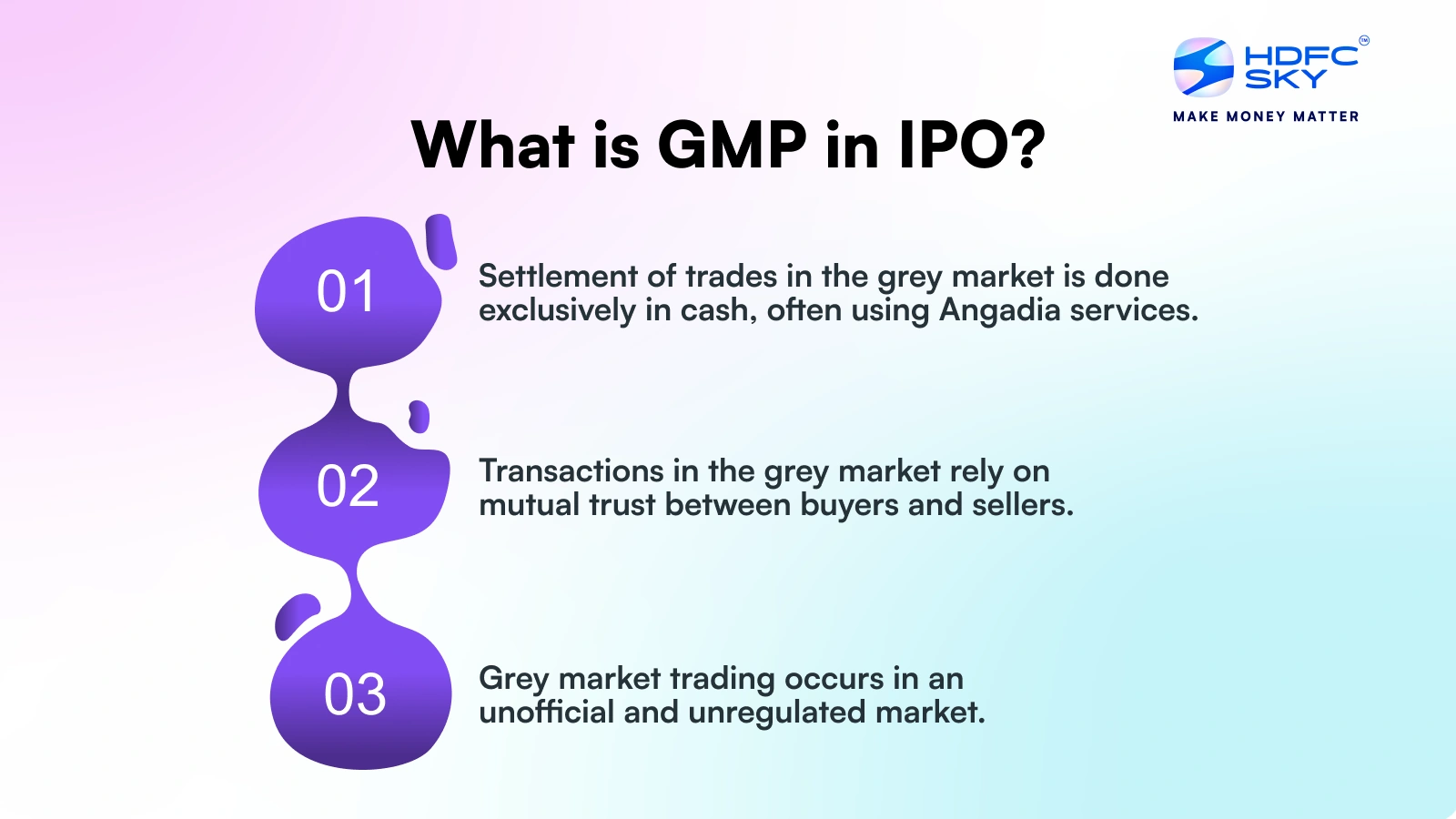
GMP full form in IPO is Grey Market Premium. It refers to the premium amount at which IPO shares are traded in the unofficial grey market before their official listing on the stock exchange. GMP gives investors a rough estimate of how the IPO might perform once listed offering insights into market sentiment and demand for the shares.
What is GMP in IPO?
GMP meaning in IPO stands for Grey Market Premium which represents the price at which IPO shares are traded unofficially before they are listed on the stock exchange. It acts as an indicator of market demand and investor sentiment for a particular IPO. For example, if a company’s IPO is priced at ₹100 and the GMP is ₹40 it means investors are willing to pay ₹140 per share in the grey market. While GMP is not regulated or officially tracked by SEBI, it is widely monitored by traders and investors to gauge the potential listing gain. However relying solely on GMP can be risky as it may not always reflect the actual performance post-listing.
Features of Trading in the Grey Market
Grey market trading occurs unofficially before an IPO lists on stock exchanges. It gives early signals about investor sentiment and expected pricing.
- Unofficial Market: Grey market trading happens outside official stock exchanges and is not regulated by SEBI.
- Pre-Listing Activity: It allows buying/selling of IPO shares before they are officially listed.
- Involves Premium (GMP): Trades are based on the Grey Market Premium, reflecting investor sentiment.
- No Legal Protection: Since it’s unregulated, investors bear full risk of loss.
- Indicates Listing Expectation: GMP often hints at potential listing price, though not guaranteed.
IPO Grey Market Dealers
Unauthorised people who purchase or sell initial public offerings (IPO) shares on an unofficial market (over-the-counter market) are known as grey market traders. The grey market dealers may also be obliged to underwrite a specific percentage of the IPO.
There are no registered traders in the IPO grey market because it is an unofficial and unregulated industry. To find out who participates in the grey market and if they can assist you in finding buyers or sellers for your transactions you should check with your local dealers.
How Does GMP in IPO Work?
GMP (Grey Market Premium) in IPO reflects the extra amount investors are willing to pay over the issue price in the unofficial market before listing.
- Pre-Listing Demand Indicator: A high GMP signals strong investor interest.
- Price Determination: Traders assess probable listing price based on GMP.
- Investor Sentiment Tool: Helps gauge enthusiasm or caution toward the IPO.
- Basis for Kostak and Subject Rates: Used to value IPO application rights.
- Unregulated Market: Trades are unofficial and not backed by SEBI.
How are IPO Shares Traded in the Grey Market?
IPO shares are traded in the grey market through informal over-the-counter (OTC) deals before the official stock market listing.
- No Official Platform: Transactions happen privately between buyers and sellers via brokers or dealers.
- Based on GMP: The trading price is influenced by the Grey Market Premium (GMP) reflecting expected listing gains.
- Application Trading: Investors also trade IPO applications (not just shares) where a buyer pays a premium to acquire the rights to allotment if approved.
- Unregulated Market: The grey market isn’t governed by SEBI so it carries higher risk and lacks legal protection.
It’s mostly used to gauge market sentiment before listing.
Steps to Trade IPO Shares in the Grey Market
Trading IPO shares in the grey market involves informal agreements to buy or sell shares before official listing often at a premium or discount. However these trades are unregulated and carry significant risks.
- Find a Grey Market Dealer: Connect with a trusted broker or dealer who operates in the grey market.
- Agree on Price: Negotiate the Grey Market Premium (GMP) or application price based on demand.
- Place Order: Confirm the buy or sell order with the dealer.
- Make Payment: Complete the payment as per the agreed terms.
- Wait for IPO Allotment: If trading application rights wait for the IPO allotment results.
- Settle Shares: Once shares are allotted and listed complete the transfer or sell the shares officially.
Types of Trading in Grey Market
Types of trading in the grey market include trading of IPO application rights, unofficial share transfers before listing and premium trading based on expected demand. These trades happen outside official exchanges.
- Grey Market Premium (GMP) Trading: Buying or selling IPO shares based on the premium (GMP) before official listing.
- Application Trading (Kostak Rate): Buying the rights to an IPO application at a fixed price regardless of allotment outcome.
- Subject to Sauda: A deal made only if the IPO allotment is successful; payment is made based on agreed premium post allotment.
These trades are unofficial and not regulated by SEBI.
IPO Grey Market Rate Types
With regard to the grey market, there are 3 market rate types of major significance:
1. IPO Grey Market Premium (GMP)
GMP can be either negative or positive. If the GMP is positive i.e. higher than the IPO issue price, it indicates the IPO may have a high listing and perform great after listing. Conversely a lower GMP indicates that investors are not confident of the stocks doing well after listing and hence the listing may be done at a discounted price.
Let us understand the implication of high or low GMP with examples:
- GMP with listing gain
Say the issue price of an IPO is Rs 500 and the GMP is 200. A grey market buyer, A, is thus willing to buy the shares at Rs 700. Say, there is an IPO applicant, B, who has 15 shares to sell in the grey market. B submits an application for the grey market IPO of Rs 7500 (15 x 500). So the grey market IPO buyer A will pay Rs 10,500 (700 x 15) for an IPO application value of Rs 7500.
| Now, suppose when the shares are listed on the exchange, the listing price is set at Rs 1000, then
Profit for buyer A of the IPO shares = Rs (15,000 – 10,500) = Rs 4500 Profit for seller B of the IPO shares = Rs (10500 – 7500) = Rs 3000 |
- GMP with listing loss
Considering the examples discussed above, say the listing price is set at Rs 500.
| With a listing price of Rs 500, the total amount for 15 bids will be Rs 9000
Loss for buyer A of the IPO shares = Rs (9000 – 10,500) |
2. Kostak Rate
The second grey market rate that one should be aware of, is the Kostak rate. Kostak rate is a mutually agreed upon IPO application price. Following the Kostak rate the IPO applications are bought and sold at this decided rate, irrespective of the status of the allotment. Thus if even an applicant does not receive any allotment the buyer of the IPO shares has to pay the agreed-upon rate. This set amount that the buyer of an IPO application pays the seller of the IPO application is known as the Kostak Price. Note that the Kostak rate is the price of the complete IPO application not a price per share and this price is mutually agreed upon by the buyer and the seller.
3. Subject to Sauda
Subject to Sauda is a guarded or extended version of the Kostak rate. If the seller of the IPO application receives allotment in the IPO, the buyer of the application agrees to pay a specified amount against the IPO application, subject to sauda. Thus, here payment depends on allotment, thereby offering a cushion, as payment is dependent on the confirmed allocation of shares, which is not there in the Kostak rate. Consequently, in general, the rates of Subject to Sauda are greater than the Kostak rates.
Grey Market Premium vs Listing Price
Until now we have discussed various market rates in the grey market and arrived at the conclusion that it is the GMP that determines whether a grey market applicant will earn gains or incur loss after the listing price is known. To have a better understanding of these two prices, given below is a table discussing the major differences between the two
| Aspect | Grey Market Premium (GMP) | Listing Price |
| Definition | Unofficial premium at which IPO shares trade before listing in the grey market | Official price at which IPO shares start trading on the stock exchange |
| Purpose | Indicates investor sentiment and demand for the IPO | Determines the actual market value when shares are listed |
| Influence | Reflects expected listing gains but is not binding | Based on final allotment and market conditions on listing day |
| Legality | Grey market trading is unofficial and not regulated | Listing price is official and regulated by stock exchanges |
Advantages of Grey Market Premium (GMP)
GMP gives investors a sneak peek into market sentiment before a stock is listed. Here are its key benefits:
- Early Sentiment Indicator: Helps gauge potential listing price and demand.
- Informs Investment Decisions: Investors can decide whether to apply for an IPO based on premium trends.
- Quick Profits Opportunity: Traders can benefit from selling shares at a premium before listing.
- Insight for Retail Investors: Offers unofficial cues for retail participation.
- Price Determination: Provides an informal idea of valuation ahead of official trading.
Disadvantages of Grey Market Premium (GMP)
While GMP offers insights, it also has drawbacks that investors should be aware of:
- Lack of Regulation: Being unofficial, GMP trading is unregulated and risky.
- Price Manipulation Risk: Prices can be artificially inflated or deflated by speculators.
- No Legal Protection: Investors have no legal recourse in case of disputes.
- Misleading Signals: GMP may not always reflect the actual listing price or market conditions.
- Limited Transparency: Transactions are private, causing information asymmetry.
Risk and Challenges
Trading in the Grey Market Premium (GMP) carries significant risks and challenges due to its unregulated nature. Key issues include:
- Regulatory Risk: GMP operates outside official exchanges, so there is no legal oversight or protection.
- Price Volatility: Prices can be highly unstable and influenced by rumors or speculation.
- Fraud Risk: Lack of transparency can lead to scams or misleading information.
- Uncertain Returns: GMP may not accurately predict the actual IPO listing price, leading to potential losses.
- Limited Market Participation: Only a niche group trades in GMP, reducing liquidity and increasing risk.
Conclusion
GMP in IPO serves as a useful indicator of investor sentiment and potential listing performance, but it should not be the sole factor guiding investment decisions. While grey market trading offers early insights and opportunities, it operates outside regulatory frameworks, making it risky and speculative. Investors must exercise caution, verify company fundamentals, and consider official data before participating in grey market deals. By balancing GMP analysis with proper research, investors can make informed choices and avoid unnecessary risks in IPO investments.
Related Articles
FAQs on What is GMP in IPO?
Is higher GMP better?
Yes, a higher GMP (Grey Market Premium) usually indicates strong demand and positive investor sentiment, suggesting the IPO may list at a higher price. However, it’s not a guaranteed indicator.
Is the grey market premium (GMP) always right?
No, the grey market premium is an indicator of the listing price. However, the final listing price may not be in line with the price direction indicated by the GMP.
How do I sell my shares in GMP?
To sell your shares in GMP, you will have to find a local dealer who will assist you in selling the shares in the grey market. The grey market premium is usually the Kostak rate or Subject to sauda.
How GMP is calculated in IPO?
The GMP in IPO is calculated by taking into consideration factors like the subscription level, market sentiment, and demand & supply of the IPO shares.
Is the grey market premium (GMP) reliable?
GMP is not a sure shot indicator but however if it is tracked properly keeping in mind other factors, like the market sentiment, and any new market updates, then GMP can be a reliable indicator of the listing price.
How does grey market premium (GMP) work?
The daily fluctuations in the demand for the stock determine the grey market premium. The day the IPO issue price is disclosed and is last modified before the listing is when the grey market opens. The listing price is estimated with the help of the GMP.
How does the GMP of an IPO impact its listings?
Though it is not guaranteed, a higher GMP indicates a higher listing price and vice-versa.
How can you use the GMP information when applying for an IPO?
GMP information gives significant insight into the market dynamics and helps you understand how the shares can perform once they are listed on the exchange.