
- Offerings
- Tools & Platforms
Tools & Calculators
- Open API
- Calculators
- SIP Calculator
- CAGR Calculator
- Compound Interest Calculator
- FD Calculator
- RD Calculator
- EPF Calculator
- Retirement Calculator
- HDFC SIP Calculator
- Mutual Fund Return Calculator
- Lumpsum Calculator
- Step Up SIP Calculator
- ETF SIP Calculator
- Brokerage Calculator
- Equity Margin Calculator
- SWP Calculator
- EMI Calculator
- MTF Calculator
- Pricing
- SKY Learn
- Mutual Funds
- Margin Trading
- Financial Planning
- Personal Finance
- Share Trading
- IPO
- Derivatives
- Currencies
- Intraday Trading
- Trading Strategies
- Demat Account
- Commodity
- ETF
How to Do Currency Trading in India: Factors Influencing the Foreign Exchange Market
By HDFC SKY | Updated at: Jun 2, 2025 03:26 PM IST
In this chapter, we will take a sneak peek into the world of currency trading. The currency market, popularly known as forex (FX), is the world’s largest financial market, with more than $4-5 trillion in notional value exchanged daily. In comparison, the average daily traded volume on the National Stock Exchange (NSE) is just $2 billion. (NSE Currency Derivative Segment Average Daily Turnover is Rs.1,13,985.43 crore for FY22-23)
The forex market is open 24 hours a day, five days a week, with all major currencies traded in all major financial centres.
Currency Pairs and How to Read Them
Currencies are traded against one another as pairs—for example, USD/INR. The first currency of a currency pair is called the base currency. In our example, it is the US dollar. The second currency is called the quote currency -the Indian rupee. The value of a currency pair tells the value of the base currency expressed in terms of the quote currency. Hence, if you see a USD/INR value of, say, Rs 80, it means $1 is equal to Rs 80.
The easiest way to remember this is to read it from left to right, i.e. how much does a single unit of base currency get you of the quote currency.
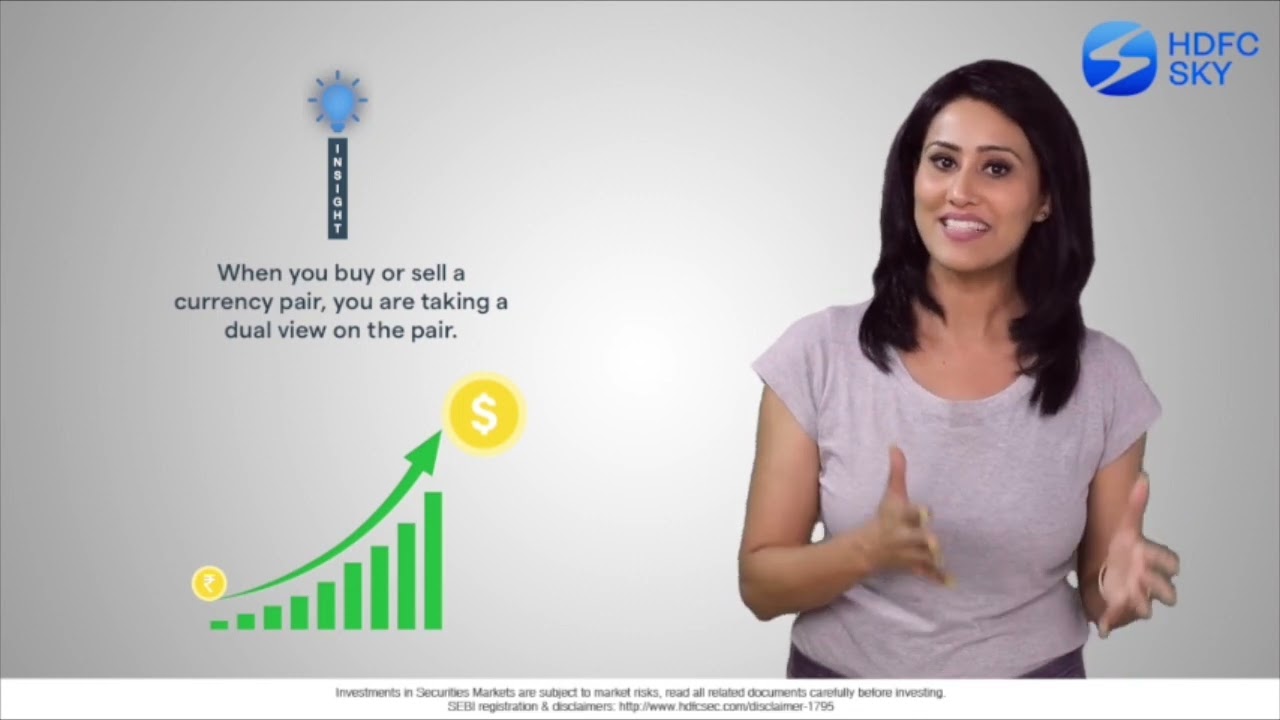
Note that when you buy or sell a currency pair, you are taking a dual view on the pair. For example, if you buy USD/INR, you are long on the US dollar and short on the Indian rupee. Hence, if the value of USD/INR is rising, it means the US dollar is strengthening versus the INR, and vice versa. Remember this point, as we will delve deeper into the factors that affect the movement of currency pairs later in this chapter.
In the forex market, currency pairs are just traded like stocks, bonds and commodities, with bid and ask prices. In case you are wondering what bid and ask prices are, read chapter 2.6.
In a nutshell, when you buy currency pairs, you pay the ask price. When you sell currency pairs, you receive the bid price.
The smaller the difference (known as spread) between the bid and ask price, the more liquid is the currency pair.
The most liquid currency pairs are referred to as the majors. These include EUR/USD, USD/JPY, GBP/USD, and USD/CHF. The EUR/USD is by far the most heavily traded currency pair in the world.
Factors Influencing the Foreign Exchange Market
Recall we had learnt that the value of currency pair fluctuates with the strengthening/weakening of the base currency against the quote currency. In our example, the value of USD/INR rose when the US dollar strengthened against the INR. Let’s look at the four biggest factors behind these fluctuations and the forex market at large.
- Interest rates: In India, the interest rates are set by the Reserve Bank of India. When the central bank raises rates, holding INR generates higher interest payments, creating more opportunities for profit growth. This would attract more interest in the local currency. As a result, INR will increase and consequently, the value of USD/INR will fall. The opposite of this happens in a falling interest rate environment – rates fall –> INR depreciates –> USD/INR rises.
- Fiscal deficit: While fiscal deficit itself is not too bad as it can help improve local infrastructure and create economic growth, too much of it can lead to inflation and currency devaluation.
- Economic stability: As we know from previous readings, if given a choice between two similar assets, investors tend to choose the one with the lower risk. Similarly, if the economy is perceived as more stable relative to the other, it will attract more interest, pushing up its currency. However, this relationship is not linear between emerging markets (such as India), and developed markets (such as the US) as more factors are at play. That said, if the global economic environment is expected to worsen, a flight to safety will be positive for the currencies of developed markets, whereas expectations of a global economic boom will be positive for currencies of emerging markets.
- Global events: Building on our learnings from the previous factor, a risk-off sentiment, such as in the case of geopolitical crisis, wars, etc., investors will move from emerging markets into developed markets. Whereas, in times of risk-on sentiment, money will flow from developed markets into emerging markets.
How to Trade Currency in India
Since there is no cash segment like in the Indian stock market, currency trading can only be done in the derivatives segment, i.e. future and options.
In India, currency futures trade on platforms offered by exchanges like NSE, BSE and MCX. To trade currency, you need to open a forex trading account with the broker. The foreign exchange (forex) market is one of the largest and most liquid financial markets in the world. For traders in India, understanding forex market timings in India is crucial to optimise trading strategies, make informed decisions, and capitalise on the most lucrative trading windows. The forex market in India operates from 9 AM to 5 PM, with cross-currency trading available till 7:30 PM.
Related Articles